Link juice is an informal SEO term used to describe the value or authority associated with a hyperlink from one webpage to another. It is closely related to the concept of link equity and is commonly used when explaining how backlinks and internal links can contribute to a website's authority, relevance, and discoverability. The value of a link is not identical in every situation. It can depend on factors such as the relevance and quality of the linking page, the context and placement of the link, anchor text, crawlability, link attributes, and the relationship between the source and destination pages. Link juice is not a public Google metric that can be measured as a fixed score. Instead, it is a practical SEO concept for understanding how links connect webpages and contribute to the broader authority and relevance of a website.
Key Takeaways
- Link juice is an informal term for link-based value or authority.
- Link juice and link equity are closely related concepts.
- External backlinks and internal links serve different but complementary SEO purposes.
- Relevance, authority, context, placement, anchor text, crawlability, and link attributes can influence how links are evaluated.
- There is no single public Google metric that measures the amount of link juice a page has.
- Internal links can help search engines discover pages and understand relationships across a website.
- Relevant editorial backlinks are generally more useful than large numbers of unrelated links.
- Technical problems such as broken links, redirect chains, and poor site architecture can weaken the usefulness of a linking system.
- Modern link building should focus on useful content, genuine authority, topical relevance, and editorial references.
- Link juice still matters as an SEO concept, but it should not be treated as a literal ranking currency.
What Is Link Juice?
Link juice is an informal SEO term used to describe the value or authority associated with a hyperlink from one webpage to another. The concept became popular as SEOs looked for a simple way to explain how links could influence the authority and ranking potential of destination pages.
For example, imagine that an established digital marketing publication publishes an article about technical SEO and links to a detailed technical SEO guide. That hyperlink creates a relationship between the two pages. In SEO terminology, people may describe the value associated with that relationship as link juice.
However, link juice should not be understood as a fixed amount of ranking power physically moving from one page to another. Google does not provide a public formula showing exactly how much value a specific link passes. Search engines evaluate links in a broader context that includes the source page, relevance, content, placement, crawlability, and other signals.
Is Link Juice the Same as Link Equity?
Link juice and link equity are commonly used to describe the same broad concept, but the terminology is slightly different.
Link juice is the informal industry term that has been used for years to describe value flowing through links. Link equity is the more professional term used to describe the broader value or authority associated with a link.
You may also see related terms such as link authority, link value, backlink authority, PageRank, and page authority. These terms are connected, but they should not be treated as identical metrics.
A useful way to separate them is:
Link juice: informal SEO terminology.
Link equity: broader professional concept of link-based value.
PageRank: Google's link-analysis system and algorithmic concept associated with evaluating the importance of pages through links.
Understanding this distinction is important because it prevents the common mistake of treating "link juice" as if Google provides a measurable score for every backlink.
How Does Link Juice Work?
The easiest way to understand link juice is to look at how webpages connect with one another.
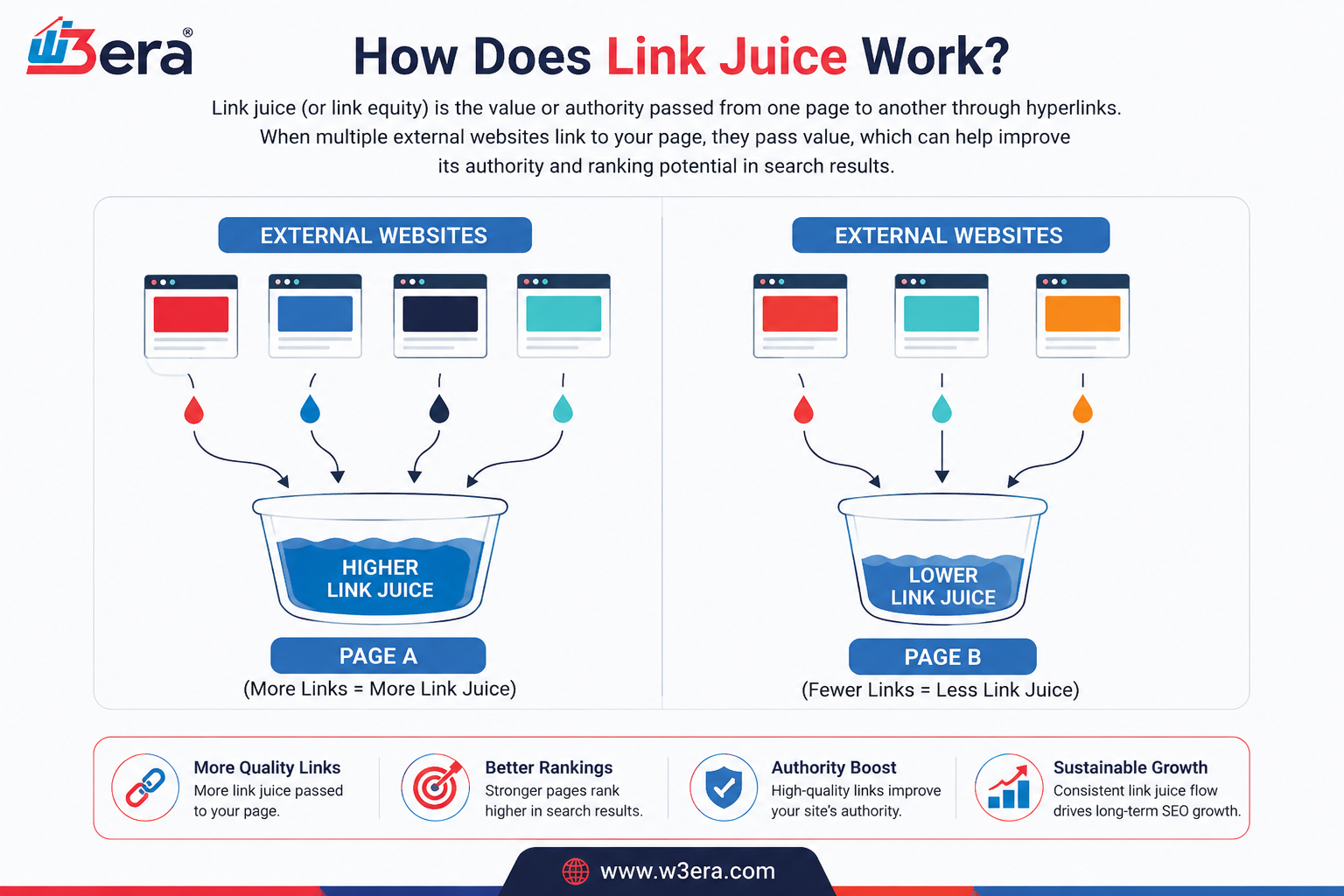
Page A → Link → Page B
When Page A links to Page B, the two pages become connected. If Page A is relevant and trustworthy and the link is useful within the surrounding content, that relationship can provide additional context about Page B.
This is especially important when the linking page and destination page cover closely related subjects. For example, a page discussing link building that naturally links to a detailed backlink guide creates a stronger topical relationship than an unrelated page linking to the same destination.
There are two major forms of link relationships to consider: external links and internal links.
External Link Juice
External link juice refers to the value associated with links coming from another website to your website.
For example, a respected SEO publication may link to an original SEO study published on your website. That link can help users discover the study and provides search engines with another relationship between your website and the external source.
The value of the backlink is not determined simply by the fact that it exists. The quality of the source, relevance of the topic, context surrounding the link, placement, and destination-page quality all matter.
This is why a relevant editorial backlink from a trustworthy industry publication can be more useful than dozens of unrelated links.
Internal Link Juice
Internal link juice refers to the value and authority relationships created through links between pages on the same website.
For example:
Homepage → SEO Services → Link Building Guide → Backlink Guide
A page that has earned strong external references can naturally link to closely related pages within the same website. This creates a connected information architecture and helps important pages become easier for users and search engines to discover.
Internal linking is therefore not just a navigation feature. It is also an important part of how a website communicates relationships between content.
For readers who want to understand the foundation of backlink-based authority, our what are backlinks guide provides a useful supporting resource.
What Factors Determine Link Juice?
Not every link should be treated equally. The strongest ranking resources consistently discuss several factors that can affect the value and usefulness of a link, including relevance, authority, placement, anchor text, crawlability, link attributes, and the surrounding link environment.
Relevance of the Linking Page
Relevance is one of the most important considerations when evaluating a link.
A backlink from an SEO publication to an SEO guide has an obvious topical relationship. A backlink from an unrelated website about gardening to an SEO service page has a much weaker relationship.
Relevant links make sense to users and provide search engines with clearer context about why one page is referencing another.
This is particularly important for semantic SEO because links can reinforce relationships between entities, concepts, and closely related topics. Our semantic SEO guide explains how search engines can understand content through broader topical relationships rather than isolated keywords.
Authority and Quality of the Linking Page
The quality of the website and specific page providing a backlink can influence how useful that link is.
Third-party SEO platforms provide metrics such as Domain Authority, Domain Rating, and Authority Score. These can be useful for comparing websites, but they are not Google's official ranking scores.
When evaluating a potential backlink, look beyond the metric. Consider the site's topical relevance, organic visibility, editorial quality, referring-domain profile, audience, and overall reputation.
A smaller website that is highly relevant to your industry and has a genuine audience can be more useful than a large website that has little connection with your subject.
Link Placement and Context
Where a link appears can influence how clearly the relationship between the source and destination can be understood.
A contextual link placed naturally within the main body of an article generally provides clearer topical context than a generic footer or sidebar link.
For example, a sentence such as:
Businesses improving organic visibility should understand technical SEO before scaling a large content program.
makes the purpose of the link obvious. The reader knows why the destination is relevant before clicking.
This is why contextual links should be created because they help the reader, rather than simply because an internal-link opportunity exists.
Anchor Text
Anchor text is the clickable text used for a link.
Descriptive anchor text helps users understand what the destination page contains. For example, technical SEO guide communicate considerably more information than click here.
Anchor text can also provide additional context about the destination page. However, that does not mean every link should use the exact same keyword.
Natural variations such as technical SEO, technical SEO guide, technical optimization, and SEO technical resources can describe the same destination in different contexts.
The objective should always be clarity and relevance rather than forced keyword repetition.
Number and Quality of Outbound Links
The number of outbound links on a page can be relevant when evaluating its overall link environment, but it should not be reduced to a simplistic mathematical formula.
A page containing hundreds of unrelated links may provide little useful context. A well-researched article containing carefully selected references can create much stronger relationships between its sources and destinations.
Therefore, do not try to "hoard" link juice by removing useful outbound links. Instead, make sure outbound links are relevant, helpful, and justified by the content.
Crawlability
A link needs to be accessible to search engines if it is going to contribute to discovery and website navigation.
Google recommends crawlable HTML links and descriptive anchor text. This means important internal links should not depend unnecessarily on inaccessible implementations or technical barriers.
During an internal-link audit, check whether the link is present in crawlable HTML, whether the destination can be reached, whether the destination is blocked, and whether the link resolves correctly.
Link Attributes
Modern links can include attributes such as nofollow, sponsored, and ugc.
These attributes help describe the relationship between the website and the linked destination. Google recommends sponsored for paid or advertising links and ugc for user-generated content. nofollow can be used when the relationship requires that qualification.
The important point is not to think about link attributes as a simple "link juice on or off" switch. They should be used according to the actual purpose and relationship of the link.
Does Link Juice Still Matter?
Yes, but the way SEOs think about it has changed.
Older SEO discussions often treated link juice almost like a physical substance that could be transferred, divided, or controlled. This led to tactics such as aggressive PageRank sculpting and excessive use of Nofollow.
Modern search engines are much more sophisticated. Google does not provide a public PageRank score for individual URLs, and there is no official "link juice" measurement that SEOs can access.
However, the underlying idea remains useful: links create relationships between webpages and can contribute to authority, relevance, discovery, and website structure.
That is why links remain an important part of SEO, even though the simplistic "juice flowing through pipes" model is no longer sufficient.
The better approach is to focus on relevant backlinks, useful content, strong internal linking, technical accessibility, and a logical information architecture.
Link juice and PageRank are related concepts, but they should not be treated as the same thing.
PageRank is Google's link-analysis system that evaluates the importance of webpages through links. It was one of the foundational ideas behind Google's early search technology.
Link juice, on the other hand, is an informal SEO term used to describe the value associated with links.
This distinction matters because SEOs sometimes talk about "passing PageRank" and "passing link juice" as though they are exactly the same technical process. They are better understood as related concepts rather than identical terms.
For practical SEO work, there is no need to calculate PageRank manually. Focus on the factors you can actually improve:
Relevant backlinks + useful content + strong internal linking + crawlability + topical relevance.
Internal Link Juice: How Does It Help SEO?
One of the most practical applications of link juice is internal linking.
Suppose a detailed SEO guide has earned strong backlinks from several relevant websites. That page now has an established position within your site's authority structure.
You can use relevant contextual internal links from that page to connect users and search engines with other valuable resources.
For example:
Backlink-rich article → Link Building Guide → SEO Service Page → Supporting SEO Resource
This does not mean every page should link to every other page. The relationship should be based on the information a user is likely to need next.
Internal linking becomes especially powerful when it follows a clear topic-cluster structure.
You can learn more about this through our topical authority guide.
How to Get More Link Juice
The most sustainable way to improve the value reaching your pages is to combine strong external link acquisition with strategic internal linking.
Earn Relevant Backlinks
Create content that other websites have a genuine reason to reference. Original research, statistics, expert commentary, case studies, tools, detailed guides, and unique datasets can all become link-worthy resources.
The goal is not to acquire links from any website willing to provide them. The goal is to earn links from sources where the reference makes sense.
For a deeper look at the acquisition side, see our link building guide.
Create Link-Worthy Content
A page is more likely to earn references when it provides something genuinely useful.
That could be original data, a comprehensive explanation, an industry study, a practical framework, a free tool, or expert analysis.
This also supports E-E-A-T because useful first-hand information, clear expertise, trustworthy references, and original research give readers more reasons to trust and reference the content.
Use Digital PR
Digital PR can help businesses earn editorial coverage by promoting original research, data, expert commentary, or newsworthy campaigns.
Unlike purely transactional link acquisition, Digital PR focuses on creating stories and resources that publishers have a genuine reason to mention.
Our Digital PR guide provides a relevant next step for understanding how PR and SEO can work together.
Fix Broken and Lost Links
Broken links can interrupt the path between a source and its intended destination.
If an old URL has valuable backlinks but has been removed, first determine whether a relevant replacement exists. If the page has permanently moved, use an appropriate permanent redirect rather than leaving valuable references pointing to a dead URL.
Google recommends permanent server-side redirects such as 301 or 308 when a URL has permanently moved.
For related technical situations, see our 301 vs 302 redirects guide.
How to Distribute Link Juice Through Internal Linking
Internal linking should be treated as an information architecture system rather than a list of random links.
Start by identifying pages that already have strong backlinks or strong organic performance. Then identify closely related pages that could naturally benefit from those connections.
For example:
Authority-rich article
↓
Supporting topic
↓
Commercial page
↓
Detailed supporting resource
The links should use descriptive anchors, match the surrounding context, and lead to genuinely useful destinations.
Avoid repeating one exact anchor throughout the site. Use natural semantic variations according to the sentence and the destination.
A broader internal site architecture guide can help when planning how these relationships should work across a larger website.
How Link Juice Supports Topic Clusters
Link juice becomes more useful when it operates inside a strong topical architecture.
A topic cluster can be structured like:
Pillar page → Supporting articles → Related subtopics
For example, an SEO cluster may contain content around technical SEO, backlinks, link building, semantic SEO, search intent, content optimization, and internal linking.
The pages should connect where the user journey makes sense rather than forcing every page to link to every other page.
This creates a stronger semantic network because the website is showing relationships between related concepts.
For a deeper explanation of this model, see our topic clusters guide.
How Link Juice Supports SEO Services Pages
Informational content should not exist separately from commercially important pages.
When a strong educational article has earned external references, relevant internal links can connect that authority-rich resource with a service page when the service is genuinely the next logical step for the reader.
For businesses competing in the United States, this can be introduced naturally when discussing authority building, content strategy, link acquisition, and organic growth.
For example, businesses looking to combine technical optimization, content development, authority building, and search visibility can explore professional SEO services in USA as part of a broader organic growth strategy.
The important part is the context. The link is useful because the reader has just learned about the broader SEO system and may want to understand how those activities can be implemented for a US market.
Link Juice for UK SEO Strategies
The UK section should remain separate so that the commercial link has its own contextual purpose.
How Link Equity Supports UK Search Visibility
For businesses targeting customers in the United Kingdom, link value should be considered alongside geographic relevance, market-specific search intent, topical authority, and the quality of referring sources.
A UK-focused content architecture can connect informational resources with relevant commercial pages while maintaining clear relationships between topics. Businesses that want to combine technical SEO, content development, authority building, and market-specific search visibility can explore SEO services in the UK.
Keeping this link in a separate market-focused section makes it more natural and prevents the USA and UK commercial links from appearing as an artificial link block.
Link Juice and Technical SEO
Technical SEO problems can interrupt the relationships created by links.
Common issues include broken internal links, redirect chains, incorrect redirects, canonical problems, orphan pages, blocked URLs, and weak website architecture.
Broken Internal Links
A link that leads to a 404 page creates a dead end for users and crawlers.
Regularly crawl your website to identify broken internal links and replace them with relevant live destinations.
Redirect Chains
Avoid creating unnecessary chains such as:
Old URL → URL 2 → URL 3 → Final URL
Whenever possible, use:
Old URL → Final URL
This becomes especially important when the original page has earned valuable backlinks.
Canonical Signals
Canonical tags help search engines understand which URL should be treated as the preferred version when multiple URLs contain similar or duplicate content.
They should be implemented carefully and should point toward a genuinely preferred version.
Our canonical tags SEO guide covers this topic in more detail.
Orphan Pages
An orphan page has few or no meaningful internal links pointing toward it.
A page can have excellent content but remain poorly connected to the website's information architecture.
Important commercial pages, pillar pages, and valuable resources should have clear internal paths from relevant sections of the site.
Does Nofollow Pass Link Juice?
This is one area where older SEO explanations can be misleading.
Historically, nofollow was often described as a simple way to prevent PageRank from being passed through a link. Google's current guidance is more nuanced. Google treats nofollow as a hint and also provides sponsored and ugc attributes to help websites communicate different link relationships.
Therefore, do not treat nofollow as a simple "zero link juice" switch.
Use link attributes according to the actual relationship:
Paid or advertising link → sponsored
User-generated link → ugc
Appropriate untrusted link → nofollow
The objective should be accurate link qualification rather than mechanical PageRank manipulation.
Link Juice and the AI Search Era
AI search has changed how users discover information, but it has not made links irrelevant.
Modern AI search systems still need to discover, interpret, connect, and evaluate information across the web. Strong content, relevant references, clear site architecture, and technically accessible pages therefore remain important.
However, there is no public Google formula showing that a specific amount of link juice guarantees inclusion in an AI Overview.
The smarter strategy is to build content that is:
Useful → Relevant → Trustworthy → Crawlable → Well connected
This creates a strong foundation for traditional organic search and modern AI-powered search experiences without inventing an unsupported "AI link juice" metric.
Common Link Juice Mistakes
Chasing Backlink Quantity
More links do not automatically mean more authority. Hundreds of unrelated links can be less useful than a smaller number of relevant editorial references.
Treating Link Juice as a Measurable Google Score
There is no public Google dashboard that tells you how much link juice a page has.
Building Irrelevant Links
A backlink should make sense within its surrounding topic and provide value to the reader.
Repeating Exact-Match Anchors
Using the same commercial anchor repeatedly can make the linking pattern look unnatural. Use descriptive variations that fit the surrounding sentence.
Ignoring Internal Links
A website can earn strong backlinks but fail to use those authority-rich pages effectively if they are poorly connected to relevant internal resources.
Trying to Hoard Link Juice
Do not remove useful outbound references simply because you believe every external link "leaks" authority. Good references can improve the usefulness and credibility of content.
Manipulating Nofollow
Use link attributes according to their intended purpose instead of trying to control every possible ranking signal.
Ignoring Lost Backlinks
Regularly check whether valuable backlinks point toward deleted, redirected, or changed URLs.
How to Measure Link Juice
You cannot measure link juice directly with an official Google metric.
Instead, evaluate the signals surrounding your external and internal link profile.
External Link Metrics
Monitor:
- Referring domains
- Relevant referring domains
- New backlinks
- Lost backlinks
- Linking-page quality
- Anchor text
- Link placement
- Referral traffic
Internal Link Metrics
Monitor:
- Internal inlinks
- Internal outlinks
- Orphan pages
- Crawl depth
- Important pages with few internal links
- Contextual links
- Links from strong-performing pages
- Anchor-text variation
Then compare your link profile with actual business and search outcomes such as rankings, impressions, clicks, organic traffic, leads, conversions, and search visibility.
This is more useful than trying to assign a made-up link juice score to individual URLs.
How to Audit Link Juice Step by Step
Step 1: Find Pages With Strong External Links
Use Google Search Console, Semrush, Ahrefs, Screaming Frog, or another suitable SEO tool to identify pages receiving valuable external references.
Step 2: Review Their Internal Links
Determine whether those pages link naturally to other important and relevant pages.
Step 3: Review Anchor Text
Make sure the anchor describes the destination accurately and does not rely on unnecessary exact-match repetition.
Step 4: Check Technical Access
Review 404 errors, redirects, canonical signals, crawlability, and indexability.
Step 5: Find Orphan Pages
Identify important pages that have weak internal support.
Step 6: Strengthen Topic Connections
Connect pages according to search intent, topical relevance, and business importance.
After implementing changes, compare organic rankings, impressions, clicks, traffic, and conversions.
This turns link analysis into a measurable SEO process rather than an abstract authority exercise.
Does More Link Juice Mean Better Rankings?
Not necessarily.
A page can have many links and still struggle to rank if its content is weak, the links are irrelevant, the page does not satisfy search intent, or technical problems prevent search engines from accessing important resources.
Link-based authority works as part of a much broader search system.
The strongest SEO strategy therefore combines:
Relevant links + Helpful content + Search intent + Technical SEO + Topical authority + Strong internal architecture.
Conclusion
Link juice is an old SEO term, but the underlying concept is still useful when understood correctly. It is not about collecting the maximum number of backlinks or trying to control every movement of authority. The stronger approach is to earn relevant links, create useful content, connect important pages through contextual internal linking, and maintain a technically accessible website.