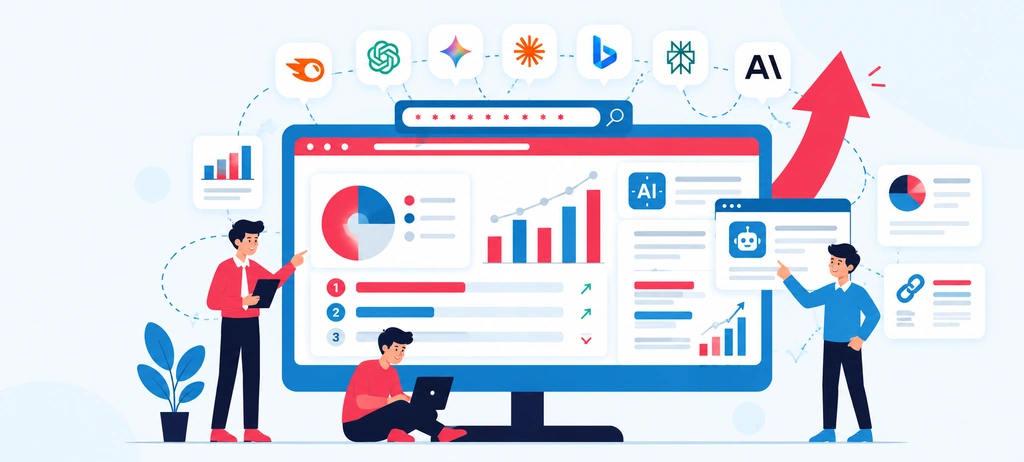
Entity SEO helps search engines understand the meaning behind a brand, person, product, service, or topic, not just the keywords on a page. Topical authority demonstrates that a website covers a subject with sufficient depth and breadth to be considered a reliable source. Together, they shape how Google, AI Overviews, and large language models rank, reference, and cite content in 2026. Brands that build clear entity signals and strong topic coverage earn better search visibility across traditional and AI-powered search.
Search has changed significantly over the past few years. Google no longer just matches words; it understands meaning, context, and relationships. That shift is why this entity seo topical authority guide 2026 matters more than ever. Brands that invest in structured identity, semantic content, and connected topic coverage will outperform those chasing individual keywords. In 2026, entity clarity and topical depth are not optional extras; they are the foundation of lasting organic visibility.
Key Takeaways
- Entity SEO is about meaning, not just mentions. Search engines recognize brands, people, products, and topics as objects with relationships, not just text strings to match.
- Topical authority requires both depth and breadth. Covering one aspect of a topic well is not enough. You need connected, structured content that answers questions across the entire subject.
- Structured data speeds up entity recognition. Organization schema, Person schema, sameAs properties, and JSON-LD markup help search engines accurately verify and classify your brand.
- AI search systems rely heavily on entity signals. ChatGPT, Perplexity, Google AI Overviews, and Gemini all favor brands with clear entity identity, trustworthy content, and strong topical coverage.
- Off-page mentions reinforce what your website says. Consistent brand details across directories, social profiles, third-party citations, and industry references strengthen how search engines perceive your authority.
What Is an Entity in SEO?
An entity, in SEO terms, is any clearly identifiable thing that a search engine can recognize, categorize, and connect to other things. People, brands, places, products, services, organizations, events, and concepts all qualify as entities. Search engines do not process these the way humans read; they store, link, and compare entity data across millions of sources to build a picture of meaning.
Understanding entities means understanding that SEO has moved well beyond keyword frequency. Google now asks: What is this page about? Who created it? What brand is behind it? How does this connect to related topics?
Google's Knowledge Graph and Entity Relationships
The Google Knowledge Graph is essentially a massive database of entities and their relationships. When you search for a well-known brand, you often see a panel on the right side of the results page with the brand name, logo, description, founded date, founders, social profiles, and related topics. That panel is powered by Knowledge Graph data.
Think of it like this: a company is an entity. Its founder is a person entity. Its headquarters is a location entity. Its products are product entities. Its industry is a topic entity. The Knowledge Graph connects all of these together. As a result, when someone searches for anything related to that brand, Google already has a structured map of what that brand is, who it involves, and what it does.
For SEO professionals, this matters because strengthening those connections through structured data, consistent brand signals, external references, and semantic content increases Google's confidence in classifying and trusting a brand.
Entities vs Keywords: The Fundamental Difference
Keywords are the phrases people type into a search box. Entities are the actual objects, concepts, or meanings behind those phrases. This difference is fundamental to modern SEO strategy.
Consider these examples:
- Keyword: "best CRM software" Entities involved: CRM software, HubSpot, Salesforce, customer relationship management, SaaS, sales pipeline
- Keyword: "local SEO agency" Entities involved: SEO agency, local SEO, Google Business Profile, W3Era, digital marketing, search optimization
When Google processes a query, it does not just look for pages with those exact words. Instead, it maps the query to known entities, understands the intent, and surfaces pages that match the meaning, not just the phrasing. This is why two pages can rank for the same concept without using identical keywords. The entity match matters more than the text match.
Named Entity Recognition in Search
Named Entity Recognition, or NER, is the process search engines use to identify specific entities within content. Google's Natural Language Processing technology scans text and labels entities, such as people, organizations, products, locations, and topics.
Google also measures entity salience how central or important a particular entity is to a piece of content. If a blog post is mostly about HubSpot, Google will assign HubSpot a high salience score for that page, signaling that the page is closely related to that entity. Understanding NER helps content creators structure pages so that the primary brand, topic, or subject receives clear recognition rather than diluted mentions scattered across unrelated content.
What Is Topical Authority?
Topical authority is the measure of how well a website is recognized as an expert on a particular subject. It is not about ranking for one keyword; it is about earning trust across an entire topic and its related subtopics. When Google sees that a website consistently produces useful, well-connected, expert-level content on a subject, it becomes more likely to rank that site for a wide range of queries within that topic.
Building topical authority takes time. It also requires a deliberate content architecture, not just frequent publishing.
Definition: Depth + Breadth of Coverage on a Topic
Content depth means covering a subject thoroughly, going beyond surface-level definitions to explore nuance, examples, use cases, and related ideas. Content breadth means covering the full width of a topic, not just one angle, but all the important subtopics, questions, and related concepts that a user might search for.
For example, a website that covers "SEO strategy" only with general tips lacks both depth and breadth. However, a site that covers technical SEO, local SEO, link building, content SEO, AI SEO, structured data, E-E-A-T, semantic search, and SEO audits, each in dedicated, well-researched articles, builds both. That site is far more likely to earn recognition for topical relevance from search engines.
How Google Measures Topical Authority
Google has not published an official "topical authority score," and that is worth making clear. However, search engines evaluate topical relevance through multiple signals: content quality, internal linking structure, entity relationships, search intent coverage, content freshness, backlink profiles from relevant sources, and user engagement patterns.
The clearer and more connected a website's content is around a subject, the more confidently Google can identify it as a strong source for that topic. This confidence directly affects ranking breadth, meaning the site starts appearing for more queries within the topic, not just the ones it initially targeted.
Topical Authority vs Domain Authority
These two concepts are often confused, but they measure very different things. Domain authority is a metric created by third-party tools like Moz. It is primarily based on the quantity and quality of backlinks pointing to a site. It is a useful proxy, but it is not a Google metric.
Topical authority, on the other hand, is about subject-level expertise. A newer website with fewer backlinks but rich, connected, accurate content on a specific topic can outrank an older, higher-DA site that covers the topic superficially. In 2026, semantic coverage and content relevance are increasingly more important than raw link counts for topic-specific queries.
Building Your Entity in Google's Knowledge Graph
Getting your brand, product, or person recognized as a verified entity in Google's system does not happen automatically. It requires deliberate, consistent, and machine-readable signals that appear across your own website and trusted external sources. The goal is to make it easy for Google to confidently say: this entity exists, this is what it does, and here is how it connects to other known entities.
Wikipedia and Wikidata for Eligible Entities
Wikipedia and Wikidata are two of the most powerful external sources for entity verification. When Google cross-references an entity mentioned on a website with a corresponding Wikipedia article or Wikidata entry, it significantly increases entity confidence.
However, not every brand qualifies. Wikipedia has strict notability guidelines, and entries that read as promotional content get removed quickly. Wikidata is more flexible but still requires accurate, source-backed information. If a brand genuinely meets the criteria, typically based on substantial third-party media coverage, pursuing these listings is worthwhile. If not, forcing it can backfire.
Google Knowledge Panel: How to Claim and Optimize
A Knowledge Panel is the information box Google displays for recognized entities. Eligible businesses, public figures, organizations, and publishers can claim their panel through Google Search Console. Once claimed, you can suggest edits, add official social profiles, upload a logo, and link to verified pages.
To support panel generation in the first place, brands should ensure their official website includes clear business information, an Organization schema with sameAs links, a consistent Google Business Profile (for local entities), and references across respected third-party sources. Claiming an existing panel is straightforward; generating one from scratch requires building enough entity signals over time.
Consistent Entity Signals: Name, Logo, Founder, Social Profiles
Consistency is one of the most underrated aspects of brand entity SEO. Search engines try to verify entity information by cross-referencing it across multiple sources. If a brand's name is spelled differently on its website, LinkedIn, Twitter/X, Google Business Profile, and industry directories, that inconsistency creates confusion and lowers entity confidence.
The key signals to keep consistent include: exact business name, official logo, founder name and role, registered address, phone number, website URL, and social profile links. Each of these should match across every platform where the brand appears.
Structured Data: Organization, Person, LocalBusiness Schema
Structured data is the most direct way to communicate entity information to search engines in a machine-readable format. Using JSON-LD schema markup, brands can specify exactly who they are, what they do, who runs the business, where they operate, and how they connect to other verified entities.
Key schema types for entity SEO include:
- Organization schema for brands, agencies, companies, publishers
- Person schema for authors, founders, public figures, experts
- LocalBusiness schema for businesses with physical locations
- Article schema for blog posts, news articles, guides
- FAQ schema for question-and-answer content
- Breadcrumb schema for site structure clarity
- sameAs property links your entity to verified external profiles (Wikipedia, LinkedIn, Wikidata, social platforms)
Adding this markup does not guarantee immediate Knowledge Panel recognition, but it provides search engines with a clear, verifiable starting point.
Topical Authority Through Content Clusters
A content cluster is a group of related pages organized around a single core topic. Instead of publishing random blog posts on unrelated subjects, a cluster structure connects a main topic page to a set of supporting articles via internal links and semantic relationships. This approach signals to search engines that a website covers a subject thoroughly, not just sporadically.
Content clusters are among the most effective structural decisions for building topical relevance in SEO. They work because they mirror how knowledge itself is organized: broad concepts supported by specific details.
Pillar Page + Cluster Model
The pillar page covers the core topic at a high level broad enough to introduce all related subtopics but not deep enough to fully explore each one. Following a Pillar Page SEO Strategy helps organize these topics into a structured content hub that improves topical authority and internal linking. Cluster pages handle that depth. Each cluster page explores one subtopic in detail and links back to the pillar page, while the pillar links out to each cluster.
For example, a pillar page on "SEO Strategy" might link to clusters covering:
- Technical SEO
- Local SEO
- Link building
- Content SEO
- AI SEO
- SEO audits
- Keyword research
- On-page optimization
Each cluster page in turn links back to the main pillar, creating a structured internal network. This internal link graph helps search engines clearly map the site's topical coverage.
Businesses competing in highly competitive search markets often implement these clustering strategies as part of professional SEO services USA, where semantic content architecture, internal linking, and topical authority are developed together to improve long-term organic visibility.
How to Map a Full Topical Cluster
Mapping a content cluster starts before writing a single word and should align with broader Content Marketing Strategies that support long-term topical authority and semantic relevance. A structured Keyword Mapping Guide can help assign target keywords to pillar pages, cluster content, and supporting resources while preventing keyword cannibalization across the site.
The process typically follows these steps:
- Choose the parent topic broad enough to justify multiple pages
- Identify child topics: subtopics, a user would logically explore within that parent
- Map search intent: informational, navigational, transactional, or commercial intent per subtopic
- Group semantic keywords: cluster related phrases under each subtopic page
- Add question-based queries: "how to," "what is," "why does" variations
- Plan pillar and support pages: assign page types to each cluster item
- Connect through internal links: plan the anchor text and linking direction
- Refresh weak or outdated pages: identify any existing thin pages that should be improved before building new ones
This process turns a content calendar from a list of random ideas into a structured, authority-building content network.
Content Gap Analysis vs Competitors
Even a well-planned content cluster has gaps, subtopics competitors cover that your site does not, questions users ask that remain unanswered, or pages that exist but rank poorly due to thin content. A content gap analysis surfaces these weaknesses.
Tools commonly used for this include Semrush's Topic Research and Keyword Gap tools, Ahrefs' Content Gap feature, Surfer SEO's Content Planner, MarketMuse's topic modeling, InLinks for entity and internal link analysis, and Google Search Console for identifying queries that already trigger impressions but receive few clicks. Running a quarterly gap analysis ensures the content cluster stays competitive and complete.
People Also Read: Keyword Research Complete Guide
Entity Building Through Off-Page Signals
A website alone cannot fully establish entity authority. Search engines assess entity strength partly by looking at what other trusted sources say about a brand, person, or organization. Off-page signals, mentions, citations, links, and references from third parties confirm that an entity is real, credible, and relevant.
Think of it as independent verification. Your website says who you are; external sources confirm it.
Brand Mentions: Linked and Unlinked
Both linked and unlinked brand mentions contribute to entity building. A linked mention of a hyperlink pointing to your website from a news article, directory, or industry publication passes authority in the traditional backlink sense. However, an unlinked mention where a trusted source simply names your brand in a relevant context also contributes to entity recognition.
Google's systems, particularly the Knowledge Graph, can pick up on co-occurring entity mentions even without hyperlinks. This is why earning coverage through press releases, industry directories, podcast appearances, guest contributions, expert interviews, and review platforms all matter, even when they do not always produce clickable backlinks.
Author Entities: E-E-A-T and Byline Strategy
In 2026, the person behind the content matters as much as the content itself. Google's E-E-A-T framework, Experience, Expertise, Authoritativeness, and Trustworthiness, places significant weight on author identity. A detailed, consistent author bio that includes professional credentials, industry experience, social profile links, and a history of published work strengthens the author entity signal.
Brands should ensure that every expert-authored piece includes a properly linked author bio, a consistent byline across all platforms, and, ideally, a dedicated author page with Person schema markup. This turns the author from an anonymous contributor into a recognized, trusted entity in Google's system.
Podcast Appearances, Interviews, and Citations as Entity Signals
External appearances across podcasts, webinars, industry conference pages, expert roundups, and media features reinforce the connection between a brand or individual and their core topic. When Google sees a person's name consistently appear in the context of "SEO strategy," "content marketing," or "AI search optimization" across multiple credible sources, it builds an entity-topic association.
These signals do not replace great content, but they amplify it. A brand with strong on-page entity signals and consistent off-page mentions creates a much clearer, more trusted entity profile than one that relies solely on its own website.
Entity SEO and AI Search
AI search systems, including Google AI Overviews, ChatGPT, Perplexity, and Gemini, do not crawl and rank pages the way traditional search engines do. Instead, they draw on training data, retrieval systems, and trusted sources to generate answers. For brands, this creates a new challenge: being recognized not just as a search result but as a trusted entity worth citing.
Entity clarity is arguably even more important in AI search than in traditional SEO. If a system cannot clearly identify who you are, what you do, and how you relate to the topic at hand, it will not reference you.
How LLMs Use Entity Data to Generate Answers
Large language models are trained on vast amounts of text from the web, including Wikipedia, schema-marked-up pages, structured databases, and high-authority publications. When generating an answer, an LLM draws on patterns, entity associations, and source credibility learned during training, as well as on retrieval-augmented generation systems that pull in fresh content at query time.
Brands that appear consistently across trusted sources, use structured data, produce clear, well-organized content, and build verifiable entity signals have a stronger presence in the data that these models draw from. This does not guarantee citation, but it does increase citation readiness.
Getting Cited by ChatGPT and Perplexity Through Entity Strength
No SEO strategy can guarantee that a brand will appear in responses from ChatGPT or Perplexity. That is worth stating clearly. However, there are legitimate practices that improve a brand's chances of being referenced:
- Clear entity signals consistent brand identity across the web
- Expert content, original insights that go beyond what competitors have already published
- Source citations linking to credible references so the content itself becomes a reliable node in the information graph
- Structured answers using FAQ formatting, numbered steps, and clear definitions that AI systems can extract cleanly
- Strong topical coverage is one of the most complete sources on a subject
- Trusted third-party mentions appearing in sources that AI systems recognize as credible
AI Overviews, AEO, and GEO in 2026
Answer Engine Optimization (AEO) and Generative Engine Optimization (GEO) are increasingly relevant strategies in 2026. AEO focuses on structuring content so that search engines and AI systems can extract direct answers. GEO focuses on making content citation-worthy for AI-generated responses.
Both connect directly to entity SEO, which is why following an AI SEO Checklist for 2026 is becoming essential for brands that want visibility in AI-generated search experiences. Clear definitions, concise answers, FAQ schema, topic completeness, structured data, and natural-language formatting all increase the likelihood that a brand's content surfaces in AI Overviews and generative answers. These are not separate strategies; they naturally extend from strong work in entity and topical authority.
As AI-driven search continues to evolve, many organisations also work with an experienced SEO agency in UK to strengthen entity signals, improve structured data, and build topic clusters that support visibility across both traditional search engines and AI-powered search experiences.
Measuring Topical Authority
Topical authority is not a single score you can look up in a dashboard. It is an emergent quality that becomes visible through a combination of ranking improvements, impression growth, content coverage, and engagement signals. That said, several tools and frameworks can help you track progress and identify areas to improve.
Consistent measurement matters because topical authority builds incrementally. Without tracking, it is hard to tell whether your content strategy is genuinely strengthening your search presence or just adding volume.
Semrush introduced a Topical Authority metric that estimates a site's relevance to a specific subject based on content coverage and ranking performance. While it is a third-party approximation rather than a Google metric, it is useful for benchmarking against competitors.
Ahrefs' Content Explorer and Topic Explorer help identify what topics a site ranks for, where gaps exist, and which competitors dominate related queries. Surfer SEO and MarketMuse use NLP-based analysis to evaluate content quality against high-ranking competitors. InLinks maps entity relationships and internal linking patterns. WordLift adds AI-based entity tagging and schema generation. Google Search Console and Bing Webmaster Tools provide first-party data on how search engines actually see your pages.
Search Console Signals to Monitor
Google Search Console remains the most direct source of truth for search performance. For topical authority tracking, focus on:
- Impressions by topic cluster are related pages that earn growing impressions together?
- Are average position trends improving over time?
- Query growth is new semantic variants appearing that you did not explicitly target?
- CTR by page: Are users clicking through, or are snippets failing to attract attention?
- Page-level performance, which pillar or cluster pages are leading, and which are dragging?
Grouping Search Console data by topic clusters (rather than individual pages) provides a clearer picture of how authority builds across a subject area.
Content Coverage and Internal Link Review
Beyond external tools, a manual content audit reveals structural weaknesses that automated platforms sometimes miss. Review your pillar pages and cluster articles to check:
- Are all subtopics covered, or are there obvious gaps?
- Do cluster pages link back to the pillar, and does the pillar link out to all clusters?
- Are anchor texts descriptive and semantically relevant?
- Are there orphan pages with no internal links pointing to them?
- Is any content outdated, thin, or factually questionable?
- Are there duplicate or near-duplicate pages competing with each other?
Running this kind of review quarterly keeps the content architecture clean and aligned with current search intent.
Semantic SEO Checklist for 2026
This checklist covers the practical steps that SEO professionals, content teams, and brand owners should work through when building or strengthening their entity and topical authority strategy. It is not a one-time exercise; treat it as an ongoing framework.
| # |
Task |
Priority |
| 1 |
Define your core brand entity name, category, description, and key people |
High |
| 2 |
Keep business details consistent across all platforms (name, address, phone, URL) |
High |
| 3 |
Add the Organization schema or the LocalBusiness schema to your homepage |
High |
| 4 |
Add Person schema for expert authors and key team members |
High |
| 5 |
Use sameAs links to verified social profiles (LinkedIn, Twitter/X, Wikidata) |
High |
| 6 |
Build pillar pages for each core topic you want to rank for |
High |
| 7 |
Create cluster content for supporting subtopics under each pillar |
High |
| 8 |
Use semantic keyword clustering to group related phrases per page, not per keyword |
Medium |
| 9 |
Map search intent before writing each page: informational, transactional, commercial, navigational |
High |
| 10 |
Add internal links between related pages with descriptive anchor text |
High |
| 11 |
Write clear author bios with credentials, experience, and profile links |
Medium |
| 12 |
Cite credible external sources to support claims and improve content trust |
Medium |
| 13 |
Add an FAQ schema where questions and direct answers appear on the page |
Medium |
| 14 |
Refresh outdated content at least once per year, update stats, examples, and structure |
Medium |
| 15 |
Track topic performance in Google Search Console by query clusters, not just individual pages |
High |
Common Entity SEO Mistakes to Avoid
Even experienced SEO teams make mistakes when shifting from keyword-first to entity-first thinking. These errors do not always tank rankings immediately, but over time, they limit how confidently search engines can trust and categorize a brand. Understanding where teams go wrong is just as useful as knowing what to do right.
The good news is that most of these mistakes are fixable with structured, deliberate effort.
Treating Entities Like Keywords
Entities are meanings, not text strings. One common mistake is using an entity term repeatedly, almost like a keyword, to try to "signal" relevance. For example, inserting the word "HubSpot" or "SEO strategy" unnaturally throughout a page does not strengthen entity associations. It creates awkward content that harms both readability and trust.
Instead, structured data, contextual co-occurrence, and semantic variation are the right tools. Mention an entity naturally and let the context, schema, and off-page signals carry the recognition work.
Publishing Isolated Blog Posts Without a Topic Map
Publishing blog posts without a content plan is one of the most common reasons websites plateau in search. Each post might attract a few visitors on its own, but without a cluster structure and internal linking, it does not contribute to broader topical authority.
Random publishing creates a collection of individual pages rather than a content ecosystem. Search engines struggle to identify a clear topical focus. The fix is to audit existing content, group posts into topic clusters retroactively where possible, build missing pillar pages, and stop publishing isolated content without first establishing where it fits in the topical map.
Ignoring Structured Data
Missing schema markup does not make pages invisible, but it makes them harder for search engines to understand at a glance. Without an Article schema, an entity-rich blog post may not be clearly identified as an article. Without the Person schema, an expert author becomes an anonymous name. Without an FAQ schema, well-written questions and answers may not surface as rich results.
Structured data is not a magic ranking switch. However, it removes ambiguity, and reducing ambiguity is exactly what entity SEO is about.
Weak Brand Consistency Across the Web
Inconsistency is the quiet killer of entity confidence. When a brand's name appears with slight variations, "W3Era," "W3 Era," "W3ERA" across directories, social profiles, and publisher pages, search engines struggle to confidently connect these mentions to a single entity.
The same applies to founder names, addresses, phone numbers, logo versions, and business descriptions. Auditing all brand touchpoints once a year and correcting inconsistencies is a simple but high-impact entity SEO task.
Writing for Algorithms Instead of Users
Entity optimization and topical authority strategy both fail if the underlying content is mechanical, shallow, or clearly written for search engines rather than people. Google's helpful content systems are specifically designed to demote content that offers little original value.
Real-world experience, first-hand insight, original analysis, well-structured explanations, and genuine answers to genuine questions are what make content worth ranking and worth citing in AI-generated responses. The technical signals support great content. They cannot replace it. Following a comprehensive blog post optimization guide ensures every piece of content is structured for users, search engines, and AI-powered discovery while reinforcing entity relevance and topical authority.
Conclusion
Entity SEO and topical authority are not trends; they are the structural foundation of how modern search works. When a brand builds clear entity signals, maintains consistent information, structures content into connected topic clusters, and earns trust through expert authorship and third-party mentions, it positions itself for long-term search visibility across both traditional and AI-powered results. The team at W3Era provides specialized Entity SEO Services to help brands strengthen structured data, semantic relevance, topical authority, and AI search readiness.