Your website may have excellent content, but if visitors and search engines struggle to navigate it, your SEO performance can suffer. This is where internal site architecture becomes essential. Internal site architecture defines how your website's pages are organized, connected, and linked together. A clear structure helps users find information quickly while enabling search engines to crawl, understand, and index your content efficiently. Whether you manage a business website, ecommerce store, SaaS platform, or enterprise website, building a logical internal architecture creates a stronger foundation for long-term organic growth.
In this guide, you'll learn:
- What internal site architecture is
- Why it matters for SEO
- Key elements of an effective site architecture
- Best practices for organizing website content
- Common mistakes to avoid
- How to optimize your internal architecture for better rankings
What Is Internal Site Architecture?
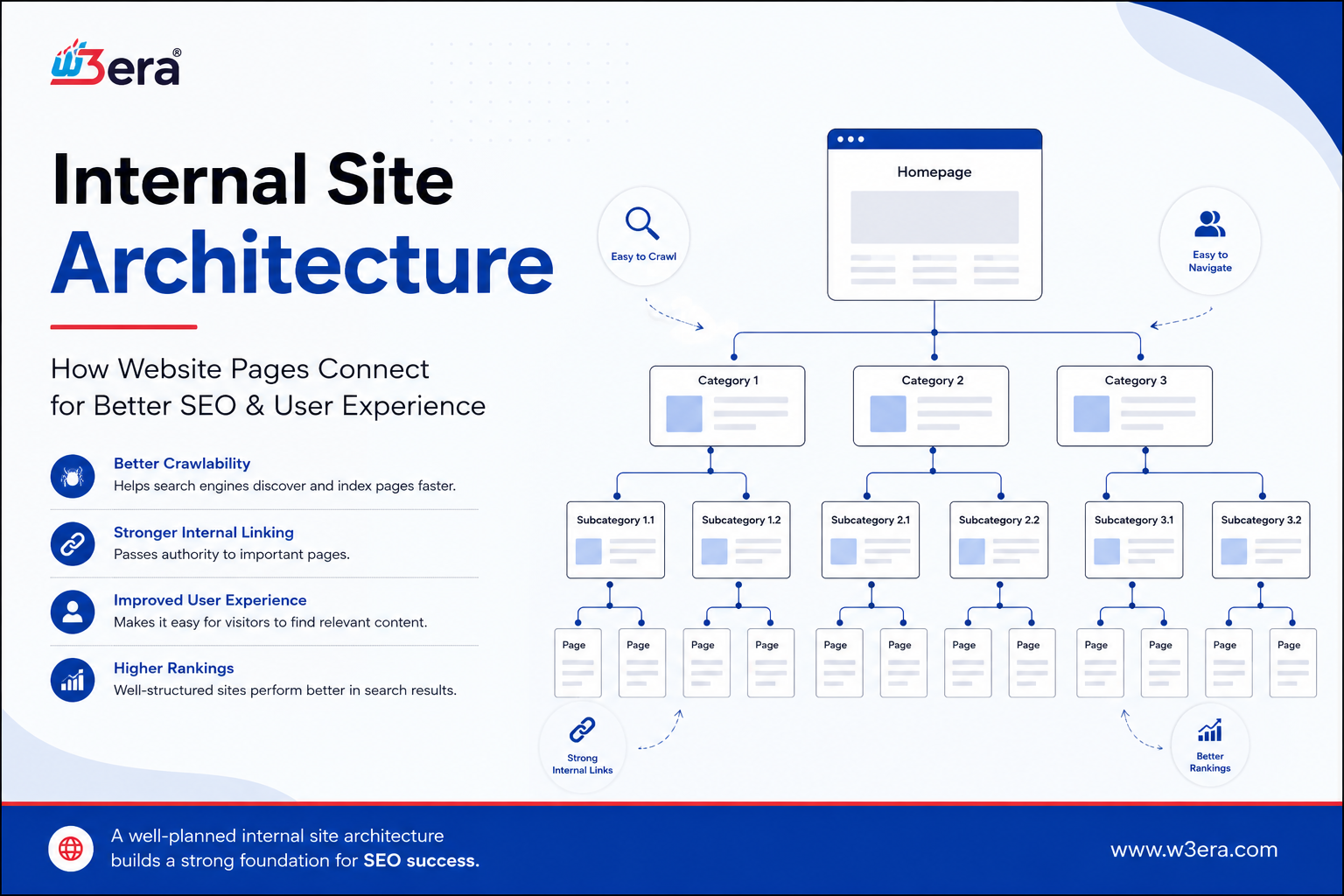
Internal site architecture is the way webpages are structured and connected within a website. It determines how users navigate between pages and how search engines discover, crawl, and understand your content.
Think of your website as a city.
- Your homepage is the city's main entrance.
- Categories are major roads.
- Subcategories are connecting streets.
- Individual pages are destinations.
- Internal links are the roads that connect everything.
When these connections are clear and logical, visitors can move effortlessly through your website, and search engines can understand which pages are most important.
A strong internal site architecture includes:
- Logical page hierarchy
- Clear navigation menus
- Organized categories and subcategories
- Contextual internal links
- Clean URL structure
- Breadcrumb navigation
- XML sitemap
Together, these elements help create an organized website that's easy to explore and simple for search engines to crawl.
Why Internal Site Architecture Matters for SEO
Internal site architecture affects almost every aspect of technical SEO.
Google relies on your website's structure to determine how pages relate to one another, which content is most important, and how authority flows throughout your site.
A well-planned architecture helps improve:
Crawlability
Search engines can discover new pages more efficiently when they're connected through logical navigation and internal links.
Indexing
Pages that are easy to reach are more likely to be indexed quickly.
Poorly connected pages may remain undiscovered or experience delayed indexing.
Internal Link Equity
Internal links distribute authority across your website.
Pages receiving more relevant internal links often have greater ranking potential.
User Experience
Visitors spend less time searching for information when navigation is intuitive.
This often leads to:
- Lower bounce rates
- Higher engagement
- Longer session duration
- Better conversion opportunities
Topical Authority
Grouping related content into organized topic clusters helps search engines understand your expertise.
For example, a Technical SEO category may naturally include guides about crawl depth, website architecture, crawl budget, XML sitemaps, robots.txt, and internal linking.
This structured relationship strengthens your topical authority.
Internal Site Architecture vs Website Architecture
These terms are closely related, but they aren't exactly the same.
| Internal Site Architecture |
Website Architecture |
| Focuses on how pages connect within the website |
Focuses on the overall structure of the entire website |
| Includes navigation and internal linking |
Includes hierarchy, categories, URLs, and technical organization |
| Improves crawlability and user navigation |
Helps search engines understand the website as a whole |
| Optimizes page relationships |
Optimizes the complete website framework |
Simply put:
Website architecture defines the blueprint of your website, while internal site architecture focuses on how every page is connected within that blueprint.
Key Components of Internal Site Architecture
Several elements work together to create an SEO-friendly internal architecture.
Logical Page Hierarchy
Pages should follow a clear hierarchy.
Example:
Homepage
↓
SEO Services
↓
Technical SEO
↓
Internal Site Architecture Guide
Visitors should never feel lost while navigating your website.
Navigation
Menus should remain simple, consistent, and focused on important pages.
Good navigation helps both users and search engines move throughout your website efficiently.
Categories and Subcategories
Organize similar topics together.
Example:
Blog
↓
SEO
↓
Technical SEO
↓
Internal Site Architecture
This organization improves topical relevance.
Internal Linking
Contextual internal links connect related pages throughout your website.
They help:
- Pass authority
- Reduce crawl depth
- Improve page discovery
- Strengthen topical relationships
URL Structure
URLs should clearly reflect your site's hierarchy.
Good example:
example.com/blog/internal-site-architecture-guide
Poor example:
example.com/page?id=56783
Clean URLs improve readability and help search engines understand page context.
Breadcrumb Navigation
Breadcrumbs display the user's location within your website.
Example:
Home
>
Blog
>
Technical SEO
>
Internal Site Architecture
They improve navigation while providing additional internal links.
Types of Internal Site Architecture
Different websites require different architectural approaches.
Hierarchical Structure
The most common architecture.
Homepage
↓
Categories
↓
Subcategories
↓
Pages
Ideal for:
- Business websites
- Blogs
- Ecommerce stores
Sequential Structure
Pages follow a fixed order.
Example:
Step 1
↓
Step 2
↓
Step 3
↓
Completion
Often used for:
- Online courses
- Tutorials
- Checkout processes
Matrix Structure
Users can navigate through multiple pathways.
Useful for:
- Knowledge bases
- Documentation websites
- Large resource centers
Database-Driven Structure
Content is generated dynamically using filters and search functionality.
Common examples include:
- Ecommerce websites
- Real estate platforms
- Job portals
- Large marketplace websites
Best Practices Checklist
An effective internal site architecture should include:
- Clear hierarchy
- Logical navigation
- Strong contextual internal linking
- Clean URLs
- Breadcrumb navigation
- XML sitemap
- Mobile-friendly navigation
- Consistent category organization
- Minimal orphan pages
- Easy access to important pages
How Search Engines Understand Internal Site Architecture
Search engines rely on your website's internal site architecture to discover, crawl, and understand the relationship between pages. Instead of reading your website like a human visitor, Googlebot follows internal links, navigation menus, and XML sitemaps to build a complete understanding of your site's structure.
Every time Googlebot lands on your homepage or another indexed page, it begins following internal links to discover additional URLs. The easier those pathways are to follow, the more efficiently search engines can crawl and index your content.
A well-organized internal site architecture helps search engines:
- Discover new pages faster.
- Understand content relationships.
- Identify high-priority pages.
- Pass authority through internal links.
- Improve crawl efficiency.
- Reduce the chances of orphan pages.
If important pages are buried too deep or have very few internal links, they may receive less crawl attention, delaying indexing and reducing their visibility in search results.
Flat vs. Deep Internal Site Architecture
One of the most important decisions when organizing a website is choosing between a flat or deep architecture.
Flat Internal Site Architecture
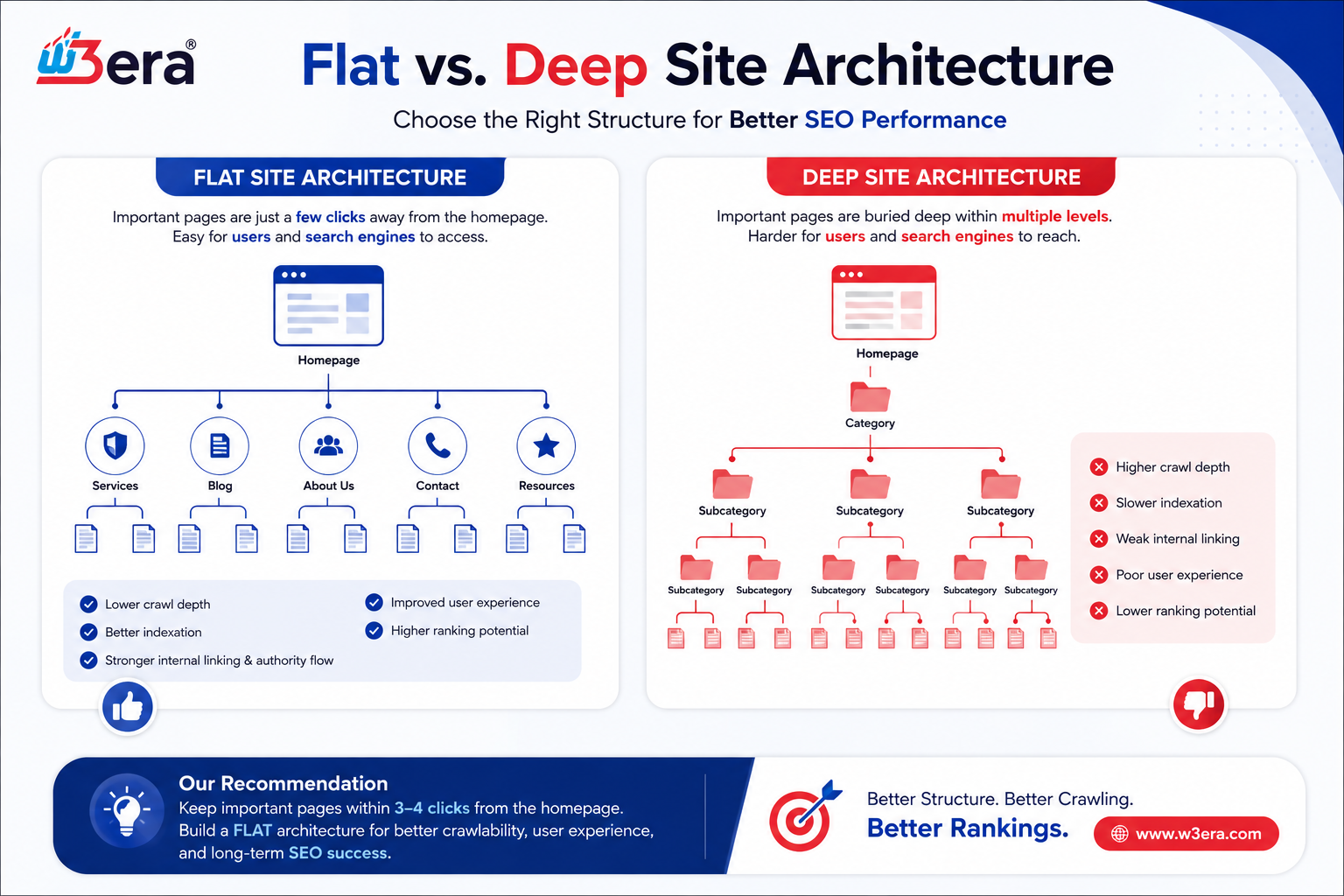
A flat architecture keeps important pages close to the homepage, usually within three to four clicks.
Example
Homepage
├── SEO Services
├── Blog
├── About
├── Contact
└── Technical SEO Guide
Benefits
- Faster crawling
- Better indexing
- Stronger internal link equity
- Easier navigation
- Better user experience
Most SEO professionals recommend using a flat architecture whenever possible because it improves both crawlability and accessibility.
Deep Internal Site Architecture
A deep architecture places pages several levels below the homepage.
Example
Homepage
↓
Services
↓
SEO
↓
Technical SEO
↓
Website Architecture
↓
Internal Site Architecture
Challenges
- Higher crawl depth
- Slower page discovery
- Reduced authority flow
- More clicks required
- Increased risk of orphan pages
Although large ecommerce websites sometimes require deeper hierarchies, unnecessary complexity should always be avoided.
Best Practices for Internal Site Architecture
Building an SEO-friendly internal site architecture requires more than simply organizing pages into folders. Every structural element should make it easier for users and search engines to navigate your website.
Keep Important Pages Close to the Homepage
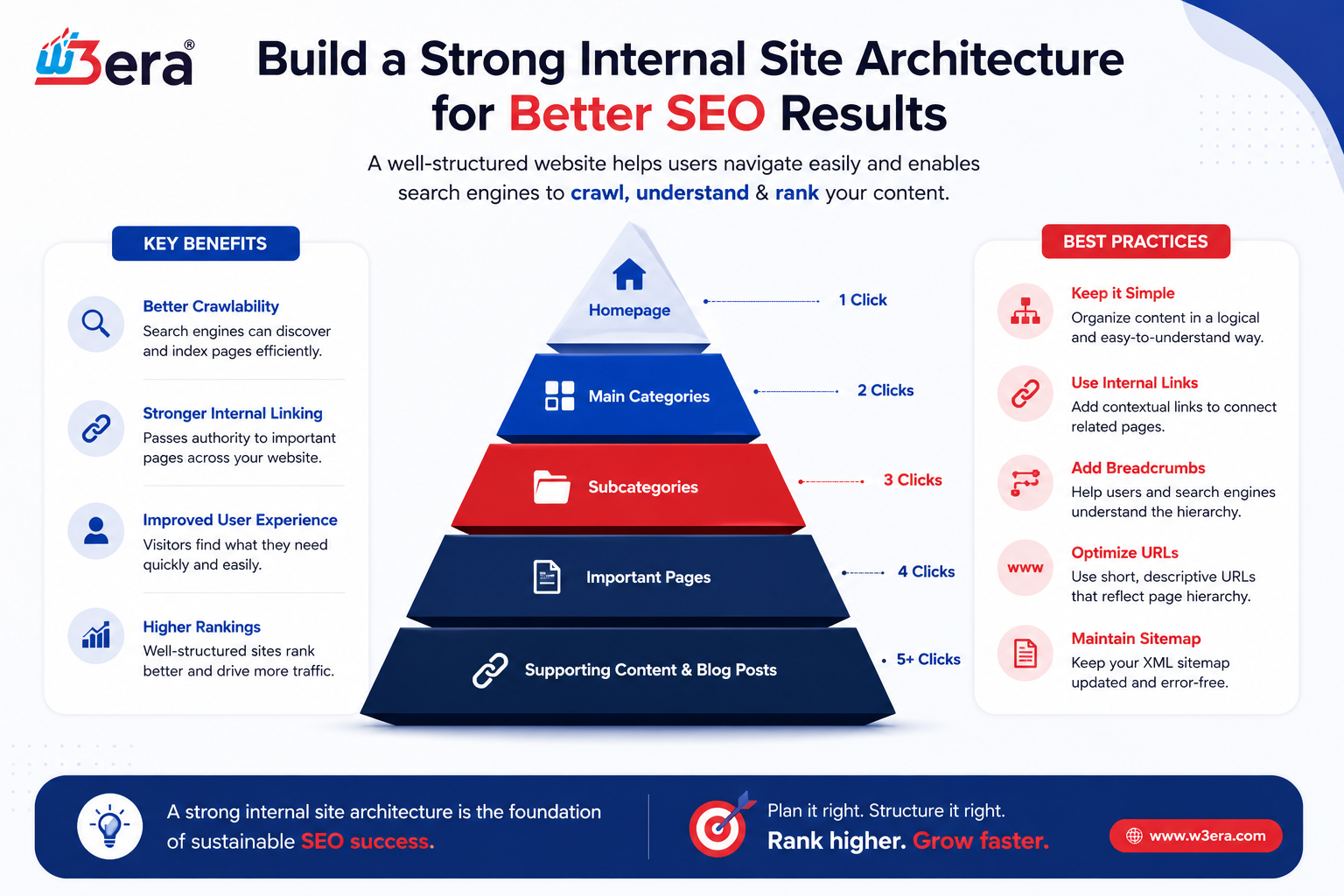
Your most valuable pages should be accessible within three to four clicks.
This improves crawl efficiency while helping visitors find important information quickly.
Create Logical Topic Clusters
Organize related pages into categories and supporting articles.
Example
Technical SEO
↓
Website Architecture
↓
Internal Site Architecture
↓
Crawl Depth
↓
XML Sitemap
This organization helps search engines understand topical relationships across your website.
Build Strong Contextual Internal Links
Instead of relying only on navigation menus, include contextual links within your content.
For example, while discussing crawlability, you can naturally reference topics like Website Architecture, Crawl Depth, XML Sitemap, or Robots.txt.
These links strengthen semantic relevance while distributing authority throughout your website.
Maintain Consistent Navigation
Visitors should always know where they are on your website.
Navigation should:
- Remain consistent
- Highlight important categories
- Avoid unnecessary menu items
- Support both desktop and mobile users
Use Breadcrumb Navigation
Breadcrumbs improve navigation while helping search engines understand page hierarchy.
Example
Home
>
Blog
>
Technical SEO
>
Internal Site Architecture
They also create additional internal linking opportunities.
Optimize Your URL Structure
URLs should reflect your website hierarchy.
Good example
example.com/blog/internal-site-architecture-guide
Avoid
example.com/page?id=89475
Short, descriptive URLs improve readability and make page context clearer.
Update Your XML Sitemap
An XML sitemap supports content discovery by providing search engines with a list of important URLs.
Keep your sitemap updated whenever:
- Publishing new pages
- Removing URLs
- Updating categories
- Launching new sections
Common Internal Site Architecture Mistakes
Many websites unintentionally create structural issues that reduce crawl efficiency and hurt SEO performance.
Orphan Pages
Pages with no internal links are difficult for search engines and users to discover.
Every important page should receive at least one contextual internal link.
Too Many Click Levels
If users need six or seven clicks to reach valuable content, Googlebot may also struggle to discover those pages efficiently.
Poor Internal Linking
Only linking through navigation menus isn't enough.
Contextual links within articles help search engines understand relationships between topics.
Duplicate Categories
Creating multiple categories around the same topic confuses both users and search engines.
Maintain one clear hierarchy.
Broken Internal Links
Broken links interrupt crawl paths and negatively affect user experience.
Regular technical audits help identify and fix these issues before they impact SEO.
Overcomplicated Navigation
Large menus containing dozens of links create unnecessary complexity.
Keep navigation focused on the pages that matter most.
How Internal Site Architecture Improves User Experience
A well-planned internal architecture doesn't only benefit search engines—it also improves how visitors interact with your website.
Benefits include:
- Faster navigation
- Easier content discovery
- Improved engagement
- Longer session duration
- Higher conversion rates
- Better mobile usability
When visitors can quickly find related information, they're more likely to continue exploring your website rather than leaving after viewing a single page.
Building an effective internal site architecture requires careful planning, strategic internal linking, and technical SEO expertise. If you're looking to improve your website's crawlability, navigation, and long-term organic performance, explore our seo company in usa to see how our team creates scalable SEO strategies that help businesses achieve sustainable growth across competitive search markets.
Need an SEO-Friendly Website Structure That Drives Rankings?
A well-planned internal site architecture improves crawlability, internal linking, indexing, and user experience. Our USA SEO experts build scalable website structures designed for long-term organic growth.
How to Audit Internal Site Architecture
Even a well-designed website can develop structural issues as new pages, categories, and content are added over time. Regular audits help identify problems before they affect your search performance.
An internal site architecture audit focuses on how pages are connected, whether users can navigate easily, and how efficiently search engines crawl your website.
Here are the key areas to review.
Crawl Your Website
Start by crawling your website using an SEO crawler.
Look for:
- Pages buried deep within the website
- Broken internal links
- Redirect chains
- Orphan pages
- Duplicate content
- Navigation issues
A crawl report gives you a clear overview of your website's structure and highlights areas that need improvement.
Analyze Internal Linking
Review how authority flows across your website.
Ask questions like:
- Which pages receive the most internal links?
- Are important pages properly connected?
- Do related articles link to one another?
- Are there orphan pages with no internal links?
Strong contextual linking helps Google understand page relationships while improving crawl efficiency.
Review Navigation Structure
Your navigation should guide visitors naturally through your website.
Check whether:
- Categories are clearly organized.
- Navigation remains consistent.
- Important pages are easy to access.
- Mobile navigation is user-friendly.
- Menu items aren't overcrowded.
A clean navigation improves both usability and crawlability.
Evaluate URL Structure
URLs should accurately reflect your website hierarchy.
Example
Good
example.com/blog/internal-site-architecture-guide
Poor
example.com/page?id=84652
Well-structured URLs improve readability while helping search engines understand page context.
Inspect XML Sitemap
Your XML sitemap should include only valuable, indexable pages.
Regularly check that:
- New pages are included.
- Deleted URLs are removed.
- Redirected pages aren't listed.
- The sitemap is submitted through Google Search Console.
A clean sitemap helps search engines discover content more efficiently.
Monitor Google Search Console
Google Search Console provides valuable insights into your website's crawlability and indexing.
Review reports for:
- Crawled – Currently Not Indexed
- Discovered – Currently Not Indexed
- Crawl Errors
- Page Indexing
- Internal Linking Opportunities
- Sitemap Status
Monitoring these reports helps identify technical issues before they affect rankings.
Several SEO tools can help evaluate your website's internal structure.
Popular options include:
- Google Search Console
- Google Analytics 4
- Screaming Frog SEO Spider
- Ahrefs Site Audit
- Semrush Site Audit
- Sitebulb
- PageSpeed Insights
Using multiple tools provides a more complete understanding of crawlability, internal linking, and website organization.
Benefits of a Strong Internal Site Architecture
Investing time in improving your internal site architecture delivers long-term SEO and user experience benefits.
Better Crawlability
Search engines discover pages more efficiently.
Faster Indexing
Important pages are indexed sooner because they're easier to find.
Stronger Internal Link Equity
Authority flows naturally across your website, helping valuable pages perform better in search results.
Improved User Experience
Visitors spend less time searching for information and more time engaging with your content.
Higher Topical Authority
Connecting related pages into logical topic clusters helps search engines understand your expertise.
Improved Organic Rankings
A well-structured website creates stronger foundations for sustainable organic growth.
Conclusion
Internal site architecture is one of the most important foundations of technical SEO. It determines how users navigate your website, how search engines discover and understand your content, and how authority flows between pages. By creating a logical hierarchy, strengthening internal links, simplifying navigation, maintaining clean URLs, and regularly auditing your website structure, you make it easier for both users and search engines to access your most valuable content. As your website grows, maintaining an organized internal architecture becomes even more important. A scalable structure not only improves crawlability and indexing but also supports topical authority, user experience, and long-term organic visibility.
Building a scalable internal site architecture is only one part of a successful SEO strategy. Consistent growth also depends on technical optimization, content planning, and strategic internal linking. If you're looking to improve your website's search performance across competitive markets, explore our seo expert UK to see how our SEO specialists create structured, search engine-friendly websites that drive sustainable organic growth.
Build a Strong Internal Site Architecture That Supports Long-Term SEO Growth
Looking to improve your website's crawlability, navigation, and organic visibility in the UK? Our SEO specialists create scalable site structures that help businesses rank higher and grow sustainably.
Explore UK SEO Services