Ashwini Rao possesses extensive experience as an SEO Expert at W3era. She can provide sustainable organic growth through the accurate execution of technical SEO skills in association with content optimization techniques. Ashwini is highly educated and always stays abreast with the dominant algorithmic updates of search engines and trend forecasts, thereby being able to provide clients with intelligent, objective-oriented solutions based on the ever-changing world of digital marketing.
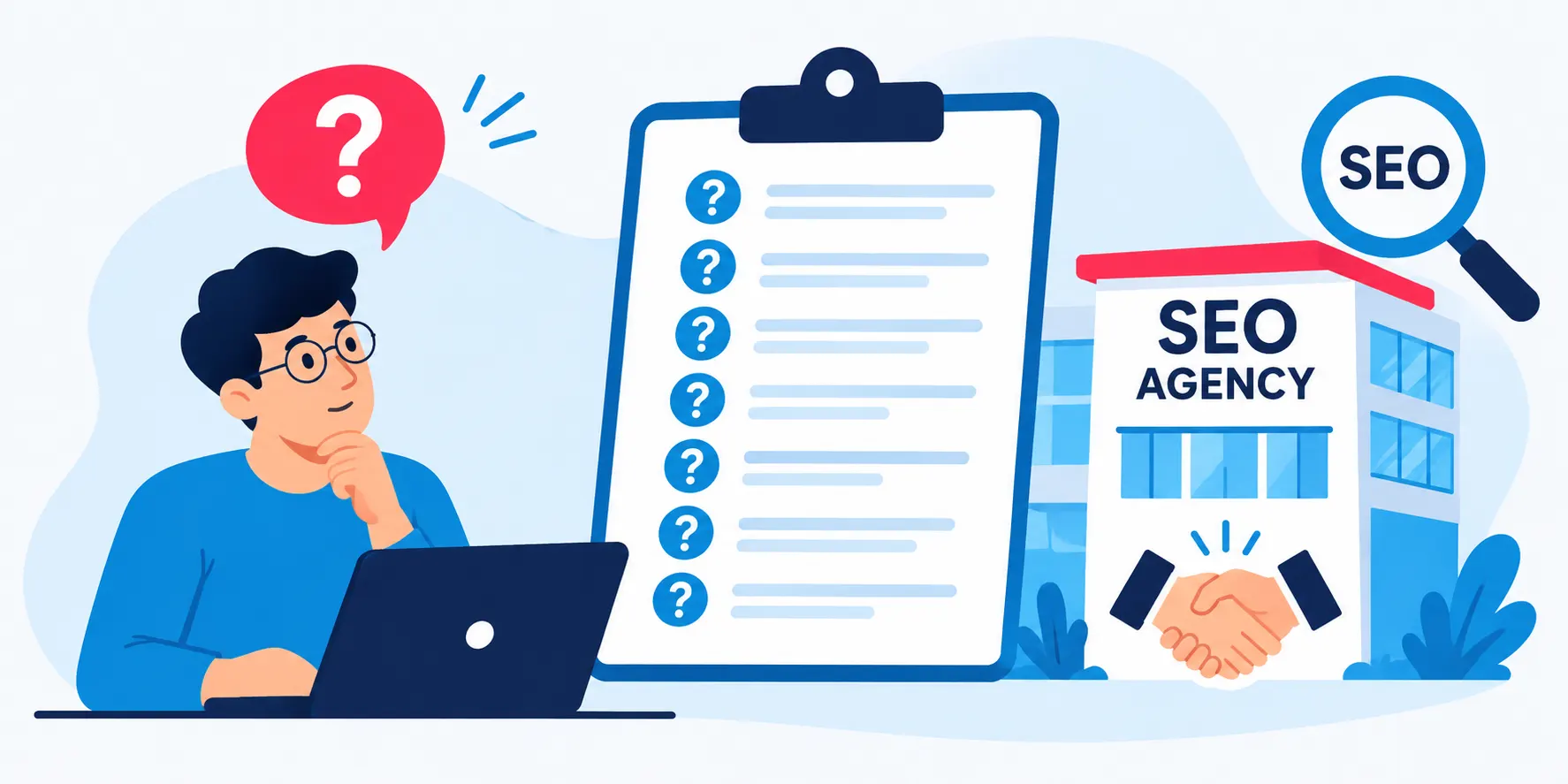
To choose an SEO agency, ask the same eight questions of every candidate: who will do the work, what results they can show for businesses like yours, how they define success, how they would prioritize your first 90 days, what reporting you will receive, what is included and excluded, how they handle content and links, and who owns your accounts and data if you leave. Score each answer, and treat guaranteed rankings as a red flag.
Most SEO agencies sound the same on a first call. The difference shows up three months into a 12-month contract, when you find out whether there was a plan behind the pitch.
These eight questions help you find that out before you sign. For each one, you'll see what a good answer sounds like and what should worry you.
W3Era publishes this guide, and the questions apply to us as much as anyone. Use them on every agency you're considering. If you're still working out what an agency would actually do for you, start with what an SEO agency does.
How to use this checklist
Ask every agency the same questions in the same order, and score the answers on the same scale: clear and specific, partly clear, or unclear. Write down names, dates and specific deliverables.
Vague answers are information too. Compare agencies side by side with the scorecard below rather than relying on first impressions.
No questions about your business, goals or current site
Pressure to sign before you receive a written proposal
No clear explanation of how they report progress
8 Questions to Ask Before Hiring an SEO Agency
1. Who will do the work, and what is their experience?
Ask who will be your day-to-day contact, who sets strategy, and who writes content or builds technical fixes.
A good answer names roles and explains how work is handed off. Check whether the people in the sales call are the people who will deliver the work.
A weak answer is "our team" with no detail, or a senior person who will not be involved after signing.
2. Which results can you show for businesses like mine?
Ask for case studies that describe the type of business, its starting point and what changed. Good examples are specific and admit their limits. Google suggests asking for examples of previous work, and about experience in your industry and your country or city.
Ask what didn't work, and what the agency changed as a result. Check whether the examples involve sites like yours, and ask for a reference call with a past client who has agreed.
If local customers matter to you, ask for an example involving Google Business Profile, reviews and location pages, not just blog rankings.
A weak answer is no examples, or screenshots with no starting point, timeframe or context.
3. How do you define success, and will you promise rankings?
A good agency explains which metrics it tracks, such as search impressions, clicks, indexed pages and conversions, and how these connect to qualified leads and revenue. Our guide to measuring SEO ROI shows what that math looks like.
It should also say what it can influence and what it cannot control, including competitor activity and search engine changes. Treat guaranteed first-page rankings as a red flag: no agency controls the search results.
Ask how the agency tracks visibility in AI search, such as Google's AI Overviews and AI Mode, ChatGPT and Perplexity. A good answer explains what it measures, such as whether your brand is mentioned or cited for key questions, and admits these results are less stable than rankings. A weak answer promises placement in AI answers.
4. How will you prioritize tasks and explain your decisions over the first 90 days?
This question matters most, because it shows how the agency thinks. A strong answer includes:
A documented audit of your site and its search data, not a generic template
A ranked task list with reasons: why each priority comes first, what it affects, and the effort and risk involved
A clear deferral list: what is being left out for now, and why
Checkpoints where you can challenge decisions: ask what would make them change the plan at day 60
Ask them to walk through a past example where data changed their plan, and what evidence they used. A weak answer is a generic checklist, or a plan that starts with content output before any analysis.
A generic plan vs an evidence-based plan. Imagine two agencies proposing a 90-day plan for the same business: a website with around 40 service pages, thin location content and a slow mobile template.
Generic plan
Evidence-based plan
Starting point
"Keyword research, on-page optimization, 12 blog posts a month, link building, monthly reporting"
An audit of crawlability, page templates and search data, with the findings stated
Priorities
None stated; every item sounds reasonable but none is tied to this site
1. Fix template issues that affect many pages. 2. Improve pages that already get impressions but few clicks. 3. New content only where search data shows an unmet question
Deferred work
Not mentioned
Named: new blog topics and link outreach wait until the foundation is fixed
Checkpoints
Monthly report
Days 30, 60 and 90, with the evidence each will use and what would change the plan
Can you challenge it?
Hard: there's nothing specific to question
Easy: ask why a task is first, and the answer refers to your site's data
5. What reporting will I receive, and how often?
Ask which reports you will receive, how often, and which data sources they use, such as Google Search Console and your analytics platform. If you're on GA4, our guide to measuring SEO in GA4 shows what a proper setup looks like.
Good reporting ties each finding to a decision and a next action. Weak reporting is a monthly slide deck of screenshots with no explanation.
Confirm that you can view the underlying data yourself, at any time, in your own accounts.
6. What is included, what is excluded, and what are the contract terms?
Get the scope in writing: strategy, technical fixes, content creation and optimization, link work, conversion tracking, reporting and tools. Check who implements technical fixes, and whether your developers need to be involved.
Exclusions matter as much as inclusions. A good scope document names responsibilities on both sides. A weak one is a "full-service" label with no list behind it.
Get the contract terms in writing too: the minimum term, the notice period, and what happens to in-progress work if you leave. A month-to-month term or a short minimum with clear notice is lower risk than a 12-month lock-in.
7. How do you approach content creation and link building?
Ask how they decide which topics to write about, how they research them and how they find or earn links. Good answers focus on usefulness, sources and editorial review, and the agency should be able to say it works within Google's Search Essentials and spam policies.
Ask what they would refuse to do. Be cautious of bulk content with no review, link buying, private blog networks or link schemes.
8. Who owns the accounts, data and content if we leave?
Confirm that you keep ownership of your domain, your Search Console and analytics access, and the content you pay for. Ask how the handover works if you end the engagement.
Good agencies have written terms and a clear handover process. Be wary of accounts created in the agency's name, or unclear rights to content.
Score Each Agency on the Same Scale
For each question, score the answer 2 (clear and specific), 1 (partly clear) or 0 (unclear). The maximum is 16.
Question
Agency A
Agency B
Agency C
1. Who does the work
2. Results for businesses like yours
3. Definition of success, no guarantees
4. First 90 days, prioritized with reasons
5. Reporting and data access
6. Scope, exclusions and contract terms
7. Content and link approach
8. Ownership and handover
Total (max 16)
Two scores matter more than the total. An agency that scores 0 on question 3 (guarantees rankings) or question 8 (keeps your accounts) is out, whatever else it scores.
If you're hiring for paid search at the same time, our guide to comparing search engine marketing companies has the matching scorecard for SEM agencies.
How Much Does an SEO Agency Cost?
Price should be the last filter, not the first, but you need a baseline to spot quotes that are far too high or too cheap to be real work.
The most common monthly retainer range was $501–$1,000, though agencies averaged about $3,209 a month.
The most common hourly rate was $75–$100, averaging about $111.
Treat these as orientation, not quotes. Competitive industries, large sites and heavy technical work cost more. A retainer far below this range usually means templated work, and the cheapest proposal is rarely the cheapest outcome once you count the months it doesn't move anything.
What matters more than the number is what sits behind it: compare each proposal's deliverables against its fee, the same way the scorecard compares answers.
What a Good Proposal Should Contain
Scope, with inclusions and exclusions
The audit approach and what it will cover
Prioritized tasks, with the reasons for each priority
Named roles and responsibilities
The reporting schedule and the data sources used
Success metrics that are measured, not guaranteed
Contract term, notice period, handover and ownership terms
An assumptions section listing what the agency needs from you
Put W3Era Through All Eight Questions
Place directly after the proposal section.
We wrote this checklist to be used on us too. Book a call and ask every question on it. We'll answer each one in writing in our proposal: who will do the work, what we'd prioritize in your first 90 days and why, what's included and excluded, and how you keep full ownership of your Search Console, analytics and content.
Start with an SEO audit →
Hiring for paid search too? Read our guide to comparing search engine marketing companies.
Next Steps
Shortlist three to five agencies, put the same eight questions to each, and compare their written proposals side by side with the scorecard. Ask for a written scope and an ownership clause before you sign.
Should a US business hire an SEO agency or do the work in house?
It depends on your team and goals. In-house work gives you direct control and builds institutional knowledge. An agency adds specialist skills and extra capacity.
Many businesses combine the two: business decisions stay in house, and an outside partner handles specialist tasks such as technical audits or content production.
➡️
What are the biggest red flags when hiring an SEO agency?
Guaranteed rankings, no named team, vague scope, no access to your own data, pressure to sign quickly, and reluctance to explain tactics. Accounts created in the agency's name are the costliest one: your data leaves when you do.
➡️
What should I prepare before the first call?
Prepare your goals, the pages that matter most to your business, access to Search Console and analytics if you have it, any previous SEO reports, and the challenges you're currently facing.
➡️
How long does it take to see SEO results?
For most sites, meaningful organic growth takes four to six months, and competitive markets take longer. Technical fixes on a large site can show results sooner; brand-new sites take longer.
The honest version of this answer depends on your starting point, which is why an agency that offers a fixed timeline before seeing your site is guessing. Our guide to how long SEO takes breaks down what moves the timeline.
➡️
Do I need a US-based agency?
Location helps with meetings, time zones and familiarity with the local market, but it doesn't guarantee quality. Evaluate expertise and process first.
If local search matters to your business, ask how the agency handles location-specific queries, Google Business Profile and reviews.