Loading Footer Banner...

For many small businesses, appearing in search results when potential customers are looking for a product or service can make a meaningful difference in how they attract new enquiries. However, improving search visibility involves more than adding keywords to a website or publishing blog posts. It requires a clear SEO strategy, a technically accessible website, useful content, and ongoing optimization based on how people search and interact with the business online.
Choosing the right SEO services for small businesses can be challenging, especially when agencies offer different packages, deliverables, pricing models, and performance promises. Some businesses need local search optimization to attract nearby customers, while others may require technical improvements, content development, ecommerce optimization, or a broader SEO strategy. The right approach depends on your business model, website condition, competition, and growth objectives.
This guide explains what small business SEO services include, how to identify the services your business actually needs, what to expect when hiring an SEO provider, and how to evaluate pricing, timelines, and performance. You'll also learn what questions to ask before choosing an SEO company or consultant and how to recognize unrealistic promises.
Whether you're comparing SEO companies for a small business in the USA or considering professional SEO support for the first time, the goal is to help you make an informed decision, understand the work involved, and invest in an approach that supports sustainable search visibility and business growth.
Key Takeaways
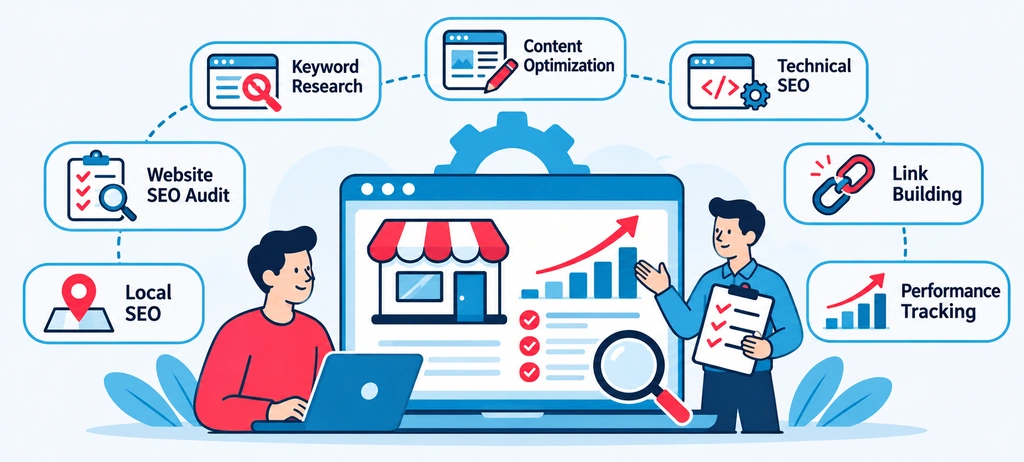
SEO services for small businesses cover the activities required to improve a website's organic search visibility, make its pages more useful to potential customers, and support business objectives through search. These services can include website audits, keyword research, on-page optimization, technical SEO, local search optimization, content improvements, and link building.
However, not every business needs the same SEO activities. A local service provider may prioritize location-based searches and service pages, while an ecommerce business may need product optimization, category page improvements, and technical support for its online store.
Understanding what each service includes makes it easier to evaluate SEO packages, identify the work your website needs, and determine whether a provider's proposed strategy is relevant to your business.
An SEO audit evaluates a website's current search visibility, content, technical structure, and optimization opportunities. It helps identify the issues that may prevent important pages from being discovered, understood, or used effectively by potential customers.
For small businesses, an SEO audit should provide a practical assessment of the website rather than an extensive list of automated warnings without business context.
What Does an SEO Audit Include?
A professional website SEO analysis typically examines several areas:
| Audit Area | What Is Reviewed | Purpose |
| Technical SEO | Crawlability, indexing, redirects, canonical tags, robots.txt | Identify technical barriers affecting important pages |
| On-page SEO | Titles, headings, content relevance, internal links | Evaluate how clearly pages communicate their purpose |
| Keyword performance | Existing impressions, clicks, rankings, and query relevance | Identify pages and search opportunities worth investigating. |
| Website structure | Navigation, URL hierarchy, page relationships | Understand how visitors and search engines discover content. |
| Content quality | Outdated information, missing details, overlapping topics | Identify content that needs improvement. |
| Mobile experience | Navigation, readability, accessibility, interaction | Review how customers use the website on mobile devices. |
| Website performance | Loading behavior and Core Web Vitals | Identify performance issues affecting user experience. |
| Local visibility | Business information and local search presence | Evaluate relevant opportunities for local businesses. |
| Backlink profile | Linking websites, link relevance, unusual patterns | Understand the website's external link profile. |
The findings should be prioritized according to their relevance, severity, and potential business impact. A problem affecting the indexing of important service pages may require more immediate attention than a minor formatting issue.
Example: Consider a residential roofing company in Houston, Texas. Its website has separate pages for roof installation, roof repairs, and roof inspections, but organic enquiries remain limited.
An SEO audit may reveal that:
These findings give the business a clearer picture of where optimization is needed.
The audit may recommend improving the roof repair page, clarifying page titles, connecting relevant pages through internal links, and making the enquiry process easier on mobile devices.
The objective is to identify actionable improvements that support search visibility and customer experience.
Keyword research helps small businesses understand the terms potential customers use when searching for products, services, information, and solutions.
Effective keyword research goes beyond selecting keywords with high search volume. It considers what the searcher wants, how closely the query relates to the business, and which website page should answer that need.
Small business keyword research generally includes:
This process helps businesses target searches that are relevant to their products and services rather than attracting visitors who are unlikely to become customers.
Understanding Search Intent Before Targeting Keywords
Search intent describes the purpose behind a search query. Understanding it helps determine whether the appropriate destination is a service page, product page, educational article, or another type of content.
| Search Intent | Example Search | Appropriate Content |
| Informational | How often should a roof be inspected? | Educational article or guide |
| Commercial investigation | Residential roofing materials comparison | Comparison or decision-support content |
| Transactional | Roof repair services Houston | Relevant roofing service page |
| Local discovery | Roofing contractor near me | Local business website and Google Business Profile |
| Navigational | A specific roofing company's name | Brand homepage or relevant business page |
For example, someone searching for "roof repair services Houston" is generally looking for a service provider. A dedicated roof repair page is more appropriate than an unrelated article about roof maintenance.
Someone searching for "how to identify roof damage after a storm" may need educational information first. That article can link naturally to the roof inspection service when professional assistance becomes relevant.
A structured keyword strategy helps prioritize relevant terms, map search intent to the right pages, and uncover opportunities competitors may be overlooking.
Explore Keyword Research Services →Keyword Mapping: Assigning Search Terms to the Right Pages
Keyword mapping connects target keywords with individual website URLs. It helps maintain a clear content structure and prevents multiple pages from targeting substantially overlapping search intent.
For example, a small accounting firm serving businesses in Chicago may organize its keyword targets as follows:
| Target Keyword | Search Intent | Suggested Page |
| Small business accountant in Chicago | Commercial and local | Accounting services page |
| Bookkeeping services in Chicago | Commercial and local | Bookkeeping service page |
| Business tax preparation | Commercial | Business tax service page |
| How to prepare small business taxes | Informational | Educational blog |
| Small business bookkeeping checklist | Informational | Checklist or guide |
The informational articles can link to the corresponding service pages when readers need professional assistance.
Keyword mapping should also account for existing website content. If a page already receives relevant search impressions, improving its relevance and usefulness may be more appropriate than publishing another page targeting the same intent.
On-page SEO involves improving the content and page elements of a website so visitors and search engines can understand what each page offers.
For small businesses, this is particularly important because service pages, product pages, and other important landing pages often serve as the entry points for potential customers.
What On-Page SEO Includes
On-page optimization may involve:
These improvements should help visitors understand the page and make informed decisions. Adding keywords without improving the content does not create meaningful value.
Optimizing Small Business Service Pages
A service page should clearly explain what the business provides, who the service is for, and how a customer can take the next step.
Let's take an example. Consider a landscaping company targeting lawn care services in Phoenix.
A useful service page could explain:
The page should accurately represent the business. It should not claim service coverage in locations where the company does not operate or make unsupported claims about results.
Optimizing Existing Content Instead of Publishing More Pages
SEO content optimization often involves improving pages that already exist.
For example, an accounting firm may have an article about small business tax preparation that receives search impressions but does not adequately answer readers' questions.
Rather than publishing multiple similar articles, the SEO provider could improve the existing content by:
| Content Problem | Appropriate Improvement |
| Page receives impressions but few clicks | Review whether its title and description accurately communicate its value |
| Content does not answer the search query | Improve the explanation and address missing information |
| Service page lacks important details | Clarify service scope, customer needs, and relevant business information |
| Multiple pages target similar intent | Review whether differentiation, consolidation, or redirection is appropriate |
| Blog readers cannot find relevant services | Add contextual internal links where professional support is relevant |
| Information is outdated | Update facts, examples, and recommendations |
Content optimization should be based on the actual page, search queries, and user needs. It should not become an exercise in inserting additional keywords into every paragraph.
Technical SEO focuses on making a website accessible to search engines and reliable for visitors. It addresses problems that can interfere with crawling, indexing, website functionality, and user experience.
For small businesses, technical SEO should prioritize issues affecting important pages and customer journeys.
Technical SEO Activities for Small Business Websites
| Technical Area | What It Involves |
| Crawlability | Ensuring important pages can be accessed by search engine crawlers |
| Indexability | Reviewing whether important pages are eligible for indexing |
| XML sitemap | Maintaining a sitemap containing relevant, canonical URLs |
| Robots.txt | Checking whether crawling restrictions block important resources or pages |
| Canonical tags | Identifying the preferred URL for duplicate or similar pages |
| Redirects | Managing URL changes without unnecessary redirect chains or errors |
| Broken links | Identifying links leading to unavailable pages |
| Mobile usability | Reviewing navigation, forms, and interactions on mobile devices |
| Core Web Vitals | Evaluating loading performance, responsiveness, and visual stability |
| HTTPS | Maintaining secure website connections |
| Structured data | Implementing accurate markup where relevant |
| URL structure | Maintaining understandable and logically organized URLs |
These activities help ensure that the website's important content can be discovered and accessed correctly.
Example: Let's take an example of resolving an e-commerce indexing problem. Imagine a small e-commerce store selling handmade home decor products. The owner publishes new product pages but notices that many products are not appearing in Google search results.
A technical SEO investigation may identify several possible causes:
The appropriate solution depends on the actual cause. The provider may need to correct indexing directives, improve category navigation, review URL handling, and verify that important product pages can be crawled.
Submitting a sitemap does not guarantee indexing. Search engines determine which pages to index based on their systems and the characteristics of the content.
Website Performance and Core Web Vitals
Website performance affects how visitors interact with a business website. Slow loading, delayed interactions, and unexpected layout shifts can make browsing or completing inquiries more difficult.
Google's Core Web Vitals include:
For example, a dental practice website may contain a large homepage banner, unnecessary scripts, and a mobile booking form that loads slowly.
Improving image delivery, reviewing scripts, and optimizing the booking experience may make the website easier to use.
Passing Core Web Vitals thresholds does not guarantee higher rankings. These measurements help identify user experience problems and guide improvements.
Technical changes should be tested carefully, especially when they involve indexing directives, canonical tags, redirects, or website architecture.
Local SEO helps businesses improve their visibility when people search for products or services in a particular geographic area.
It is especially relevant for small businesses serving customers within a city, region, or defined service area.
Examples include:
Local SEO combines website optimization, business profile management, geographic relevance, and accurate business information.
Google Business Profile Optimization
Google Business Profile is an important component of local search visibility for eligible businesses.
SEO providers may review and optimize:
Businesses should use their real-world business name rather than adding unnecessary keywords. Business information should accurately reflect the company's operations.
Google Business Profile optimization does not guarantee a particular Maps ranking. Local results are influenced by relevance, distance, and prominence, among other factors.
Location Pages and Geographic Relevance
Businesses serving multiple locations may need separate landing pages when each location represents a genuine service area or business operation, and the page provides useful information.
For example, a cleaning company serving Austin, Round Rock, and Cedar Park may create location-specific pages explaining:
Creating numerous pages that simply replace a city name while repeating identical content is not a useful local SEO strategy.
Each location page should have a legitimate purpose and provide information relevant to customers in that area.
Example: Let's take an example for local SEO for a dental practice. Consider a dental clinic in Orlando that wants to improve its online visibility and attract relevant appointment inquiries.
Its local SEO activities may include:
| Activity | Practical Implementation |
| Business profile | Maintain accurate business details, hours, categories, and appointment links. |
| Service pages | Improve relevant dental service descriptions. |
| Local keyword research | Identify searches related to services and location. |
| Geographic relevance | Communicate the clinic's actual location and coverage. |
| Reviews | Follow appropriate practices for requesting and responding to genuine patient reviews. |
| Website structure | Connect service pages and useful patient education content. |
| Conversion access | Make appointment information and contact options are easy to find. |
The goal is to help potential patients discover accurate business information and understand the services available.
Accurate business information, optimized location pages, and local citations help customers discover and evaluate businesses in nearby searches.
Improve Local Search Visibility →Link building involves earning links from other websites that point to a business's website. These links can help people discover useful resources and provide search engines with information about how websites and pages are connected.
For small businesses, link building should focus on relevant, legitimate opportunities rather than simply increasing backlink counts.
Link Building Activities for Small Businesses
Potential approaches include:
For example, a small accounting firm could publish a practical guide explaining bookkeeping mistakes commonly made by new businesses. A relevant business publication or entrepreneurship organization may reference the guide when discussing financial management.
The link provides value because it helps readers discover relevant information.
Evaluating Link Quality Instead of Counting Backlinks
Not every backlink is useful. Links from irrelevant websites, automated networks, or low-value placements may provide little audience benefit and can introduce spam risks.
A responsible SEO provider should explain how links are acquired and why the opportunities are relevant.
| Link Building Approach | What to Consider |
| Relevant industry publications | Audience relevance and editorial quality |
| Local business organizations | Genuine participation and business relevance |
| Original research and resources | Whether the material provides information worth referencing |
| Editorial mentions | Context, credibility, and relevance |
| Paid links intended to manipulate rankings | Potential violation of search engine spam policies |
| Automated bulk backlinks | Risk of unnatural link patterns and low-value placements |
| Irrelevant guest post networks | Limited audience relevance and editorial value |
Google identifies practices such as buying links intended to manipulate rankings and large-scale low-value link campaigns as potential link spam.
Small businesses should therefore evaluate link building based on relevance, credibility, transparency, and compliance with search engine policies.
Link Building Should Support Business Visibility
Backlink counts and third-party authority scores should not be treated as direct measures of business success.
A relevant editorial mention from a regional publication may introduce a roofing company to potential customers, while hundreds of unrelated backlinks may provide little practical value.
Useful questions include:
Link building can support discovery, reputation, and website authority, but it cannot guarantee rankings or a specific amount of organic traffic.
The six service areas support different parts of a small business's organic search strategy.
Keyword research helps identify relevant customer searches. On-page SEO connects those searches with useful website content. Technical SEO supports accessibility and website functionality. Local SEO helps eligible businesses reach geographically relevant customers, while link building can support discovery and reputation.
An SEO audit helps identify which activities deserve attention first.
| SEO Service | Primary Role | How It Supports the Business |
| SEO audits | Identify website issues and opportunities | Helps prioritize optimization work |
| Keyword research | Understand search demand and intent | Helps target relevant customers |
| On-page SEO | Improve content and page relevance | Makes pages more useful and understandable |
| Technical SEO | Improve website accessibility and functionality | Helps reduce technical barriers |
| Local SEO | Improve geographic business visibility | Supports relevant local discovery |
| Link building | Earn relevant external references | Supports discovery and reputation |
The right combination depends on the business's website, industry, target customers, and growth objectives. A small business should not purchase every SEO service automatically. It should understand which activities address its current needs and how those activities fit into a broader strategy.
For businesses that need professional support across these areas, W3era's USA SEO services provide a relevant next step to explore SEO support for their website and business objectives.
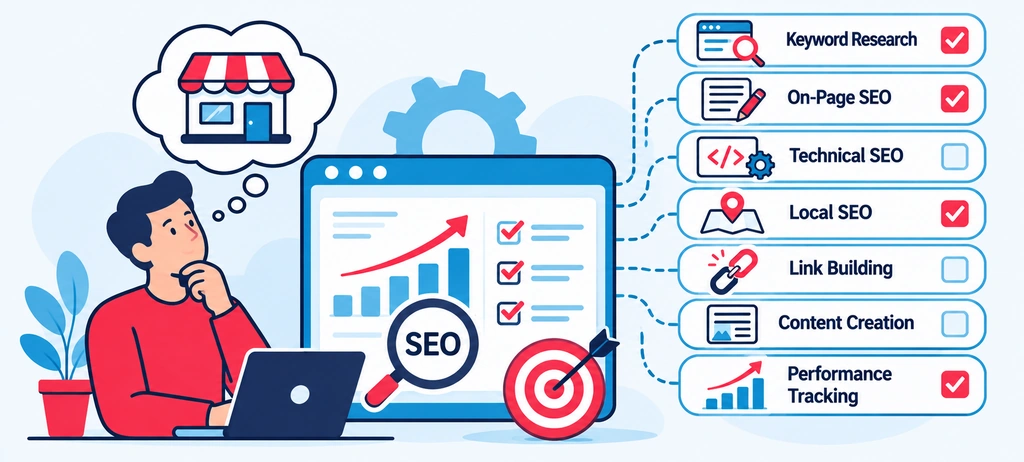
Not every small business needs the same SEO strategy. The services that matter most depend on how your business attracts customers, the products, or services you sell, your website's current condition, and the level of competition in your market.
A business that depends on customers in a specific city may need local SEO and service-page optimization. An online retailer may need product-page improvements, category optimization, and better website structure. A newly launched website may require foundational SEO work, while an established business may need to address technical issues, improve existing content, or expand its organic visibility.
Before investing in small business SEO services, identify the areas that directly support your business goals. This helps you prioritize work, understand agency recommendations, and avoid paying for activities that do not address your actual requirements.
Local and service-based businesses often depend on customers searching for a service within a particular city, region, or service area. Their SEO strategy should make it easier for potential customers to find relevant services, understand what the business offers, and contact the company when they are ready to take action.
Local SEO and service-page optimization are particularly important when customers search using service-related terms combined with geographic modifiers. However, local visibility involves more than adding a city name to every page. Businesses need accurate information, useful service descriptions, a clear website structure, and a consistent online presence.
For example, a plumbing company operating in several communities may receive inquiries for emergency repairs, water heater installation, drain cleaning, and other services. If all these services are described on one general page, visitors may struggle to find the information they need. Search engines may also have less context about the individual services offered.
A more useful approach is to create dedicated service pages where each page explains the specific service, its benefits, common customer concerns, and how to request assistance. Location pages can support genuine service areas when they provide meaningful information about the business's work in those locations. Creating numerous nearly identical city pages with only the location name changed is not a substitute for useful local content.
For businesses that qualify for a Google Business Profile, maintaining accurate business details, choosing relevant categories, updating operating hours, adding appropriate photos, and responding to customer reviews can also support local visibility and customer confidence. Google identifies relevance, distance, and prominence as the primary considerations for local rankings, so businesses should understand that local SEO cannot guarantee visibility in every location or search. Google's local ranking guidance explains these factors in more detail.
The following SEO activities are commonly relevant to local and service-based businesses:
| SEO Activity | Why It Matters |
| Local keyword research | Identifies how customers search for services in relevant areas. |
| Service-page optimization | Helps visitors understand individual services and their relevance to their needs. |
| Google Business Profile optimization | Improves the completeness and accuracy of business information. |
| Local landing pages | Supports visibility in genuine service areas when pages provide useful, distinct information. |
| Review management | Helps businesses understand customer feedback and build confidence. |
| Technical SEO | Ensures service pages can be crawled, indexed, and accessed properly. |
| Conversion optimization | Makes it easier for visitors to call, submit forms, or request estimates. |
For service businesses, SEO should support the complete customer journey—from discovering a service to evaluating the provider and submitting an inquiry. Traffic alone is not enough if visitors cannot find relevant service information or contact the business.
Ecommerce businesses have different SEO requirements because their websites contain product listings, category pages, product descriptions, filters, and often a large number of URLs. Their SEO strategy needs to help search engines understand the relationship between products and categories while making it easier for customers to discover and evaluate items.
A small online business selling specialized cycling accessories, for instance, may offer helmets, lights, repair kits, gloves, and different product variations. If product pages contain only manufacturer descriptions or category pages provide little useful information, customers may have difficulty understanding which products meet their requirements.
Product and category optimization can help address these problems. Category pages should explain the products available and help customers navigate relevant collections. Product pages should include accurate descriptions, specifications, images, availability, pricing, and information that helps buyers make informed decisions. Where appropriate, structured data can communicate product details to search engines and support eligible search features.
Ecommerce SEO also requires attention to website architecture and technical issues. Filters, sorting options, product variants, pagination, and discontinued products can create URL and indexing challenges. A large number of unnecessary or duplicate URLs may make website management more difficult and can affect how search engines discover and process important pages.
A small retailer should therefore prioritize the pages that matter most to its customers and business performance instead of attempting to optimize every URL independently.
| Ecommerce SEO Priority | What the Work Involves |
| Category-page optimization | Improve category descriptions, navigation, headings, and product discovery. |
| Product-page optimization | Provide useful product descriptions, specifications, images, and relevant information. |
| Keyword and intent research | Understand searches related to product categories, specific products, and purchase decisions. |
| Website architecture | Organize categories, subcategories, and products into a logical structure. |
| Technical SEO | Review crawlability, indexation, canonical tags, redirects, and duplicate URLs. |
| Product structured data | Add accurate product information using supported structured data where appropriate. |
| Internal linking | Connect related categories, products, and useful buying guides. |
| Content development | Create useful buying guides, comparisons, and product-related resources where they genuinely help customers. |
For an ecommerce business, the priority is not simply increasing the number of indexed product pages. It is improving the discoverability and usefulness of commercially important categories and products while maintaining a website structure that customers and search engines can understand.
Businesses evaluating professional ecommerce SEO support should look for a provider that understands product discovery, technical ecommerce requirements, and the relationship between organic traffic and product sales.
Product and category optimization, technical improvements, and structured data help shoppers discover products through organic search.
Explore Ecommerce SEO Solutions →The SEO priorities of a newly launched website can differ considerably from those of an established business. A new website generally needs a strong foundation, while an established website may require improvements based on existing search performance, technical problems, and content opportunities.
For a new business launching its website, foundational SEO work should begin before or during development. This includes planning the website structure, identifying the pages customers need, researching relevant search terms, preparing useful content, and ensuring important pages can be crawled and indexed. Technical checks should also cover redirects, canonical tags, sitemap configuration, and mobile usability where relevant.
For example, a newly launched pet grooming business may need separate pages for grooming services, pricing information, appointment requests, and its operating locations. Establishing a clear structure before publishing the website can help customers navigate the services and provide search engines with meaningful page relationships.
An established business, on the other hand, may already have valuable content, backlinks, rankings, and organic traffic. Its SEO strategy should begin by reviewing what is working before making significant changes. Removing useful pages, changing URLs without appropriate redirects, or rewriting content without understanding its existing performance can create unnecessary risks.
The appropriate priorities often differ as follows:
| SEO Area | New Website | Established Website |
| Website structure | Build a logical structure around services, products, and customer needs. | Review existing architecture and identify navigation or hierarchy problems. |
| Keyword research | Identify target searches before creating important pages. | Evaluate existing keyword visibility and identify relevant content gaps. |
| Content | Develop essential service, product, and informational pages. | Improve existing pages and develop content where meaningful opportunities exist. |
| Technical SEO | Establish crawlability, indexation, canonicalization, and sitemap foundations. | Identify technical problems, indexing issues, and changes affecting existing visibility. |
| Internal linking | Create useful connections between important pages from the beginning. | Improve internal links while preserving relevant existing relationships. |
| Search performance | Establish Search Console tracking and monitor early visibility. | Analyze historical performance, page-level trends, and changes in search visibility. |
| SEO priorities | Build a reliable foundation and develop relevant search presence. | Protect existing value while addressing weaknesses and growth opportunities. |
A new website does not automatically require every SEO service available. Likewise, an established website does not necessarily need a complete SEO overhaul. The right scope should come from a website assessment, business objectives, and evidence of actual opportunities.
For both situations, professional SEO support should explain which improvements are necessary, why they matter, and how their implementation will be evaluated. Businesses considering external support can explore W3era's USA SEO services to understand how an SEO engagement can support their website and business objectives.
Before hiring an SEO company, identify your primary business objective, the condition of your website, the audience you want to reach, and the pages that contribute most directly to your business. These factors provide a practical starting point for evaluating recommendations and deciding which SEO services deserve priority.
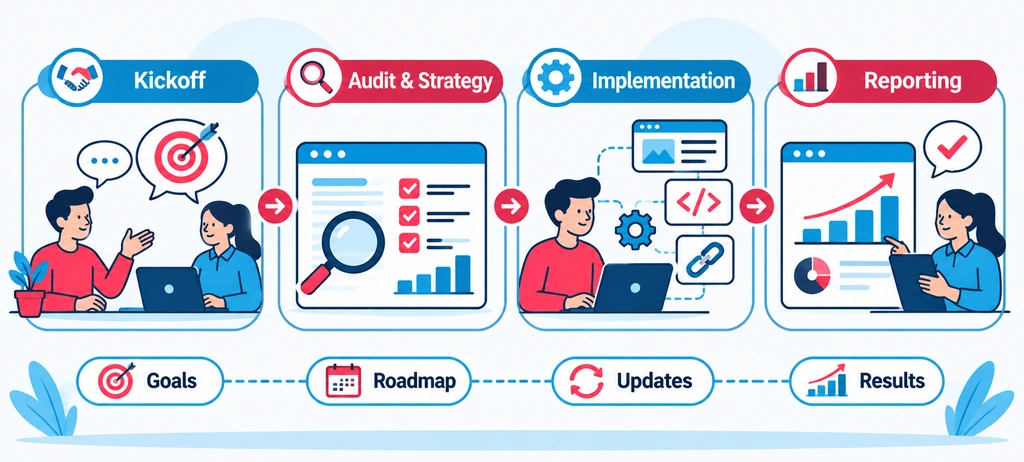
Hiring an SEO provider is not simply a decision to outsource keyword optimization or website updates. It is an ongoing working relationship in which your business, website, and search performance are evaluated to determine what should be improved and how those improvements support your objectives.
When hiring for small business SEO services, you should expect a clear process that connects research, strategy, implementation, and performance measurement. Your SEO provider should explain what work is being recommended, why it matters, who is responsible for completing it, and how its impact will be evaluated.
The scope of work will vary depending on your website, industry, competition, and business goals. However, a professional SEO engagement should generally include an initial assessment, a documented strategy, ongoing optimization, and regular communication about progress.
The initial website assessment is the foundation of an SEO campaign. Before recommending specific activities, an SEO company should understand your business, target audience, website condition, current search visibility, and competitive environment.
This process should go beyond checking a few keywords or providing a generic SEO score. The provider should review relevant website data, identify problems affecting organic search performance, and distinguish high-priority improvements from tasks that can be addressed later.
For a small business, the assessment typically considers:
For example, when a small commercial cleaning company hires an SEO provider, the initial assessment should identify which services generate the most valuable enquiries, which pages attract relevant search traffic, and whether the website clearly explains its services and operating areas. This helps the provider recommend improvements based on actual business requirements rather than simply targeting keywords with high search volume.
The findings should be converted into a practical SEO roadmap. This roadmap should explain the recommended activities, their priority, dependencies, and expected purpose. It should also identify where the business needs to provide information, approve content, or coordinate with its development team.
A useful strategy document may include:
| Strategy Deliverable | What It Should Explain |
| SEO audit findings | Important website issues and opportunities identified during the assessment. |
| Keyword and page mapping | Which relevant search terms and search intents should be addressed by existing or planned pages. |
| Content recommendations | Pages requiring improvement and topics that may need additional content. |
| Technical recommendations | Website changes needed to support crawling, indexing, and search accessibility. |
| Priority roadmap | Which activities should be completed first and why. |
| Implementation responsibilities | Tasks assigned to the SEO provider, business, content team, or developer. |
| Performance baseline | Existing visibility and conversion data used to evaluate future progress. |
The strategy should be specific enough for the business to understand what it is paying for. If recommendations involve substantial website changes, the provider should explain the potential impact, implementation requirements, and relevant precautions.
Businesses can also review W3era's SEO audit services to understand how website assessments can identify optimization opportunities and help establish a prioritized improvement plan.
Once the strategy has been agreed upon, the next stage is implementation. This is where SEO recommendations become actual improvements to the website, content, and search optimization process.
The implementation model depends on the agreement. Some SEO companies handle technical changes, content updates, and optimization directly. Others provide recommendations that the client's internal team or development partner implements. Small businesses should clarify this arrangement before signing an agreement because strategy delivery and implementation are not necessarily the same service.
Ongoing SEO work may involve:
Consider a small company that provides workplace safety training. During implementation, its SEO provider may identify a service page that needs clearer information about available training programs, eligibility, and booking options. The provider may also recommend technical improvements or supporting educational content. These tasks should be coordinated so that updates improve the website without creating duplicate pages or disrupting existing search visibility.
SEO implementation should not be treated as a fixed checklist that remains unchanged throughout the campaign. Search behavior, website performance, competitors, and business priorities can change. Ongoing optimization involves reviewing available evidence and deciding whether the existing plan needs adjustments.
A professional SEO services provider should also distinguish between completed work and its potential impact. Publishing a page or fixing a technical issue is an implementation milestone; it does not automatically mean rankings, traffic, or enquiries will improve. Search performance needs to be evaluated after changes are implemented and search engines have had an opportunity to process them.
For small businesses, a useful monthly SEO workflow might look like this:
| Activity | Purpose |
| Review campaign priorities | Confirm which tasks should be completed during the current period. |
| Implement approved changes | Make agreed technical, content, and optimization improvements. |
| Validate completed work | Check that changes were implemented correctly and important pages remain accessible. |
| Monitor search performance | Identify changes in impressions, clicks, visibility, and relevant conversions. |
| Review new opportunities | Assess whether additional optimization or content work is justified. |
| Update the roadmap | Adjust upcoming priorities based on completed work and available evidence. |
This process helps small business SEO services remain focused on meaningful improvements instead of producing activity reports without a clear connection to business goals.
Businesses that need support with planning and content execution can also explore SEO content strategy services, which cover keyword mapping, content planning, content briefs, and optimization roadmaps.
Consistent implementation and ongoing optimization help resolve website issues, improve important pages, and strengthen organic search performance.
Build an SEO Improvement Plan →SEO reporting should help business owners understand what has been done, what has changed, and what the team plans to do next. A report that only lists rankings or completed tasks does not provide enough context to evaluate the value of an SEO campaign.
When hiring an SEO company for a small business, look for reporting that connects campaign activities with search visibility and business performance. The reporting format may vary, but the information should be understandable, consistent, and relevant to the objectives established at the beginning of the engagement.
A useful SEO report generally covers the following areas:
| Reporting Area | What to Review |
| Organic search performance | Clicks, impressions, click-through rate, and average search position from Google Search Console. |
| Page-level performance | Which landing pages are gaining or losing search visibility and traffic. |
| Search query performance | Relevant queries generating impressions and clicks, including emerging opportunities. |
| Technical progress | Important issues identified, resolved, and still awaiting implementation. |
| Content progress | Pages updated, new content published, and recommendations awaiting approval. |
| Website engagement | Relevant sessions, engagement indicators, and landing-page performance in analytics. |
| Conversions | Organic leads, form submissions, calls, purchases, or other tracked business actions. |
| Next steps | Planned activities, priorities, dependencies, and decisions required from the business. |
For example, if a small business receives more organic impressions but its enquiries remain unchanged, the report should help investigate the difference. The team may need to review which queries are generating visibility, whether visitors are reaching relevant pages, and whether those pages provide a clear path to conversion. This is more useful than reporting an increase in impressions as a complete business success.
Google Search Console and Google Analytics can support different parts of this analysis. Search Console provides information about website performance in Google Search, while Analytics can help evaluate website visits and tracked user actions. These tools measure different aspects of performance, so their numbers should not be treated as interchangeable.
Reporting should also explain limitations. Average search position is not a fixed ranking for every user, impressions do not necessarily represent qualified visitors, and organic conversions may depend on factors beyond SEO. A transparent SEO service provider should discuss these distinctions rather than presenting individual metrics as proof of guaranteed business growth.
Communication is equally important. Small business owners should know who their primary contact is, how often campaign updates are provided, how urgent website issues are escalated, and how approvals are handled. Reports should allow time for questions and decisions rather than simply being delivered without explanation.
Before starting an engagement, agree on:
The goal of SEO reporting is not to make every month appear successful. It is to give your business an accurate understanding of progress, explain challenges, and support better decisions about the next stage of optimization.
Before committing to small business SEO services, make sure the provider explains the scope of work, implementation responsibilities, reporting arrangements, and how campaign priorities will be determined. These details make it easier to compare SEO companies, evaluate the quality of their recommendations, and establish realistic expectations.
The next important consideration is cost. Once you understand what an SEO engagement involves, you can evaluate pricing models, monthly packages, and the factors that influence the cost of SEO services for small businesses.

The cost of SEO services for small businesses depends on what your website needs, how competitive your market is, and how much work your SEO provider is responsible for completing. A business looking for local visibility in one service area may require a different investment from a company competing nationally or an ecommerce store with hundreds of product pages.
This is why two SEO companies can quote very different prices for what appears to be the same service. One proposal may cover keyword research, reporting, and recommendations, while another includes content production, technical implementation, and ongoing optimization. Comparing the monthly fee without comparing the scope can lead to an inaccurate assessment of value.
For small business owners in the USA, published industry pricing surveys provide a useful starting point. SE Ranking's agency pricing survey identified monthly retainers, hourly consulting, and project-based pricing as common models, with 1,000 per month among the most frequently reported retainer ranges. Clutch's pricing guide also shows substantial variation in agency fees depending on service scope, experience, and market. These figures describe provider pricing patterns, not a guaranteed price for every small business.
The more useful question is not simply how much SEO costs, but what your business needs to invest to receive the work required to improve its search visibility and support its growth objectives.
Small business SEO pricing is influenced by several factors. Understanding these differences helps you evaluate proposals, identify unnecessary services, and determine whether a quoted fee matches the work involved.
1. Website size and technical complexity
A small website with a limited number of service pages may require less review and optimization than a large ecommerce website with thousands of URLs, product variations, filters, and technical dependencies.
The cost can also increase when the website has existing problems that require significant investigation or coordination with developers. A website migration, complex indexation issue, or extensive technical cleanup may require specialized work beyond routine monthly optimization.
2. Keyword competition and target market
SEO pricing also depends on the difficulty of competing for relevant search terms. A business targeting a narrow local market may face different competitive conditions from a company targeting customers across the United States.
The number of target keywords alone does not determine the cost. Search intent, competing websites, the quality of existing pages, and the amount of work needed to establish relevant visibility all influence the strategy.
For example, a company targeting a specialized service across several states may need a more extensive content and optimization plan than a business serving one local market. The difference comes from the scope and competitive requirements, not simply the geographic size of the target.
3. Content development and optimization requirements
Content is another major cost driver. Some businesses already have useful pages that need targeted improvements. Others require new service pages, supporting articles, product content, or substantial editorial revisions.
Content costs may include keyword research, subject-matter research, writing, editing, fact-checking, optimization, and publishing. If the business expects its SEO provider to manage the complete content process, the proposal should explain what content production is included and how quality is reviewed.
4. Implementation responsibilities
A proposal that includes recommendations only may cost less than one that includes implementation. Technical changes, website development, content publishing, and conversion improvements require additional time and expertise.
Small business owners should check whether the SEO provider will implement approved changes or whether the business must arrange a separate developer, writer, or internal team. This distinction can materially affect the total cost of SEO services.
5. Business model and campaign objectives
A local service business, ecommerce company, and national B2B organization have different SEO requirements. Their priorities may include local search visibility, product discovery, commercial landing pages, lead generation, or content supporting longer buying cycles.
The campaign should be priced according to the work required to support those objectives. A package built around a generic number of keywords or blog posts may not address the business's actual needs.
6. Provider expertise and team involvement
SEO companies, independent consultants, and freelancers differ in their expertise, service structure, and available resources. A specialist consultant may focus on strategy and technical guidance, while an agency may provide coordinated support across SEO, content, development, and reporting.
Higher fees do not automatically mean better results. However, experience in relevant markets, the quality of recommendations, implementation capability, and accountability should be considered when comparing providers.
| Pricing Factor | What to Check in an SEO Proposal |
| Website complexity | How many pages, templates, and technical issues require attention? |
| Competition | What research supports the recommended scope? |
| Content | Is writing, editing, publishing, or content updating included? |
| Implementation | Who makes technical and website changes? |
| Reporting | Which performance data and business metrics are included? |
| Expertise | Who will perform the work, and what experience is relevant? |
| Additional costs | Are development, content, tools, or other services billed separately? |
A useful way to evaluate the cost is to connect the proposed activities with their purpose. If an SEO company recommends a large monthly content commitment, it should explain the search opportunities those pages address and how they fit the website's overall strategy.
SEO providers generally use monthly retainers, fixed-price projects, or hourly consulting. Each model serves a different purpose, and the right choice depends on whether your business needs continuous optimization, a defined deliverable, or specialized advice.
Monthly SEO Packages and Retainers
A monthly retainer is suitable when a business needs ongoing SEO work rather than a single deliverable. This model commonly supports continuous optimization, content planning, technical monitoring, performance reviews, and implementation across an agreed scope.
Monthly SEO packages for small businesses may be structured around a defined set of activities, while customized retainers are built around the website's requirements and priorities. The important distinction is whether the package provides sufficient work to address the business's actual SEO needs.
Before selecting a monthly plan, confirm:
A monthly package should not be evaluated solely by the number of keywords, backlinks, or articles promised. The quality, relevance, and implementation of the work matter more than the quantity of deliverables.
Project-Based SEO Services
Project-based SEO is appropriate when the business has a specific requirement with a defined beginning and end.
Common examples include:
For example, a small business preparing to redesign its website may commission a project to review its existing URLs, identify pages that need to be retained, and prepare a redirect plan before development begins. This is a clearly defined requirement that does not necessarily need a long-term retainer.
The proposal should specify the deliverables, review process, implementation responsibilities, and completion criteria. If the project identifies additional work, the provider should explain what falls outside the original scope before charging for it.
Hourly SEO Consulting
Hourly consulting is useful when a business needs expert advice without outsourcing its entire SEO operation.
This model can work well for companies with an internal marketing team, an experienced developer, or an existing content team that can implement recommendations. The consultant may provide strategy reviews, technical guidance, training, troubleshooting, or a second opinion on an agency proposal.
Hourly consulting is also useful when a business wants to understand its SEO priorities before committing to an ongoing engagement. However, the company should agree on the consultant's responsibilities, expected time, and the specific output of the engagement.
| Pricing Model | Best Fit | What to Confirm |
| Monthly retainer | Continuous optimization and ongoing SEO support. | Monthly scope, deliverables, implementation, reporting, and contract terms. |
| Fixed-price project | A defined audit, migration, roadmap, or technical task. | Deliverables, completion criteria, exclusions, and additional work costs. |
| Hourly consulting | Expert advice, reviews, training, or targeted problem-solving. | Hourly rate, estimated time, scope, and documentation. |
The best SEO pricing model is the one that matches your requirements and provides a clear understanding of the work being purchased. Businesses should compare proposals on scope and accountability before comparing the final price.
Compare SEO deliverables, implementation requirements, and campaign priorities to identify an investment that fits the business budget.
Compare Small Business SEO Packages →Affordable SEO services can be a practical starting point for small businesses with limited budgets. However, affordable should mean a focused scope of work—not an unclear package that promises extensive results without explaining how the work will be delivered.
A lower-cost SEO package may be appropriate when the website is relatively simple, competition is manageable, and the business has internal resources to support implementation. It may also work when the company needs help with a limited set of priorities rather than a complete SEO program.
The limitations become important when a business expects a small monthly fee to cover technical SEO, content production, link acquisition, development, reporting, and extensive optimization across a large website. These activities require time and expertise, and a provider may not be able to deliver meaningful depth across every area within a very limited budget.
For example, a small professional services firm may initially choose a focused engagement covering an audit, a few important landing pages, and a clear optimization roadmap. If its internal team can publish content and implement website changes, the business may not need to purchase every service from the SEO provider. The arrangement can remain affordable while still addressing important priorities.
When comparing affordable SEO services for small businesses, evaluate the following:
| Evaluation Point | What a Responsible Provider Should Explain |
| Scope | Which services are included and which are excluded? |
| Deliverables | What work will actually be completed during the engagement? |
| Implementation | Who is responsible for publishing content and making website changes? |
| Content quality | How are research, accuracy, originality, and editorial quality maintained? |
| Link acquisition | How are relevant links earned, and what practices are avoided? |
| Reporting | How will progress, completed work, and challenges be communicated? |
| Contract terms | What is the commitment period, renewal process, and cancellation policy? |
| Expectations | What can reasonably be measured, and what outcomes cannot be guaranteed? |
Be cautious of packages that advertise thousands of backlinks, guaranteed first-page rankings, or large quantities of content at unusually low prices without explaining quality controls. Google warns that manipulative SEO practices can damage a website's visibility and reputation. Its guidance on hiring an SEO specifically recommends researching providers and understanding the risks of irresponsible optimization.
An affordable engagement should still provide transparency, useful work, and a realistic strategy. If a provider cannot explain how its activities support your business objectives, the low price may not represent good value.

Choosing an SEO provider requires more than comparing monthly packages or reviewing a list of ranking results. The right partner should understand your business model, identify opportunities that matter to your customers, and explain how SEO activities connect to measurable business outcomes.
For small businesses, this decision becomes particularly important when resources are limited. An SEO company may influence which pages are created, how existing content is changed, how your website is structured, and where your marketing budget is allocated. A provider that focuses only on traffic growth without considering lead quality or customer acquisition can create activity without meaningful business results.
Before hiring, evaluate the provider's expertise, working process, communication, and willingness to explain its recommendations. These factors can help you distinguish a capable SEO partner from a company selling standardized deliverables.
An SEO company and an independent SEO consultant can both provide effective support. The difference usually comes down to the range of expertise required, the amount of implementation work involved, and how much coordination your business can manage internally.
An SEO consultant for small businesses may be a suitable choice when you already have a marketing or development team and need strategic direction, technical recommendations, keyword research, or guidance on improving existing content. Consultants can also be useful when you need an independent assessment before committing to a larger SEO campaign.
An SEO company for small business USA may be a better fit when your website requires several types of work, such as technical SEO, content development, local search optimization, website improvements, and ongoing performance analysis. An agency can coordinate different specialists, although its actual capabilities depend on the people assigned to your account, not simply the size of its team.
For example, a regional equipment distributor planning to expand its product catalog across multiple states may need technical support, product and category page optimization, content development, and ongoing search performance analysis. A consultant could develop the strategy, but an agency with the right implementation capabilities may be better equipped to manage the work across departments.
| Consideration | SEO Consultant | SEO Company |
| Best suited for | Strategy, audits, focused SEO support | Broader campaigns and ongoing execution |
| Team structure | Usually one primary specialist | Multiple specialists or a coordinated team |
| Communication | Often direct access to the consultant | Usually through an account manager or project lead |
| Implementation | May provide recommendations or hands-on work | May coordinate SEO, content, and technical execution |
| Flexibility | Often suitable for defined or advisory engagements | Can support larger or continuing workloads |
| What to verify | Individual experience and available capacity | Actual team assigned and specialist expertise |
Neither option is automatically better. A consultant with relevant experience and strong implementation skills may outperform an agency with a generic process. Likewise, a capable SEO company may provide more consistent execution when the campaign requires several disciplines.
The practical decision is to match the provider's capabilities to your workload. If your team can implement recommendations, consulting may be enough. If your business needs a partner to coordinate strategy and execution, a broader SEO service may be more appropriate.
The best SEO company for a small business is not necessarily the one with the largest portfolio, the lowest price, or the most aggressive sales pitch. Look for evidence that the provider can understand your business, make informed decisions, explain its work, and adapt its strategy as your website develops.
1. Relevant industry and market experience
An SEO provider should understand how customers in your industry search, compare options, and make purchasing decisions. Experience in your exact niche can be useful, but transferable experience matters too when the provider understands similar business models, customer journeys, or competitive markets.
If your target audience is in the United States, ask whether the provider has experience researching US search results, regional competitors, customer terminology, and the search behavior relevant to your target market. A campaign targeting customers in Texas may require a different geographic and competitive approach from one targeting the entire country.
2. A strategy built around your website, not a fixed checklist
A reliable SEO provider should evaluate your existing website before recommending a campaign. The strategy should reflect your current organic visibility, technical condition, content quality, competition, business objectives, and available resources.
Two businesses in the same industry may require very different priorities. One may need to improve existing pages that already attract relevant search impressions, while another may need to establish its core service pages and resolve indexing problems first.
Ask the provider to explain why particular activities are being prioritized. A recommendation should connect an identified opportunity or problem to a proposed action, rather than simply appearing in a standard monthly SEO checklist.
3. Clear deliverables and implementation responsibilities
SEO recommendations only create value when they are implemented correctly. Before hiring, establish whether the provider will make website changes, prepare content for publication, coordinate with your developers, or deliver recommendations for your internal team.
A useful proposal should identify:
This is particularly important for small businesses without dedicated SEO or development teams. A technically detailed audit may look valuable, but it will not improve the website if nobody is responsible for implementing its findings.
4. Transparent reporting and meaningful performance measurement
A good SEO provider should explain performance using data that you can access and understand. Google Search Console and Google Analytics can help evaluate search visibility, organic traffic, user activity, and conversions when configured appropriately.
Look for reporting that distinguishes between search impressions, clicks, relevant landing pages, qualified enquiries, and business outcomes. Ranking positions can provide useful context, but they should not be the only measure of campaign performance.
Ask how the provider establishes a baseline, compares performance over time, and investigates unexpected changes. Reports should explain what happened, why it may have happened, and what the team intends to do next, not simply display charts and traffic totals.
5. A transparent approach to SEO recommendations
The provider should be able to explain its recommendations in language your business can understand. This includes the purpose of content changes, technical improvements, internal linking, and any proposed link-building activity.
Google recommends evaluating SEO advice against its official guidance and being cautious about claims that third-party tools or services are approved by Google. Tools can provide useful data, but their scores and recommendations are not equivalent to Google's internal ranking information.
6. Client references and verifiable work
Case studies can help you assess whether an SEO company has handled campaigns similar to yours. However, a screenshot showing increased traffic is not enough to establish the quality of the work.
Ask what the business objective was, what changes were made, how long the campaign ran, and whether the results included relevant leads or sales. Where possible, request a reference from a client who can describe the provider's communication, reliability, and implementation process.
A useful evaluation checklist is:
| Evaluation area | What a credible provider should demonstrate |
| Business understanding | Questions about customers, services, margins, competition, and growth priorities |
| SEO strategy | Clear priorities supported by website analysis and search data |
| Technical expertise | Ability to identify and explain relevant technical issues |
| Content quality | Research-driven content planning and meaningful page improvements |
| Implementation | Defined responsibilities, timelines, and approval processes |
| Reporting | Accessible data, clear explanations, and business-relevant metrics |
| Communication | Consistent updates, documented decisions, and realistic expectations |
| Accountability | Transparency about work completed, limitations, and next steps |
If you are comparing SEO companies for a small business, use these criteria to evaluate the actual team and proposed work, not just the agency's website or sales presentation.
A sales meeting is an opportunity to understand how an SEO company thinks, not just what it promises to deliver. Ask the same core questions to each shortlisted provider so you can compare their answers consistently.
| Question | What a strong answer should include |
| How would you approach our website during the first 90 days? | A preliminary assessment, priorities, dependencies, and a realistic sequence of work |
| What experience do you have with businesses similar to ours? | Relevant examples, specific responsibilities, and context behind reported results |
| Which SEO opportunities would you prioritize for our business? | Recommendations connected to search data, website condition, customer intent, and business objectives |
| Who will actually work on our account? | Named roles, relevant expertise, and a clear primary contact |
| What work is included in the monthly package? | Specific deliverables, implementation responsibilities, and exclusions |
| How will you measure campaign performance? | Baselines, relevant SEO metrics, conversion measurement, and reporting frequency |
| How do you approach link building? | A clear explanation of methods, relevance, quality, and how links are acquired |
| How will you communicate website changes? | Documented recommendations, approvals, and a record of completed changes |
| What happens if results are slower than expected? | A process for reviewing evidence, adjusting priorities, and explaining limitations |
| What happens if we end the agreement? | Clear cancellation terms, access retention, and a practical handover process |
Pay attention to whether the provider asks questions about your business in return. A serious SEO discussion should include your products or services, customer acquisition process, competitive position, website limitations, and the types of inquiries that are valuable to you.
For instance, if a specialty food manufacturer wants to attract wholesale buyers rather than individual consumers, the SEO strategy should account for that distinction. A provider focused exclusively on increasing general website traffic may prioritize searches that generate visitors but have little commercial relevance. The discussion should instead consider how search intent, product information, and business-focused landing pages can support wholesale inquiries.
A practical way to compare proposals is to score each provider on business understanding, strategy quality, execution capability, transparency, communication, and commercial fit. A company that explains its reasoning clearly and identifies realistic limitations may be a stronger choice than one offering an impressive list of deliverables without explaining their relevance.
Understand website priorities, campaign requirements, and expected deliverables before selecting an SEO provider.
Discuss SEO Priorities With an Expert →Not every SEO proposal that sounds attractive is necessarily reliable. Some warning signs become apparent during the sales process, while others emerge after work begins. Recognizing them early can help protect your website, marketing budget, and long-term search visibility.
1. Guaranteed rankings or guaranteed organic traffic
No SEO company can legitimately guarantee a specific Google ranking. Search results depend on many factors outside a provider's direct control, and rankings can change as competition, search systems, and user behavior evolve.
Be cautious of claims such as guaranteed first-page rankings, guaranteed top-three positions, or a fixed number of organic visitors within a short period. A credible provider can establish targets, explain its approach, and report progress without presenting uncertain outcomes as guaranteed results.
2. Claims of a special relationship with Google
An SEO company should not claim privileged access to Google's ranking systems, guaranteed indexing, or a special arrangement that allows it to control organic search positions. Google explicitly warns website owners against providers making these claims.
3. Unclear link-building methods
Avoid providers that sell large quantities of backlinks without explaining where the links come from, why they are relevant, or how they are acquired. Paid link schemes, manipulative link exchanges, and other practices intended to influence rankings can create search-policy risks.
Ask for transparency around link acquisition methods rather than accepting a monthly backlink count as proof of quality.
4. Generic content produced at scale without meaningful review
A proposal centered on publishing large numbers of pages with minimal research, limited originality, or repeated location-based variations deserves scrutiny. Content should serve a distinct audience need and provide useful information, not exist primarily to capture keyword variations.
For example, publishing dozens of nearly identical service pages for neighboring cities without meaningful differences in services, coverage, or customer information may create a poor experience rather than a useful search destination.
5. No access to your own website data or marketing accounts
Your business should retain control of its website, domain, Google Search Console, Google Analytics, and other important marketing accounts. An SEO provider may require access to perform its work, but that access should be granted through appropriate permissions and remain under your organization's ownership.
Google recommends granting read-only Search Console access during an initial SEO audit rather than immediately providing write access. Access can be expanded later when responsibilities and trust are established.
6. Secretive processes or refusal to explain changes
An SEO company may have its own workflow, but it should still explain the work being performed and why it is necessary. Statements such as "our proprietary method cannot be explained" should not prevent you from understanding significant website changes, content decisions, or link-building practices.
7. Unusually low pricing paired with extensive promises
Affordable SEO services for small businesses can be legitimate when the scope is focused and clearly defined. The warning sign is a low fee combined with promises of extensive content production, technical implementation, high-volume link building, and guaranteed results.
Compare the actual work included rather than the package name. A focused campaign that addresses a few important website issues may provide more practical value than a broad package filled with low-impact activities.
8. Long contracts without clear deliverables or exit terms
A contract should explain the service scope, payment terms, minimum commitment, cancellation process, and responsibilities for website access and completed work. Be cautious if a provider requires a lengthy commitment but cannot clearly explain what will be delivered or how progress will be evaluated.
The right SEO partner should be able to explain what it recommends, why the work matters, how success will be evaluated, and what limitations remain. That level of clarity is more useful than a promise of fast rankings or a package filled with activities.
The strongest hiring decision is one based on a clear strategy, realistic expectations, transparent execution, and an understanding of how organic search can contribute to your business, not simply on the number of keywords an agency promises to rank.

One of the first questions small business owners ask before investing in SEO is how long it will take to see results. The answer depends on the website's current condition, competition, the scope of optimization, and how consistently recommended changes are implemented.
SEO is different from paid advertising. Paid campaigns can generate visibility as soon as ads become eligible to run, while organic search visibility develops as search engines discover, process, and evaluate website content. Some improvements may produce early movement, but sustainable growth generally requires continued optimization rather than a single round of website changes.
For planning purposes, many SEO campaigns use a three-to-six-month window to evaluate early measurable progress. This is a planning benchmark, not a guaranteed timeline. Highly competitive markets, new websites, major technical problems, and limited implementation resources can extend the time required to achieve meaningful results.
Understanding what happens during the first six months helps businesses evaluate progress more accurately and avoid making decisions based on short-term ranking fluctuations.
The first six months of small business SEO services should be viewed as a period of building, implementing, evaluating, and improving a search strategy. The exact activities and results will vary, but a structured campaign should have clear priorities and measurable progress throughout this period.
The following timeline provides a practical framework for understanding how SEO work may develop.
| Period | Main SEO Activities | What Businesses Should Monitor |
| Month 1: Research and assessment | Website audit, keyword research, competitor analysis, baseline reporting, and campaign planning | Existing search visibility, indexing issues, website limitations, and priority opportunities |
| Months 2–3: Implementation | Technical fixes, on-page optimization, content improvements, internal linking, and priority page updates | Completed recommendations, indexing of updated pages, impressions, and early search visibility changes |
| Months 3–4: Initial evaluation | Review implemented changes, analyze search queries, improve page relevance, and identify additional opportunities | Search impressions, query coverage, ranking movement, click-through rates, and landing page performance |
| Months 4–6: Optimization and growth | Refine content, expand relevant keyword coverage, improve conversion paths, and address remaining technical or content gaps | Organic clicks, qualified traffic, leads, conversion trends, and performance of priority pages |
What if your small business does not see significant results in six months?
The absence of substantial traffic growth does not automatically mean SEO has failed. It does mean the campaign should be evaluated against its baseline, completed work, search visibility trends, and business objectives.
Review whether:
If the campaign has produced little evidence of improvement, the next step should be a documented reassessment of strategy and execution, not an automatic increase in content volume or backlink activity.
The time required for SEO to produce measurable results varies considerably between businesses. Two websites targeting similar keywords may experience different outcomes because their technical condition, content, competition, and implementation resources are not the same.
Understanding these factors helps small businesses evaluate SEO timelines more realistically and identify which issues may be slowing progress.
1. Website age, history, and existing search visibility
A website with established search visibility, useful content, and relevant links may have opportunities to improve existing pages relatively quickly. A newly launched website usually needs more foundational work before it can build meaningful organic visibility.
However, website age alone does not determine SEO performance. An older website with poor content, technical problems, or an unclear structure may require substantial improvements despite having been online for years.
2. Keyword competition and search intent
The competitiveness of target keywords has a significant influence on how difficult it may be to achieve visibility. Broad commercial searches often attract established businesses with extensive content, strong websites, and substantial marketing resources.
A small business targeting a highly competitive national keyword may need a longer campaign than one focusing on specific services, customer needs, or geographic markets with less competition.
Keyword selection should therefore consider more than search volume. Relevance, competition, customer intent, and the business value of a search are equally important when deciding which opportunities to prioritize.
3. Technical condition of the website
Technical SEO issues can delay progress when important pages cannot be crawled, indexed, or understood properly. Problems involving site architecture, canonicalization, redirects, mobile usability, or page performance may need to be addressed before content improvements can achieve their intended impact.
The scale of the issue matters. Fixing a few incorrect internal links is different from resolving widespread indexing problems across hundreds of pages.
A focused SEO audit can help identify technical and structural issues that need attention before a business invests further in content or broader optimization.
4. Content quality and topical relevance
Websites with limited useful content may need to build a stronger foundation before they can compete for meaningful search visibility. This does not mean publishing as many articles as possible.
The priority is to develop pages that answer relevant customer questions, explain products or services clearly, and provide information that helps visitors make decisions.
For example, a commercial refrigeration supplier may need detailed product category pages, equipment specifications, installation information, and maintenance guidance. A collection of generic blog posts would not necessarily address the search needs of buyers looking for equipment or technical information.
Content development should follow a clear strategy that connects search intent with the website's commercial and informational pages. A structured SEO content strategy can help prioritize those pages and reduce the risk of creating overlapping content that competes for the same searches.
5. Implementation speed and available resources
SEO recommendations do not influence search performance until the relevant changes are implemented and processed. Delays in development, content approvals, website access, or publishing can extend the campaign timeline even when the strategy is sound.
Small businesses should understand who is responsible for implementation and how quickly work can move from recommendation to publication. An SEO provider working with an internal development team may need to account for release schedules, testing, and approval requirements.
A realistic timeline should reflect the business's actual capacity to complete the work, not simply the number of tasks an agency plans to deliver.
6. Website authority and relevant external signals
A website's ability to compete can also be influenced by its reputation, relevant external references, and the quality of its broader online presence. Established competitors may have earned relevant links, industry recognition, and references that support their visibility.
Building these signals takes time and should focus on legitimate methods, such as useful resources, industry relationships, original research, and genuinely relevant business references. Artificially increasing backlink counts does not provide a reliable shortcut to sustainable SEO results.
7. Geographic targeting and business model
Local SEO and national SEO can involve different competitive conditions. A business serving a defined area may compete primarily with nearby providers, while a company targeting customers across the United States may face a much broader competitive landscape.
A local business can sometimes make progress on specific geographic searches sooner than on broad national terms. However, local results also depend on factors such as relevance, distance, and prominence, which are not entirely controlled by an SEO provider.
For businesses targeting multiple US markets, the campaign may need to develop location-specific relevance, service coverage information, and appropriate landing pages without creating repetitive or misleading content.
8. Consistency of optimization and campaign direction
SEO is not a one-time activity. Search behavior changes, competitors update their websites, and new opportunities emerge as a business develops.
A campaign that consistently reviews performance and improves important pages can respond to these changes more effectively than one that publishes content or builds links without evaluating results.
The objective is not to maintain a fixed number of SEO tasks every month. It is to keep improving the website based on evidence, business priorities, and the needs of its audience.
When evaluating SEO services for small businesses, ask the provider to establish a baseline, define the first implementation priorities, and identify the indicators that will be used to evaluate progress over time.
For a small business, the most useful question is therefore not simply "How many months until SEO works?" It is whether the campaign is improving the website's ability to attract relevant searchers, helping those visitors find the information they need, and creating measurable opportunities for the business.
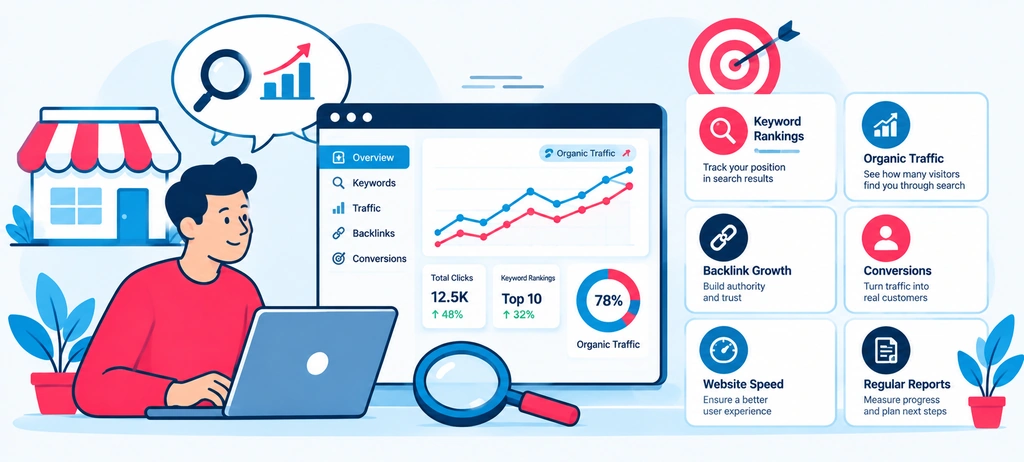
Investing in SEO becomes easier to evaluate when you can connect search visibility with the actions customers take on your website. For small businesses, the objective is not simply to increase organic traffic. It is to attract people who are relevant to the business, help them find the information they need, and create opportunities for inquiries, purchases, or other meaningful outcomes.
A website can receive more organic visitors without generating additional customers. Similarly, a service page may attract fewer visitors than a blog article but contribute more qualified inquiries. This is why SEO performance should be measured across search visibility, website engagement, and business results rather than relying on a single ranking or traffic metric.
A practical SEO measurement framework combines Google Search Console, Google Analytics, conversion tracking, and business records. Together, these sources help small businesses understand which pages attract searchers, which visitors take meaningful actions, and where further optimization may improve performance.
The most useful SEO metrics depend on your business objectives and the stage of your campaign. During the initial months, search visibility and indexing data may help evaluate whether optimization is progressing. As organic traffic develops, landing page performance, engagement, and conversions become increasingly important.
The following metrics provide a practical starting point for evaluating small business SEO results:
| SEO Metric | What It Measures | Why It Matters |
| Organic impressions | How often your website appears in Google Search results | Helps identify growing search visibility and opportunities to improve existing pages |
| Organic clicks | Clicks from Google Search results to your website | Shows whether search visibility is generating visits |
| Click-through rate (CTR) | Clicks divided by impressions | Helps evaluate how frequently search impressions result in clicks |
| Average search position | Average position of your site's top result across reported searches | Provides context for visibility trends, but should not be treated as an exact ranking for every query |
| Organic sessions | Website sessions attributed to organic search | Measures visits from organic search within your analytics reporting |
| Landing page performance | How visitors interact with pages where they enter your website | Helps identify which SEO landing pages attract relevant visitors and support business goals |
| Engagement rate | Percentage of sessions classified as engaged in GA4 | Provides context about visitor interaction, not a direct measure of SEO success |
| Key events and conversions | Important actions completed by website visitors | Helps evaluate whether organic traffic contributes to enquiries, purchases, and other business outcomes |
| Qualified leads | Enquiries that meet your business's qualification criteria | Connects SEO activity to potential customers rather than simply counting form submissions |
| Revenue from organic search | Revenue attributed to organic search using available tracking and attribution | Helps ecommerce businesses and businesses with reliable revenue tracking assess commercial contribution |
Metrics should be interpreted according to business context
Not every business needs the same SEO dashboard. A local service provider may prioritize calls and qualified inquiries, while an ecommerce business may focus on organic product discovery, purchases, and revenue.
A useful reporting framework should therefore distinguish between SEO activity, search performance, and commercial outcomes.
| Business Type | Useful SEO Performance Indicators |
| Local service business | Relevant organic visits, service-page visibility, calls, enquiry forms, qualified leads |
| B2B company | Commercial search visibility, service-page engagement, consultation requests, qualified opportunities |
| Ecommerce business | Product and category visibility, organic sessions, purchases, conversion rate, revenue |
| Content-led business | Relevant search traffic, content engagement, returning visitors, newsletter signups, or other defined actions |
The objective is to measure whether SEO is supporting the business model—not to maximize every available metric.
Search visibility and traffic show whether SEO is helping people discover your website. To evaluate its business contribution, you also need to measure what visitors do after arriving.
For small businesses, this often means tracking inquiry forms, phone calls, consultation requests, purchases, bookings, or other actions that indicate genuine customer interest.
1. Define which actions count as conversions
Start by identifying the actions that matter to your business. Not every website interaction should be treated as a conversion.
For a service business, meaningful actions might include:
For an ecommerce business, the primary conversion may be a completed purchase, supported by additional indicators such as product views, add-to-cart activity, and checkout progress.
A newsletter signup or brochure download may also be useful, but it should be reported separately from a qualified sales enquiry. Treating every interaction as an equally valuable conversion can make SEO performance appear stronger than its actual business contribution.
2. Configure conversion tracking in Google Analytics
Google Analytics 4 allows businesses to measure website events and designate important events as key events. This makes it possible to evaluate actions that occur after visitors arrive through organic search.
The tracking setup should reflect the actual website experience. A form submission should ideally be recorded after a successful submission rather than when someone simply opens the form or clicks its button.
For a business that receives quote requests, the tracking process might include:
Tracking quality matters. Duplicate events, incomplete tagging, or incorrectly configured conversion actions can distort reports and lead to poor marketing decisions.
3. Connect organic landing pages with lead quality
A conversion report becomes more useful when you can identify which organic landing pages contributed to inquiries.
For example, a commercial laboratory equipment supplier may find that its organic visitors frequently enter through technical product pages and submit requests for specifications or quotations. Those pages may have a stronger commercial contribution than articles attracting a larger number of general research visitors.
The analysis should consider more than total form submissions. Review the source landing page, the type of enquiry, the customer's requirements, and whether the enquiry progresses into a sales opportunity.
This helps identify which pages attract the right audience and where additional content or conversion improvements may be justified.
4. Measure qualified leads instead of counting every inquiry equally
An inquiry is not automatically a qualified lead. Some submissions may be unrelated, incomplete, outside the business's service area, or from customers who do not match the company's target market.
Small businesses can improve SEO reporting by connecting website inquiries with their CRM or sales records.
A basic lead-quality framework might include:
| Measurement | What to Record |
| Total inquiries | All inquiries received through tracked website actions |
| Qualified leads | Enquiries meeting defined customer or business criteria |
| Sales opportunities | Qualified leads that progress into active sales discussions |
| Closed customers | Leads that eventually become paying customers |
| Lead source | Organic search, paid search, referral, direct, or another identified channel |
| Landing page | The page associated with the tracked inquiry, where available |
This approach helps distinguish organic traffic that generates meaningful commercial opportunities from traffic that produces little business value.
5. Evaluate revenue and SEO's commercial contribution
Ecommerce businesses can often measure organic revenue more directly through transaction tracking. Service businesses may need to connect website inquiries with CRM records, sales outcomes, and customer revenue.
For example, if a business receives organic inquiries that eventually become contracts, the final revenue may occur weeks or months after the original website visit. The SEO report should therefore account for the sales cycle rather than evaluating every inquiry only within the month it was generated.
Attribution also requires care. A customer may discover a company through organic search, return through direct traffic, and later convert after interacting with another marketing channel. Analytics attribution models distribute credit differently across these interactions, so organic search should not automatically be treated as the sole source of every conversion it influenced.
Google Analytics provides attribution settings that determine how credit is assigned to channels and interactions before a key event occurs. Understanding those settings is important when reporting organic search conversions or comparing SEO with other marketing channels.
For a practical SEO measurement setup, businesses should use a consistent reporting period, maintain reliable conversion tracking, and document how leads and revenue are attributed.
6. Build a small business SEO reporting dashboard
A useful SEO dashboard should make performance understandable without requiring the business owner to interpret dozens of unrelated metrics.
A monthly reporting framework could include:
| Reporting Area | Recommended Information |
| Search visibility | Impressions, clicks, CTR, average position, relevant query trends |
| Organic traffic | Organic sessions, landing pages, engagement trends |
| SEO implementation | Important technical fixes, content updates, completed priorities |
| Lead generation | Enquiries, qualified leads, conversion rate |
| Sales outcomes | Opportunities, customers, and revenue where reliably attributable |
| Next steps | Opportunities identified, issues requiring attention, upcoming priorities |
The reporting period should be compared with an appropriate baseline. Depending on the business, month-over-month comparisons can help identify recent changes, while year-over-year comparisons may provide better context for seasonal demand.
Avoid drawing conclusions from very small datasets. A few inquiries in one month can produce large percentage changes, even when the underlying business performance has not materially changed.
7. Use SEO data to make better decisions
The purpose of SEO reporting is to improve the campaign, not simply to document what happened.
If a service page gains relevant impressions but receives few clicks, investigate its search-result presentation and query relevance. If organic traffic increases but qualified inquiries remain unchanged, review the landing page's commercial relevance, information quality, and conversion process. If enquiries improve despite modest traffic growth, examine which pages and searches are contributing to those results.
These findings can guide the next round of keyword prioritization, content updates, internal linking, and technical improvements.
For businesses evaluating professional SEO services, the reporting process should make these decisions visible. A provider should explain which activities contributed to observed changes, what remains uncertain, and which improvements are supported by the available data.
The most useful SEO results are not always the largest increases in traffic. They are improvements that help the business attract relevant customers, strengthen important landing pages, generate qualified inquiries, or increase revenue through organic search.
Track qualified enquiries, conversions, and revenue alongside organic traffic to understand SEO's contribution to business growth.
Measure SEO Performance More Effectively →Investing in the right SEO services for small businesses means choosing a strategy that aligns with your customers, business goals, and long-term growth. Prioritize meaningful search visibility, useful content, and measurable results over quick ranking promises. With the right approach and consistent optimization, SEO can become a sustainable source of qualified leads and business opportunities.
SEO success can be measured through organic clicks, relevant search impressions, landing page performance, qualified leads, conversions, and revenue where tracking is available. Google Search Console helps evaluate search visibility, while Google Analytics measures website activity and configured key events. Businesses should connect these metrics with their actual sales and lead-generation objectives.
SEO services for small businesses in the USA commonly range from several hundred dollars to several thousand dollars per month, depending on the campaign's scope and competition. Pricing is influenced by website size, technical requirements, content development, implementation, and ongoing optimization. Businesses should compare deliverables and responsibilities instead of choosing a provider based only on the lowest monthly fee.
No legitimate SEO company can guarantee a specific Google ranking or position. Search results depend on Google's systems, competition, search context, and other factors outside an SEO provider's control. A reliable provider should focus on improving website quality, search visibility, and measurable business performance rather than promising guaranteed rankings.
Yes, SEO services can be valuable for small businesses that want to attract customers through organic search. They can improve search visibility, help potential customers discover relevant products or services, and generate qualified inquiries over time. The value depends on targeting relevant searches, implementing effective optimization, and measuring business outcomes rather than traffic alone.
SEO may show early improvements within weeks, but meaningful organic growth often requires several months of consistent work. Many campaigns use three to six months as an initial evaluation period, although competitive markets and new websites can take longer. Results depend on website condition, competition, content quality, and implementation speed.
Yes, small businesses can handle many basic SEO activities themselves, including keyword research, writing useful website content, optimizing page titles, improving internal links, and setting up Google Search Console. More complex technical SEO, large-scale content planning, and competitive campaigns may require professional expertise. The decision depends on available time, knowledge, and implementation resources.
The best SEO services depend on the business model, website condition, and customer acquisition goals. Common priorities include technical SEO, keyword research, on-page optimization, content strategy, local SEO, and conversion tracking. Local businesses may need geographic optimization, while ecommerce businesses often require product, category, and technical SEO improvements.
Start by identifying SEO companies with relevant experience, transparent deliverables, and a clear understanding of your target market. Review their case studies, verify client references, ask about implementation responsibilities, and understand how they measure results. Avoid providers that guarantee rankings or refuse to explain their SEO methods.
Small business SEO services generally include website audits, keyword research, on-page optimization, technical improvements, content optimization, and performance reporting. Depending on the business, services may also include local SEO, link acquisition, ecommerce optimization, and conversion tracking. The exact scope should be documented in the SEO proposal.
Local SEO is particularly useful for businesses serving customers in specific cities or geographic areas because it helps improve visibility for location-related searches. General or national SEO is more appropriate for businesses targeting customers across broader markets. Some small businesses benefit from combining local SEO with broader service or product optimization.
More Related Blogs:
Loading Footer Banner...
Discover How We Can Help Your Business Grow.

Discover How We Can Help Your Business Grow.