Website architecture in SEO refers to how a website's pages are organized, connected, and structured for users and search engines. A well-planned website architecture improves crawling, indexing, internal linking, user experience, and search rankings by making important pages easier to discover and navigate.
Introduction
Think of your website as a city. Without organized roads, clear directions, and logical neighborhoods, people would struggle to find their destination. Search engines face the same challenge when crawling websites. If your pages aren't connected logically, Google may have difficulty discovering, understanding, and prioritizing your content.
That's where website architecture becomes essential.
Website architecture is the foundation of technical SEO. It determines how your pages are organized, how internal links connect different sections, and how easily search engines can crawl and index your content. A strong website structure not only helps Google understand your site but also creates a smoother experience for visitors, increasing engagement and conversions.
Whether you manage a small business website, an ecommerce store, or a large enterprise platform, investing in an SEO-friendly website architecture can improve crawl efficiency, strengthen topical authority, and help your most important pages rank higher in search results.
In this guide, you'll learn what website architecture is, why it matters for SEO, common website architecture models, best practices, mistakes to avoid, and practical ways to build a search engine-friendly site structure.
Key Takeaways
- Website architecture is the way your website's pages are organized, linked, and structured.
- A logical website structure helps Google crawl, index, and understand your content more efficiently.
- Strong internal linking distributes authority and improves page discoverability.
- Flat website architecture generally provides better crawl efficiency than overly deep structures.
- Navigation, breadcrumbs, URL structure, and XML sitemaps all contribute to SEO-friendly website architecture.
- Poor website architecture can lead to orphan pages, crawl inefficiencies, and reduced search visibility.
- Regular website audits help identify structural issues before they impact rankings.
What Is Website Architecture in SEO?
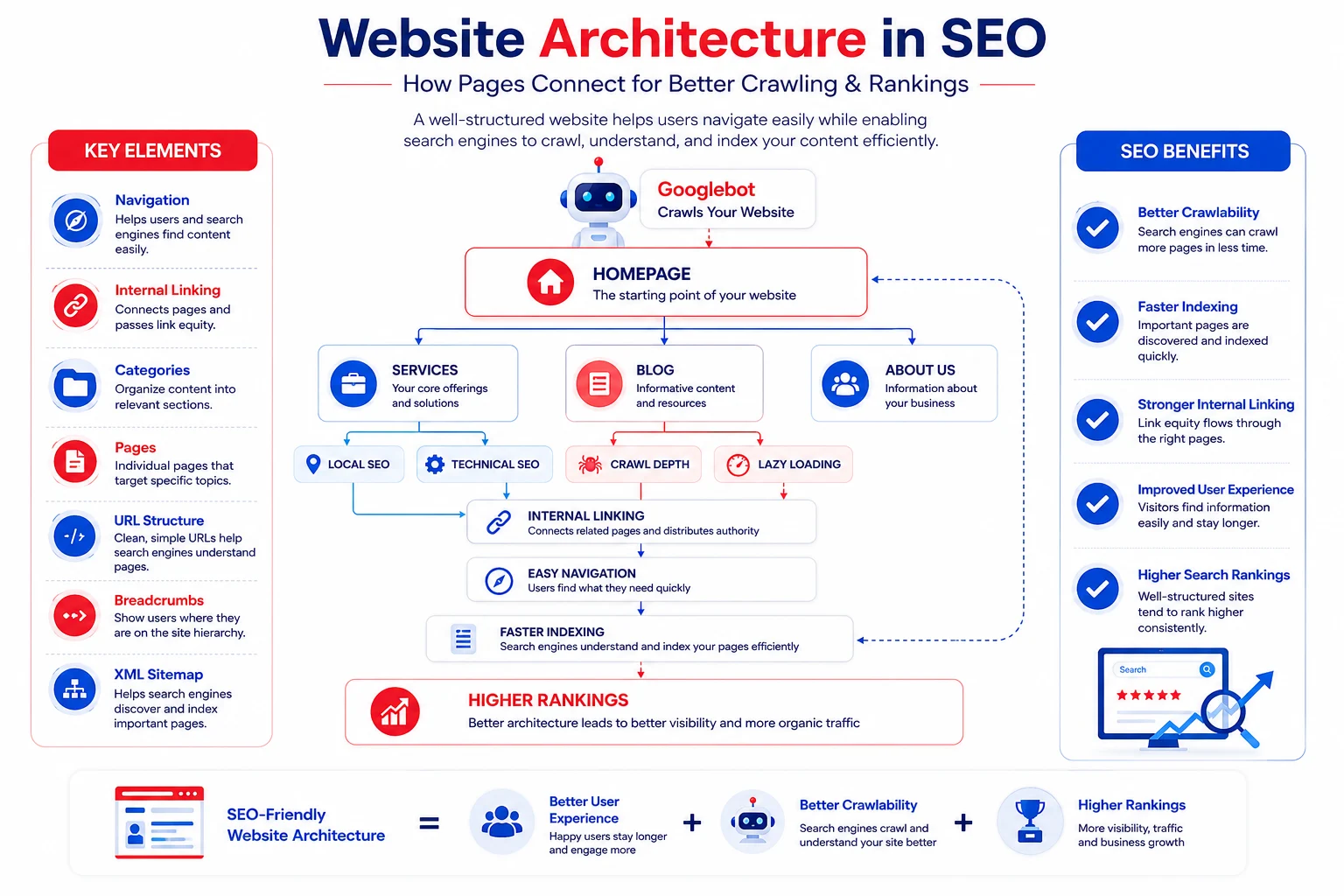
Website architecture in SEO refers to the way a website's pages are organized, connected, and presented through navigation, internal links, categories, and URL structure. It provides a clear hierarchy that helps users navigate your website while enabling search engines to crawl, understand, and index content efficiently.
A well-structured website acts as a roadmap for Googlebot. Instead of discovering pages randomly, search engine crawlers follow logical pathways created through menus, categories, breadcrumbs, and internal links. This improves crawl efficiency, distributes link equity across important pages, and ensures valuable content is easier to find.
An SEO-friendly website architecture also creates a better user experience. Visitors can move between related pages naturally, find information quickly, and spend more time engaging with your content. This combination of improved usability and crawlability makes website architecture one of the most important foundations of technical SEO.
Example: Imagine an online clothing store. Rather than placing every product directly under the homepage, a logical structure organizes pages into categories such as Men, Women, and Accessories, followed by subcategories like Shoes, Shirts, or Bags. This hierarchy makes navigation intuitive for users and easier for search engines to understand.
Why Website Architecture Matters for SEO
A well-planned website architecture directly influences how search engines crawl your website and how users interact with your content. Even high-quality pages may struggle to rank if they're buried deep within the site's hierarchy or disconnected from relevant internal links.
Here are the key reasons website architecture is essential for SEO:
Improves Crawlability
Search engines rely on internal links and navigation to discover new pages. A logical architecture ensures Googlebot can crawl your content efficiently without wasting crawl resources.
Supports Faster Indexing
Pages connected through clear navigation and strong internal linking are more likely to be discovered and indexed quickly, helping new content appear in search results sooner.
Strengthens Internal Linking
A structured website naturally connects related pages, distributing authority across your website and helping important pages gain more visibility in search.
Enhances User Experience
Visitors can easily find relevant information, navigate between related topics, and complete desired actions without unnecessary clicks or confusion.
Builds Topical Authority
Organizing content into related categories and topic clusters helps search engines understand your expertise, improving relevance for broader keyword groups.
Increases Organic Visibility
A clean, crawl-friendly website structure supports better indexing, stronger internal linking, and improved user engagement—all of which contribute to stronger long-term SEO performance.
How Search Engines Understand Website Architecture
Search engines don't view your website the way humans do. Instead, they rely on links, navigation, sitemaps, and page relationships to understand how your content is organized.
When Googlebot visits your website, it begins crawling from known URLs, such as your homepage, XML sitemap, or previously indexed pages. It then follows internal links to discover additional pages and determine how they're connected.
A well-organized website architecture helps search engines:
- Discover new pages faster.
- Understand the relationship between categories and subcategories.
- Identify your most important pages.
- Distribute link equity throughout the website.
- Crawl more pages efficiently using the available crawl budget.
On the other hand, poor website architecture can leave valuable pages buried too deep or disconnected entirely, making them difficult for search engines to find and index.
Flat vs. Deep Website Architecture
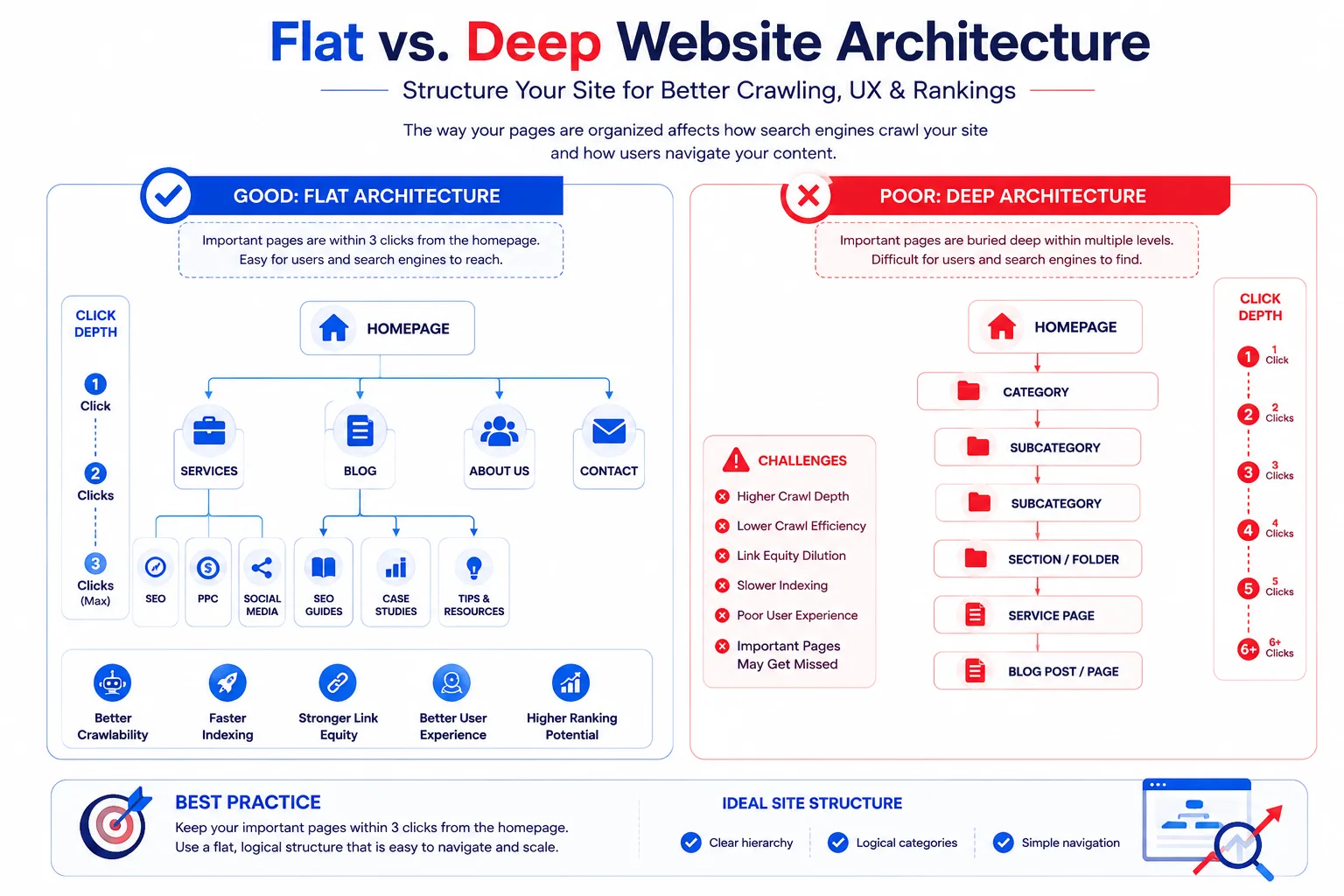
Website architecture is commonly divided into two models: flat architecture and deep architecture. The way your pages are organized directly impacts crawlability, navigation, and SEO performance.
Flat Website Architecture
A flat website architecture keeps important pages within a few clicks of the homepage. Ideally, users and search engines should reach any key page in three to four clicks or fewer.
Benefits
- Faster crawling and indexing
- Better distribution of link equity
- Improved user navigation
- Lower crawl depth
- Stronger SEO performance
Example:
Homepage
├── SEO Services
├── Blogs
├── About
└── Contact
This structure allows both users and Googlebot to discover important pages quickly.
Deep Website Architecture
A deep website architecture requires users and search engines to navigate through many levels before reaching important pages.
Example:
Homepage
└── Services
└── SEO
└── USA
└── Technical SEO
└── Crawl Budget
└── Blog
Challenges
- Higher crawl depth
- Slower page discovery
- Reduced internal authority
- Poor user experience
- Increased risk of orphan pages
While some large ecommerce websites naturally require deeper hierarchies, unnecessary levels should always be avoided.
Website Architecture vs. Website Structure
Although these terms are often used interchangeably, they represent slightly different concepts.
| Website Architecture |
Website Structure |
| Overall organization of the website |
Physical arrangement of pages and URLs |
| Focuses on hierarchy and relationships |
Focuses on folders, URLs, and navigation |
| Includes internal linking strategy |
Includes technical organization |
| Helps search engines understand your website |
Helps users and crawlers navigate efficiently |
Think of website architecture as the blueprint, while website structure is the actual building constructed from that blueprint.
Core Elements of an SEO-Friendly Website Architecture
Building an SEO-friendly website architecture involves much more than organizing pages into categories. Several technical and navigational components work together to create a structure that's easy for both users and search engines to understand.
Logical Site Hierarchy
Every website should have a clear hierarchy that starts with the homepage and gradually branches into categories, subcategories, and individual pages.
Example:
Homepage
↓
SEO Services
↓
Technical SEO
↓
Website Architecture Guide
This logical organization helps users navigate naturally while providing search engines with a clear understanding of content relationships.
Internal Linking
Internal links connect related pages throughout your website and help Google discover content more efficiently.
An effective internal linking strategy:
- Passes authority between pages
- Strengthens topical relevance
- Reduces crawl depth
- Helps users discover related content
For example, a guide about Website Architecture can naturally link to related topics like Crawl Depth, Lazy Loading, and Render Blocking, creating a stronger technical SEO content cluster.
Navigation
Navigation menus act as the primary roadmap for visitors and search engines.
An SEO-friendly navigation should:
- Be simple and intuitive
- Highlight important categories
- Limit unnecessary menu items
- Remain consistent across all pages
- Make key content accessible within a few clicks
Complicated navigation often creates friction for users and reduces crawl efficiency.
URL Structure
Clean URLs improve both usability and crawlability.
A good URL:
example.com/blog/website-architecture-seo
A poor URL:
example.com/page?id=48372&cat=seo&type=blog
Best practices include:
- Using descriptive keywords
- Keeping URLs short
- Avoiding unnecessary parameters
- Maintaining a consistent folder structure
Breadcrumb Navigation
Breadcrumbs show users where they are within the website hierarchy.
Example:
Home
>
Blog
>
Technical SEO
>
Website Architecture
Benefits include:
- Improved navigation
- Better user experience
- Additional internal links
- Enhanced search result appearance when structured data is implemented
XML Sitemap
An XML sitemap provides search engines with a structured list of important pages on your website.
Although Google discovers many pages through internal links, XML sitemaps help search engines find:
- Newly published pages
- Updated content
- Large websites with thousands of URLs
- Pages that receive fewer internal links
Submitting an XML sitemap through Google Search Console improves content discovery and indexing efficiency.
How Website Architecture Impacts SEO
Website architecture influences nearly every aspect of technical SEO.
A well-designed architecture helps search engines crawl efficiently, understand page relationships, distribute authority, and prioritize important content.
Key SEO benefits include:
Improved Crawl Efficiency
Googlebot spends less time discovering pages and more time indexing valuable content.
Better Indexing
Clear pathways help search engines find and index pages faster.
Stronger Internal Link Equity
Authority flows naturally from high-value pages to supporting content.
Better User Experience
Visitors find information faster, reducing frustration and encouraging deeper engagement.
Higher Topical Authority
Grouping related content into well-organized clusters helps Google understand your expertise in a subject area.
Build an SEO-Friendly Website Architecture That Improves Crawlability, Indexing & Rankings
A strong website architecture is the foundation of long-term SEO success. Our USA SEO Services help businesses optimize site structure, internal linking, navigation, and technical SEO to improve search visibility, user experience, and sustainable organic growth.
Explore USA SEO Services
Website Architecture Best Practices for SEO
A well-planned website architecture makes it easier for users to navigate your site and helps search engines crawl, index, and understand your content efficiently. Follow these best practices to build a scalable, SEO-friendly website.
1. Keep Important Pages Within Three Clicks
Try to ensure users and search engines can reach your most valuable pages within three to four clicks from the homepage.
This reduces crawl depth, improves discoverability, and helps distribute link equity more effectively.
Best Practice
Homepage
↓
Category
↓
Subcategory
↓
Important Page
2. Create a Logical Content Hierarchy
Organize your website into clear categories and subcategories.
For example:
Homepage
↓
SEO Services
↓
Technical SEO
↓
Website Architecture
A logical hierarchy improves navigation while helping Google understand how your content is related.
3. Build Strong Internal Linking
Every important page should connect naturally to related content.
For example, this guide should internally link to:
- What Is Crawl Depth?
- What Is Lazy Loading?
- What Is Render Blocking?
- Technical SEO Services
Strong internal linking:
- Improves crawlability
- Passes authority
- Increases page discovery
- Builds topical authority
4. Use Clean, Descriptive URLs
Keep URLs short, readable, and keyword-focused.
Good
example.com/blog/website-architecture-seo
Poor
example.com/page?id=4589&cat=seo
5. Simplify Website Navigation
Your navigation menu should help users quickly reach important sections without overwhelming them.
Avoid:
- Too many menu items
- Duplicate navigation paths
- Confusing category names
6. Add Breadcrumb Navigation
Breadcrumbs improve both user experience and crawlability.
Example
Home
>
Blog
>
Technical SEO
>
Website Architecture
They also strengthen internal linking and can enhance search results when paired with structured data.
7. Maintain an XML Sitemap
An XML sitemap helps search engines discover important pages more efficiently.
Keep your sitemap updated whenever you:
- Publish new pages
- Remove URLs
- Update website sections
- Launch new categories
8. Design for Scalability
As your website grows, your architecture should remain organized.
Whether you're adding:
- New service pages
- Blog clusters
- Ecommerce categories
- Location pages
Your hierarchy should continue to make sense for both users and search engines.
A well-planned website architecture is only one part of a successful SEO strategy. To maximize your website's visibility, you also need expert technical optimization, strategic internal linking, content planning, and ongoing performance improvements. Our USA SEO Services help businesses build scalable, search engine-friendly websites that improve crawlability, indexing, user experience, and long-term organic rankings.
Common Website Architecture Mistakes
Even websites with excellent content can struggle to rank if their architecture creates crawl or navigation issues.
Too Many Click Levels
Pages buried several levels deep often receive less crawl attention and fewer internal links.
Orphan Pages
Pages without internal links are difficult for users and search engines to discover.
Always ensure every important page is connected within your website.
Poor Internal Linking
Only linking from menus isn't enough.
Contextual links inside your content help Google understand relationships between topics.
Duplicate Categories
Creating multiple categories covering nearly identical topics can confuse both users and search engines.
Keep your taxonomy simple and consistent.
Broken Internal Links
Broken links interrupt crawl paths and create a poor user experience.
Regularly audit your internal links to identify and fix broken URLs.
Confusing Navigation
Large menus with too many options make navigation difficult.
Prioritize your most important pages and organize them logically.
How to Audit Your Website Architecture
Regular audits help identify structural issues before they impact your SEO performance.
Crawl Your Website
Use crawling tools to understand your site's hierarchy and identify pages with excessive crawl depth.
Look for:
- Deep pages
- Redirect chains
- Broken links
- Orphan pages
Review Internal Links
Check whether important pages receive enough contextual internal links.
If a valuable page has very few incoming links, it may struggle to gain authority.
Analyze Navigation
Ask yourself:
- Can visitors reach important pages easily?
- Are categories organized logically?
- Is the navigation consistent across the website?
Inspect URL Structure
Ensure URLs remain:
- Short
- Descriptive
- Consistent
- Keyword-focused
Check Google Search Console
Google Search Console helps identify:
- Crawling issues
- Indexed pages
- Discovered but not indexed URLs
- Sitemap errors
- Coverage problems
Regular monitoring allows you to resolve technical issues before they affect rankings.
Several SEO tools can help evaluate and improve your website architecture.
- Google Search Console
- Google Analytics 4
- Screaming Frog SEO Spider
- Semrush Site Audit
- Ahrefs Site Audit
- Sitebulb
- PageSpeed Insights
Using these tools together provides a complete view of crawlability, internal linking, indexing, and site structure.
Conclusion
Website architecture is much more than organizing pages—it's the foundation of a website that users can navigate easily and search engines can understand efficiently. A logical hierarchy, strong internal linking, intuitive navigation, clean URLs, and well-structured categories all contribute to better crawlability, faster indexing, and stronger SEO performance.
As your website grows, maintaining a scalable architecture becomes even more important. Regular audits, continuous optimization, and thoughtful planning help ensure your content remains accessible, discoverable, and competitive in search results.
Whether you're managing a small business website, an e-commerce store, or a large enterprise platform, investing in an SEO-friendly website architecture creates a stronger foundation for long-term organic growth.
A strong website architecture is one of the core elements of successful SEO, but achieving consistent organic growth also requires technical optimization, content strategy, and ongoing performance monitoring. If you're looking to improve your website's structure, crawlability, and search visibility, explore our UK SEO in Services to see how our experts build scalable SEO strategies that support long-term rankings and business growth.