Crawl depth refers to how many links or clicks a search engine crawler must follow from your homepage to discover a specific page on your website. Pages that are closer to the homepage are generally crawled and indexed more frequently, while pages buried deep within a site's structure may be discovered less often. Maintaining a shallow crawl depth through effective internal linking and logical site architecture helps search engines access important pages faster and improves overall SEO performance.
Introduction
Search engines discover your website by following links from one page to another. The easier it is for Googlebot to reach your important pages, the more efficiently it can crawl, understand, and index your website. This is where crawl depth becomes an important part of technical SEO.
Many website owners focus on keywords, backlinks, and content but overlook how deeply important pages are buried within their site's architecture. If Google has to navigate through several layers of pages before reaching valuable content, those pages may be crawled less frequently and could experience slower indexing.
A well-planned website structure with optimized crawl depth helps search engines discover content faster, distribute authority more effectively, and improve the visibility of important pages in search results.
In this guide, you'll learn what crawl depth is, why it matters for SEO, how it affects crawling and indexing, common mistakes to avoid, and practical ways to improve your website's crawl efficiency.
Key Takeaways
- Crawl depth measures how many links search engines follow from the homepage to reach a page.
- Pages with lower crawl depth are usually discovered and crawled more frequently.
- Deep website structures can reduce crawl efficiency and delay indexing.
- Strong internal linking helps reduce crawl depth and improves website navigation.
- Crawl depth is different from page depth and crawl budget, although all three work together.
- A logical site architecture helps Google understand your website more efficiently.
- Regular technical SEO audits help identify pages buried too deep within your site.
What Is Crawl Depth?
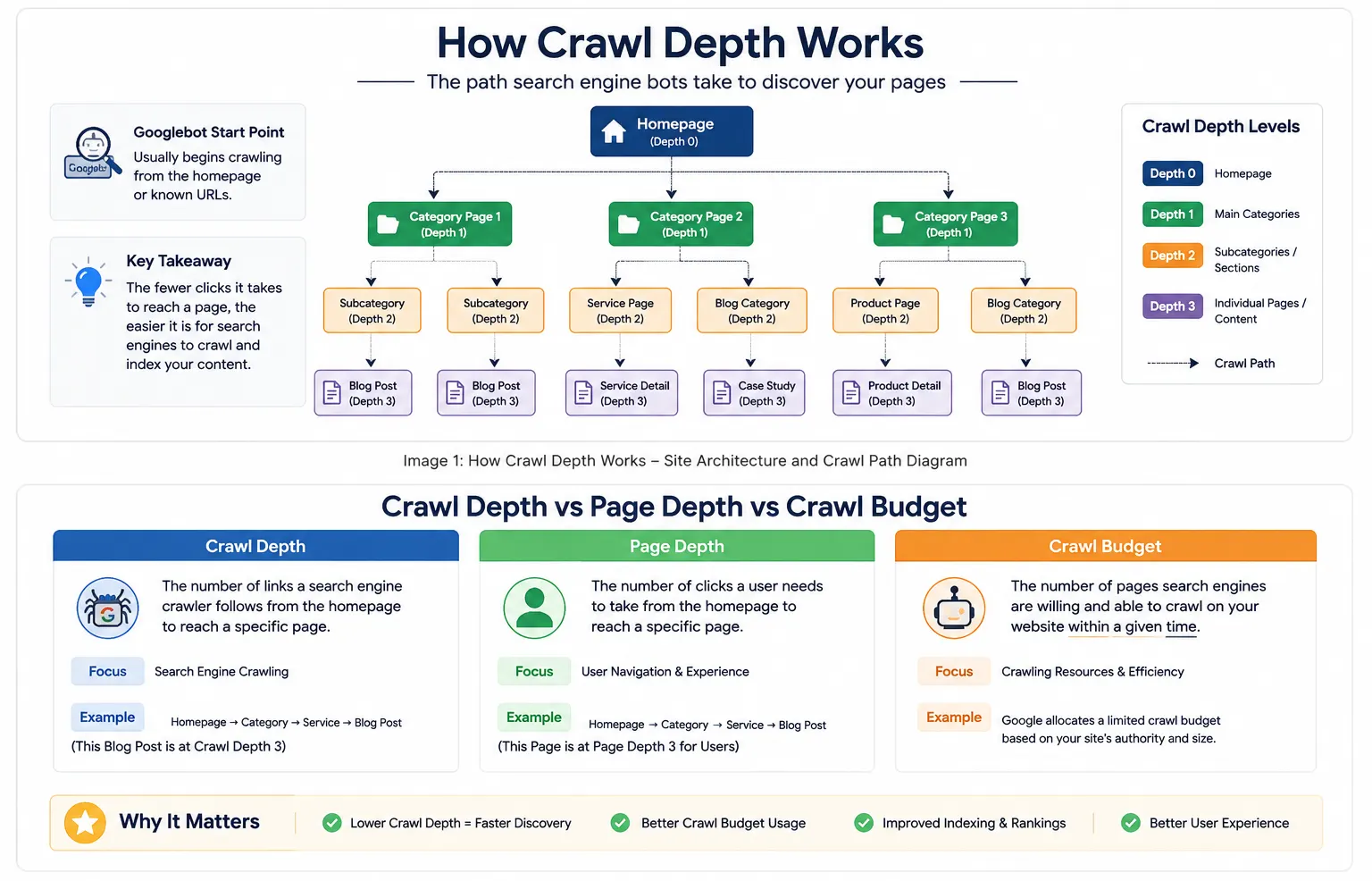
Crawl depth is the number of links a search engine crawler follows from your homepage to reach a particular page on your website.
Think of your homepage as the starting point for Google's crawler. Every internal link represents another step. The more steps Google must take to reach a page, the greater its crawl depth.
For example:
Homepage
↓
SEO Services
↓
Technical SEO
↓
Technical SEO Checklist
In this example:
- Homepage = Depth 0
- SEO Services = Depth 1
- Technical SEO = Depth 2
- Technical SEO Checklist = Depth 3
The deeper a page is within your site's hierarchy, the longer it may take search engines to discover and revisit it. While Google can crawl deep pages, important content should generally remain accessible within a few clicks to improve crawl efficiency and user experience.
Crawl depth doesn't directly determine rankings, but it influences how easily search engines can access, crawl, and understand your website.
Why Crawl Depth Matters for SEO
Crawl depth plays a significant role in how efficiently search engines explore your website. A well-structured site allows Googlebot to discover important pages quickly, while a complex structure can make valuable content harder to find.
Lower crawl depth offers several SEO benefits:
- Faster discovery of new pages
- More efficient crawling and indexing
- Better distribution of internal link equity
- Improved user navigation
- Stronger website architecture
- Easier maintenance for large websites
On the other hand, pages buried several levels deep may receive less crawling attention, especially on large websites with thousands of URLs. Over time, this can slow indexing and reduce the visibility of important content.
If your goal is to maximize organic visibility, reducing unnecessary crawl depth should be part of every technical SEO strategy.
How Search Engines Crawl Your Website
Before understanding crawl depth, it's helpful to know how search engines discover content.
Google begins crawling from known URLs, such as previously indexed pages, XML sitemaps, and external backlinks. From there, Googlebot follows internal links throughout your website, discovering new pages as it moves from one URL to another.
The process generally looks like this:
Homepage
↓
Category Page
↓
Subcategory
↓
Service Page
↓
Blog Post
Every additional layer increases crawl depth.
If important pages are hidden behind multiple levels of navigation or have very few internal links pointing to them, search engines may crawl them less frequently than pages located closer to the homepage.
A clear site hierarchy, logical navigation, and strong internal linking make it easier for Googlebot to move efficiently through your website. This not only improves crawl efficiency but also helps search engines better understand the relationships between your pages and their overall topical relevance.
Crawl Depth vs. Page Depth
Although crawl depth and page depth are often used interchangeably, they describe different concepts.
Crawl depth refers to how many links a search engine crawler follows from the homepage to reach a page.
Page depth, on the other hand, measures how many clicks a user needs to access that same page using the shortest navigation path.
For example:
Homepage
↓
Services
↓
SEO Services
↓
Technical SEO
In this structure:
- Crawl Depth = 3
- Page Depth = 3
However, if you add a direct internal link from the homepage to the Technical SEO page, the page depth becomes 1 for users, and Google can also discover it more efficiently through that shortcut.
This is why strategic internal linking is one of the simplest ways to improve crawl efficiency without changing your entire website structure.
For websites publishing educational content, linking related articles together also helps search engines understand topical relationships. For example, if you're learning about crawl depth, you may also want to read our guide on What Is Render Blocking?, which explains how technical website issues can affect search performance.
Crawl Depth vs. Crawl Budget
Crawl depth and crawl budget are closely related, but they are not the same.
Crawl budget is the number of URLs Googlebot is willing and able to crawl on your website within a given period.
Crawl depth determines how far Googlebot must travel through your website before reaching important pages.
Think of crawl budget as the amount of fuel available for a journey, while crawl depth represents the distance the crawler must travel.
If your most valuable pages are buried several levels deep, Googlebot may spend more time crawling less important URLs before reaching them. On large websites, this can slow the discovery and indexing of important content.
Improving crawl depth helps search engines use their crawl budget more efficiently by making valuable pages easier to reach.
What Is an Ideal Crawl Depth?
There isn't a universal rule for the perfect crawl depth because every website has a different structure.
However, most SEO professionals recommend keeping important pages within three to four clicks from the homepage whenever possible.
A simple website hierarchy often looks like this:
Homepage
↓
Category
↓
Subcategory
↓
Important Page
This structure helps search engines:
- Discover content faster
- Crawl important pages more frequently
- Pass internal authority more efficiently
- Understand your site's hierarchy
For larger ecommerce websites or enterprise websites with thousands of URLs, deeper structures are sometimes unavoidable. In these cases, strategic internal linking, XML sitemaps, and category optimization become even more important.
How Crawl Depth Affects SEO
Crawl depth is not a direct Google ranking factor, but it influences several technical SEO signals that affect organic visibility.
Faster Crawling and Indexing
Pages located closer to the homepage are generally easier for Googlebot to discover. This often results in quicker crawling and faster indexing, especially for newly published content.
Better Internal Link Equity
Internal links distribute authority throughout your website.
When important pages are easier to reach, they typically receive stronger internal link signals, helping search engines understand their importance.
Improved Website Architecture
A shallow website structure creates logical relationships between pages.
This improves both user navigation and Google's understanding of your site's topical hierarchy.
Better User Experience
Visitors also benefit from a clear site structure.
If users can find information within just a few clicks, they are more likely to stay engaged and explore additional content.
Higher Crawl Efficiency
Search engines spend less time navigating unnecessary page layers and more time discovering valuable content.
This becomes especially important for websites with hundreds or thousands of pages.
While improving crawl depth is possible through better internal linking, site architecture, and technical optimization, implementing these changes across a growing website can become complex. Businesses looking to improve crawlability, indexing, and long-term organic performance often work with professional SEO services in the USA to identify technical issues and build a search engine-friendly website structure.
Common Crawl Depth Problems
Improve Your Website's Crawlability with Expert Technical SEO Services
Struggling with poor crawl efficiency, indexing issues, or a complex website structure? W3era's USA SEO Services help businesses optimize crawl depth, strengthen internal linking, improve site architecture, and maximize organic search visibility with data-driven technical SEO strategies.
Explore USA SEO Services
Many websites unintentionally create deep site structures that make crawling less efficient.
Some of the most common issues include:
Orphan Pages
Pages with no internal links are difficult for search engines to discover because they aren't connected to the rest of your website.
Excessive Navigation Levels
Some websites place important pages five, six, or even seven levels deep.
For example:
Homepage
↓
Services
↓
SEO
↓
Technical SEO
↓
Resources
↓
Guides
↓
Blog
This creates unnecessary crawl depth and slows content discovery.
Poor Internal Linking
Publishing new content without linking it from related pages makes it harder for both users and search engines to find.
For example, after reading this guide, you may also find our article on What Is Lazy Loading? helpful, as it explains another technical optimization that improves website performance and user experience. Similarly, our What Is Render Blocking? guide explores how render-blocking resources affect page speed and Core Web Vitals. Linking related technical SEO topics together strengthens your site's topical authority while helping search engines crawl connected content more efficiently.
Broken Internal Links
Broken links interrupt Google's crawling path.
If crawlers repeatedly encounter dead ends, they may stop exploring deeper sections of your website.
Weak Site Architecture
Random page organization without a logical hierarchy makes it harder for Google to understand which pages are most important.
A well-planned site architecture supports efficient crawling, indexing, and stronger SEO performance.
How to Reduce Crawl Depth
Improving crawl depth doesn't always require rebuilding your entire website. In most cases, a few strategic technical SEO improvements can make your important pages easier for search engines to discover and crawl.
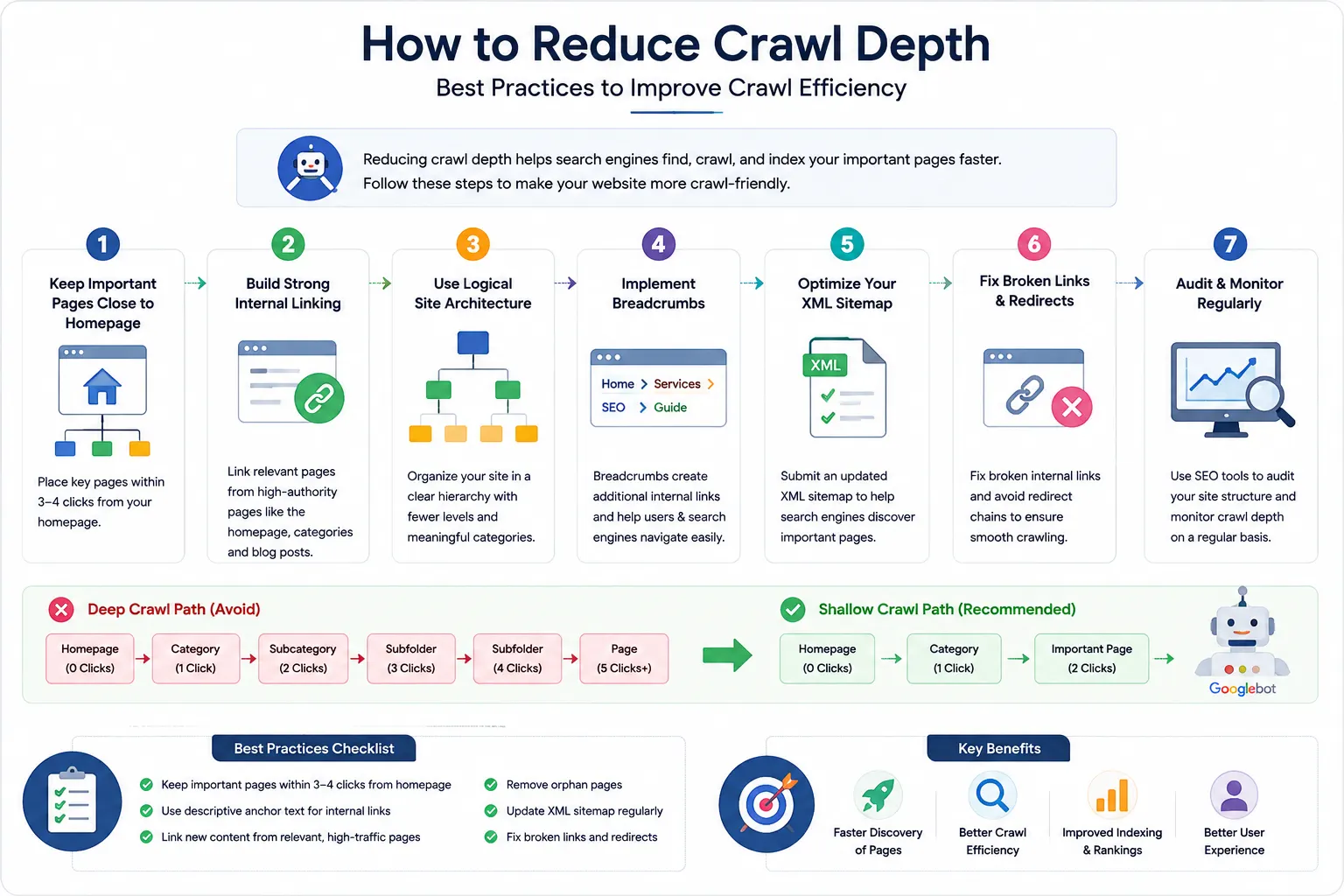
Here are the most effective ways to reduce crawl depth.
Improve Your Internal Linking Structure
Internal links act as pathways that guide search engine crawlers through your website.
Every relevant internal link creates another route for Googlebot to discover your pages. If an important page only receives one internal link from a deep section of your site, search engines may take longer to find and revisit it.
Instead, link important pages from:
- Homepage
- Service pages
- Category pages
- Related blog posts
- Resource pages
For example, technical SEO articles should naturally connect to related topics like crawl efficiency, page speed, lazy loading, render blocking, and site architecture. This improves both crawlability and topical authority.
Keep Important Pages Close to the Homepage
Your most valuable pages should be easy to access for both users and search engines.
Examples include:
- Core service pages
- High-converting landing pages
- Category pages
- Cornerstone blog content
- Contact page
If users need five or six clicks to reach an important page, Googlebot also has to follow that same path unless a shorter internal link exists.
Create a Logical Site Architecture
A simple website hierarchy helps search engines understand the relationship between pages.
An effective structure typically looks like this:
Homepage
│
├── Services
│ ├── Technical SEO
│ ├── Local SEO
│ └── Ecommerce SEO
│
├── Blog
│ ├── Technical SEO
│ ├── On-Page SEO
│ └── Local SEO
│
└── Contact
This type of organization makes crawling more efficient while improving the overall user experience.
Use Breadcrumb Navigation
Breadcrumbs provide additional internal links that help both visitors and search engines understand where a page belongs within your website hierarchy.
Example:
Home > Blog > Technical SEO > Crawl Depth
Breadcrumb navigation also improves site organization and can enhance search result snippets.
Optimize Your XML Sitemap
An XML sitemap acts as a roadmap for search engines by listing the URLs you want them to crawl.
While it doesn't replace internal linking, it helps Google discover important pages more efficiently—especially on large websites or sites that frequently publish new content.
Keep your sitemap updated by:
- Including only indexable URLs
- Removing redirected or broken pages
- Updating it when publishing new content
Fix Broken Internal Links
Broken links interrupt Google's crawling path.
Regularly audit your website to identify:
- 404 pages
- Redirect chains
- Redirect loops
- Incorrect internal URLs
Repairing these issues helps search engines crawl your website more efficiently.
Best Practices for Maintaining an SEO-Friendly Crawl Depth
Reducing crawl depth is only the first step. Maintaining a crawl-friendly website requires ongoing technical SEO improvements.
Follow these best practices:
- Keep important pages within three to four clicks of the homepage whenever possible.
- Build contextual internal links between related pages.
- Publish content within clear topical categories.
- Regularly update your XML sitemap.
- Remove orphan pages by linking them from relevant content.
- Fix broken links and unnecessary redirect chains.
- Audit your website architecture as it grows.
- Monitor crawl reports in Google Search Console and site auditing tools.
Consistent maintenance helps search engines crawl your website efficiently as new pages are added.
Several SEO tools allow you to analyze how deeply pages are buried within your website.
Google Search Console
Google Search Console helps you monitor indexing, discover crawl issues, and identify pages that may not be receiving sufficient crawling attention.
Screaming Frog SEO Spider
Screaming Frog visualizes your site's crawl structure and reports crawl depth for every URL.
It is one of the most widely used tools for technical SEO audits.
Sitebulb
Sitebulb provides interactive visualizations of your website architecture, making it easy to identify pages with excessive crawl depth and internal linking issues.
Ahrefs Site Audit
Ahrefs helps uncover technical SEO problems, orphan pages, crawlability issues, and internal linking opportunities that may affect crawl efficiency.
Semrush Site Audit
Semrush audits your website for technical SEO issues, including crawlability, broken links, internal linking problems, and website architecture improvements.
Common Crawl Depth Mistakes to Avoid
Even well-designed websites can develop crawl depth issues over time.
Avoid these common mistakes:
- Burying important pages too deep within navigation.
- Publishing content without adding internal links.
- Relying only on XML sitemaps instead of building strong internal linking.
- Leaving orphan pages disconnected from the rest of the website.
- Creating unnecessary URL hierarchy levels.
- Ignoring broken internal links.
- Failing to review website architecture after adding new sections.
Regular technical SEO audits help prevent these issues before they impact crawling and indexing.
Whether you manage a small business website or a large enterprise platform, maintaining a crawl-friendly website structure is an ongoing process. If you're looking for expert guidance to improve crawlability, technical SEO, and long-term organic growth, partnering with an experienced UK SEO services provider can help you build a stronger foundation for sustainable search visibility.
Conclusion
Crawl depth plays an important role in how efficiently search engines discover, crawl, and understand your website.
Although it isn't a direct ranking factor, a shallow and well-organized website structure helps search engines access important pages faster, improves internal link distribution, and supports better indexing.
The good news is that improving crawl depth doesn't require major website changes. By creating a logical site hierarchy, strengthening internal linking, fixing crawl barriers, and regularly auditing your website, you make it easier for both users and search engines to navigate your content.
As your website grows, monitoring crawl depth should become a regular part of your technical SEO strategy to ensure new and existing pages remain easy to discover.