A high-quality backlink is a relevant, trustworthy link from another website that genuinely benefits users and naturally references your content. The strongest backlinks usually come from a page and website that are relevant to your topic, have a credible reputation and real audience, and place the link naturally within useful editorial content. Anchor text and the surrounding context should accurately describe the destination, while the linked page should provide the information or resource the reader expects. Quality is more important than simply increasing backlink volume, and third-party metrics such as Domain Authority, Domain Rating, or Authority Score should be treated as evaluation aids rather than Google's own ranking metrics.
Key Takeaways
- A high-quality backlink is primarily about relevance, credibility, context, and editorial value.
- The quality of the specific linking page matters, not just the domain.
- A natural contextual link is generally more meaningful than a link placed in a footer, sidebar, or unrelated section.
- Anchor text should describe the destination naturally rather than being repeatedly exact-match optimized.
- A useful backlink can generate referral traffic and visibility as well as contribute to a site's broader authority signals.
- Referring-domain diversity is more informative than judging a backlink profile by raw link count alone.
- Third-party SEO metrics can help compare opportunities, but they should not be mistaken for Google's own ranking metrics.
- The safest approach is to earn links through useful content, relationships, editorial coverage, research, and digital PR.
How has link building evolved in 2026?
Backlinks are still an important part of SEO, but the difficult question is no longer simply how to get more links. The more useful question is what makes one backlink valuable and another barely worth pursuing?
A high-quality backlink is not defined by one number in an SEO tool. A link can come from a domain with a strong reputation and still be a poor opportunity if the linking page is irrelevant, the placement is forced, or the destination does not satisfy the reader. Conversely, a highly relevant editorial link from a focused industry publication can be valuable even when the domain does not have an exceptionally high third-party authority score.
This guide explains how to evaluate backlink quality at the domain, page, link, and destination levels, how to distinguish useful links from weak ones, and how to build a backlink profile that supports sustainable organic growth.
Evaluating backlink quality is only one part of a successful organic growth strategy. Businesses that want to combine USA SEO with technical SEO, content development, authority building, and ongoing search optimization can use a broader strategy rather than treating link building as an isolated activity.
USA SEO & AUTHORITY BUILDING
Build High-Quality Backlinks That Strengthen Your SEO
High-quality backlinks come from relevance, authority, strong content, and genuine editorial value. Our USA SEO team builds authority-focused link strategies designed to earn relevant mentions, strengthen topical relevance, and support sustainable organic growth.
Relevant Backlinks Digital PR Authority Building
Explore USA SEO Services →
What Makes a High-Quality Backlink?
A high-quality backlink is generally a link from a relevant, credible website or webpage that is placed naturally within useful content and points to a genuinely valuable destination.
The strongest backlink opportunities usually share several characteristics: the source is relevant to the subject, the source and destination have a logical relationship, the link is editorially placed, the anchor text is natural and descriptive, the source has a real audience or established reputation, and the destination provides genuine value to the people clicking it.
No single characteristic makes a link "high quality" by itself. Think of backlink quality as a combination of signals rather than a pass-or-fail metric.
For example, a link from a respected marketing publication to an in-depth SEO study can be a strong fit because the publication has a reason to reference the study, the audience can benefit from it, and the destination supports the subject being discussed.
How Do You Evaluate Backlink Quality?
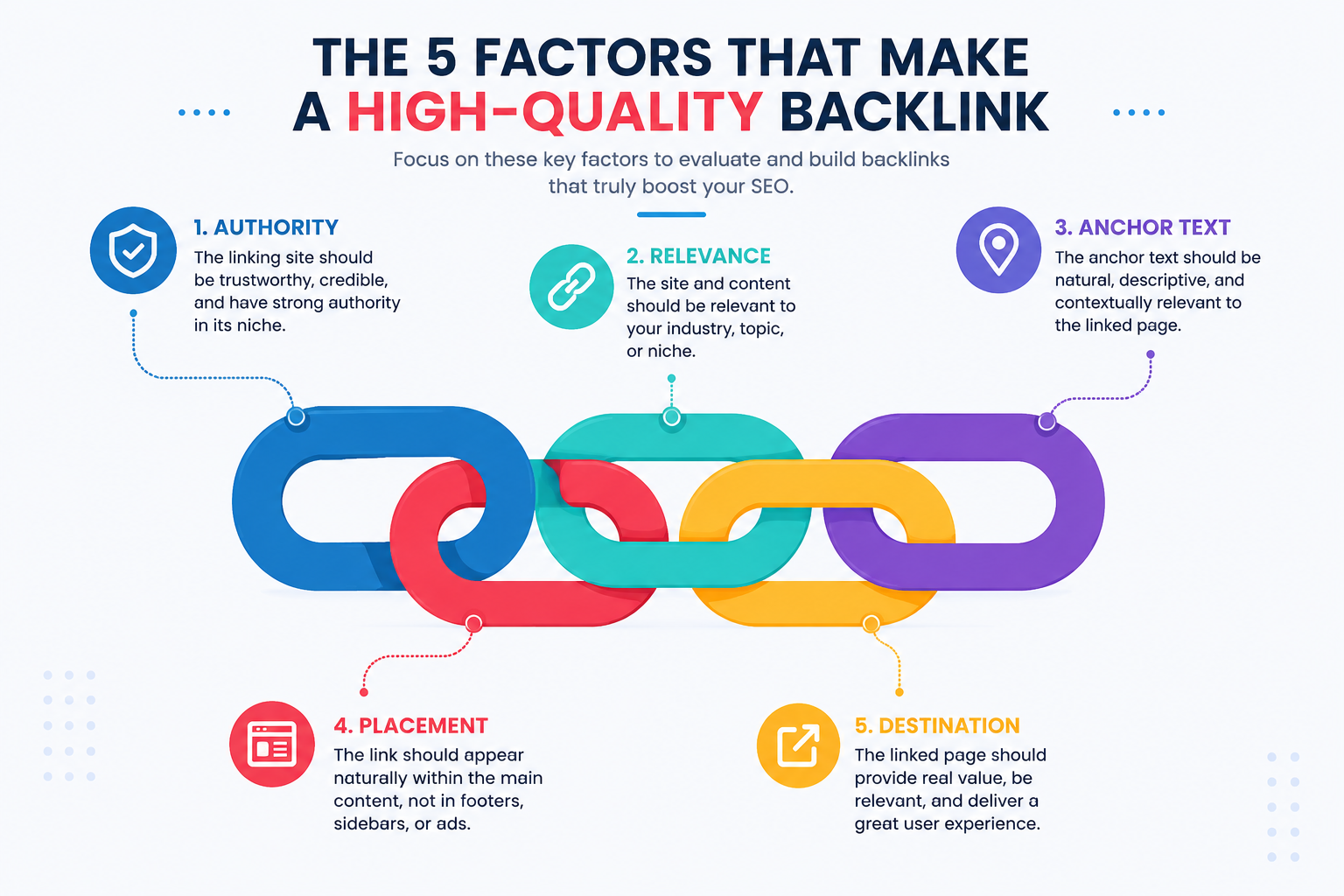
A practical backlink evaluation should answer five questions:
Is it relevant? Is the source credible? Is the placement editorial? Does the link make sense in context? Does the destination deserve the click?
Ahrefs currently frames its backlink-quality evaluation around five core concepts: authority, relevance, anchor text, placement, and destination. Other current resources add related considerations such as source quality, editorial control, referring-domain diversity, and the overall backlink profile.
This gives us a useful evaluation model:
Source quality → topical relevance → editorial context → link placement → anchor text → destination quality
The closer a backlink gets to satisfying the complete chain, the more compelling the opportunity becomes.
1. Topical Relevance Is the First Quality Check
Relevance is one of the clearest indicators that a backlink makes sense.
A backlink from a website or webpage that discusses the same industry, subject, audience, or problem provides a logical connection. A backlink from a completely unrelated site may still exist, but the topical relationship is much harder to justify.
For example, imagine a company publishing a detailed guide about enterprise technical SEO. A contextual backlink from an established SEO publication, web-development resource, or marketing technology website makes sense because the audience and subject overlap.
A random backlink from an unrelated entertainment site does not offer the same contextual fit.
This does not mean every backlink must come from a website covering exactly the same topic. Related subjects can naturally intersect. Ahrefs gives the useful example that a fitness site may reasonably link to content about nutrition or self-improvement even when the topics are not identical.
The practical rule is:
Ask whether a real editor would have a genuine reason to reference the page.
If the answer is yes, the relevance is easier to defend.
Page-Level Relevance vs Domain-Level Relevance
Do not evaluate relevance only at the domain level.
A general business publication might contain a page specifically about SEO, content marketing, or search strategy. That individual page can be much more relevant to an SEO resource than the site's broader category suggests.
This is why backlink audits should examine:
- Referring domain
- Referring page
- Page topic
- Surrounding content
- Destination topic
- Audience overlap
The specific linking page can tell you much more about contextual relevance than a domain-level label alone.
2. Source Credibility and Authority Matter
A strong backlink usually comes from a source that has a credible presence within its subject area.
That credibility can come from:
- Strong editorial standards
- Useful original content
- A real audience
- Industry recognition
- Consistent publishing
- Independent references
- A healthy backlink profile
Third-party metrics such as Domain Authority, Domain Rating, or Authority Score can help you compare websites, but they should be treated as diagnostic metrics rather than Google's internal scoring system. Ahrefs and Ranko Media both caution against relying on a single tool metric to judge backlink quality.
For example, a site with a DR of 80 is not automatically a better backlink opportunity than a relevant site with a DR of 45.
Look at the full picture.
A relevant DR 45 website with real traffic, a focused audience, strong editorial standards, and a page directly related to your subject may be more useful than an unrelated DR 80 site that publishes almost anything.
What to Check Beyond DA or DR
Before accepting a backlink opportunity, review:
Organic visibility: Does the site actually rank for useful queries?
Topical focus: Does it consistently cover subjects related to your industry?
Content quality: Is the site publishing useful material or thin pages built primarily to sell links?
Audience: Would people who read this site actually care about your resource?
Link environment: Does the website link selectively to useful resources, or does every article contain dozens of unrelated commercial links?
These checks produce a better judgment than a single authority score.
3. Editorial Placement Is a Major Quality Signal
A strong backlink should look like a genuine editorial recommendation rather than an advertisement disguised as a hyperlink.
The most useful placement is usually within the main content where the link naturally supports the surrounding discussion.
For example:
Businesses auditing their backlink profile should compare both referring-domain quality and the relevance of each linking page. A detailed backlink analysis guide can help identify patterns that are difficult to spot from a raw link count.
The link makes sense because the paragraph explains why the resource is useful.
Compare that with a footer block containing:
SEO Services | Backlinks | Link Building | Marketing
The second example has little editorial context.
Ahrefs specifically identifies editorial placement within content as one of its five major concepts for evaluating high-quality backlinks.
Why Placement Matters
Placement affects both interpretation and usability.
A contextual backlink can:
- Explain why the destination is relevant
- Give the reader a reason to click
- Provide stronger surrounding context
- Look more natural than a boilerplate link
- Generate qualified referral traffic
This is why a backlink should be judged not simply as:
"Does this page link to me?"
but as:
"Why does this page link to me?"
4. Anchor Text Should Be Natural and Relevant
Anchor text is the clickable wording used for a link.
Good anchor text helps explain the destination.
For example:
technical SEO guide
is descriptive.
click here
is vague.
best technical SEO company in the USA
may be appropriate in a commercial context, but repeatedly forcing that exact phrase into dozens of backlinks can create an unnatural profile.
Ahrefs recommends keeping anchor text and the surrounding words relevant to the destination while allowing natural variation rather than forcing a single anchor pattern.
A healthy backlink profile can naturally contain:
- Branded anchors
- Partial-match anchors
- Related phrases
- Descriptive anchors
- Naked URLs
- Generic anchors
- Page-title anchors
The key is not to engineer a perfect ratio. The key is to let the wording reflect how people naturally reference useful resources.
Anchor Text and the Surrounding Sentence
Anchor text should be evaluated together with its surrounding content.
Consider:
Companies improving organic visibility often start by reviewing their technical SEO foundation before investing heavily in content and authority building.
The words immediately around the anchor help explain the relationship.
This is why a good backlink is better understood as a contextual reference, not just a hyperlink.
5. The Destination Page Has to Deserve the Link
This is an area that is often overlooked.
A backlink can come from an excellent website and still be a weak opportunity if the destination page is poor.
Ask:
Does the destination answer the question?
Does it provide original or useful information?
Is it trustworthy?
Does it match the anchor text?
Would a reader be happy they clicked?
Ahrefs explicitly includes destination quality as one of its five backlink evaluation concepts. It recommends considering whether the page being linked provides informational or functional value rather than simply being a sales page.
This creates an important relationship:
Good source + good link + poor destination = weak overall experience
A high-quality backlink is strongest when both sides of the relationship are valuable.
6. Context Around the Link Matters
The paragraph, section, heading, and surrounding entities can all help establish context.
Suppose a website publishes a section about local search visibility and links to a detailed guide on local citations. The relationship is immediately understandable.
Now imagine the same backlink placed in a paragraph about unrelated software. The link becomes much harder to justify.
This is especially important for semantic SEO because pages are interpreted within broader topic relationships.
The practical evaluation should therefore include:
What is the page about?
What is the paragraph about?
What does the anchor describe?
What is the destination about?
Why would the reader need this resource?
When all five answers align, the link has strong contextual logic.
7. Referring-Domain Diversity Is More Useful Than Raw Link Count
A backlink profile should not be judged only by total backlinks.
Suppose Website A has 500 backlinks, but most come from three domains.
Website B has 150 backlinks from 80 relevant domains.
The second profile may provide a more diverse set of independent references.
This is why referring domains matter when evaluating the broader backlink profile.
At the same time, do not turn "more referring domains" into a rigid ranking formula. Fifty irrelevant domains are not automatically better than ten highly relevant and trusted domains.
The useful question is:
How many independent, credible sources recognize this website as useful within its subject area?
8. Traffic Can Be Valuable, but It Is Not a Quality Guarantee
A website with real traffic can offer meaningful referral exposure.
If an industry publication links to your article and its readers actually click the link, that backlink can create value even beyond SEO.
However, traffic should not be used as the only quality filter.
A site can have inflated traffic estimates, rankings for irrelevant queries, or large audiences that have no relationship with your business.
Evaluate traffic alongside:
relevance + credibility + editorial quality + audience fit
A backlink that sends qualified visitors to the destination can be especially valuable because it has a clear business purpose.
9. Link Status and Attributes Matter
Links can use attributes such as:
These attributes help describe the nature of the relationship.
Google recommends using sponsored for paid or advertising-related links and ugc for user-generated content. nofollow can be used where the relationship requires that qualification. (developers.google.com)
Do not reduce these attributes to a simplistic "good link versus bad link" rule.
A sponsored link can still be valuable for referral traffic and visibility. A no-follow link can still introduce your brand to a relevant audience. A UGC link can still be useful in a genuine community context.
The important distinction is between link value for SEO signals and business or audience value.
10. The Source Page Should Be Indexable and Accessible
A source page needs to exist and be accessible to search engines for its link relationships to be discoverable.
When evaluating a backlink opportunity, check whether the source page:
- Loads normally
- Is not blocked by robots.txt
- Is not intentionally no-indexed when it needs to be visible
- Is accessible to crawlers
- Contains the link in crawlable HTML where appropriate
This connects backlink analysis with technical SEO.
For a broader understanding of crawlability and technical foundations, see our technical SEO guide.
High-Quality vs Low-Quality Backlinks
The easiest way to understand backlink quality is to compare strong and weak patterns.
| Quality signal |
High-quality backlink |
Low-quality backlink |
| Relevance |
Closely related topic |
Unrelated topic |
| Source |
Trusted, genuine website |
Thin or spam-focused website |
| Placement |
Natural editorial context |
Footer, sidebar, comment, or forced placement |
| Anchor |
Descriptive and natural |
Repeated or manipulated exact match |
| Destination |
Useful, relevant resource |
Thin or irrelevant page |
| Audience |
Relevant audience |
No meaningful audience overlap |
| Profile |
Diverse, earned naturally |
Large volume of repetitive links |
| Purpose |
Helps readers |
Exists mainly to manipulate rankings |
This does not mean every backlink will fit perfectly into one category. Backlink quality exists on a spectrum.
What Is a Medium-Quality Backlink?
A backlink does not have to be perfect to be useful.
For example, a genuine business publication may be relevant at the page level but only moderately relevant at the domain level. The link may still be useful because it is editorial, relevant to the article, and helpful to readers.
Digital Marketing Institute makes a similar distinction between high-, medium-, and low-quality links, emphasizing natural, reputable, and relevant backlinks as the strongest class.
This is a useful reminder: link evaluation should be based on the complete context, not a binary "good or bad" label.
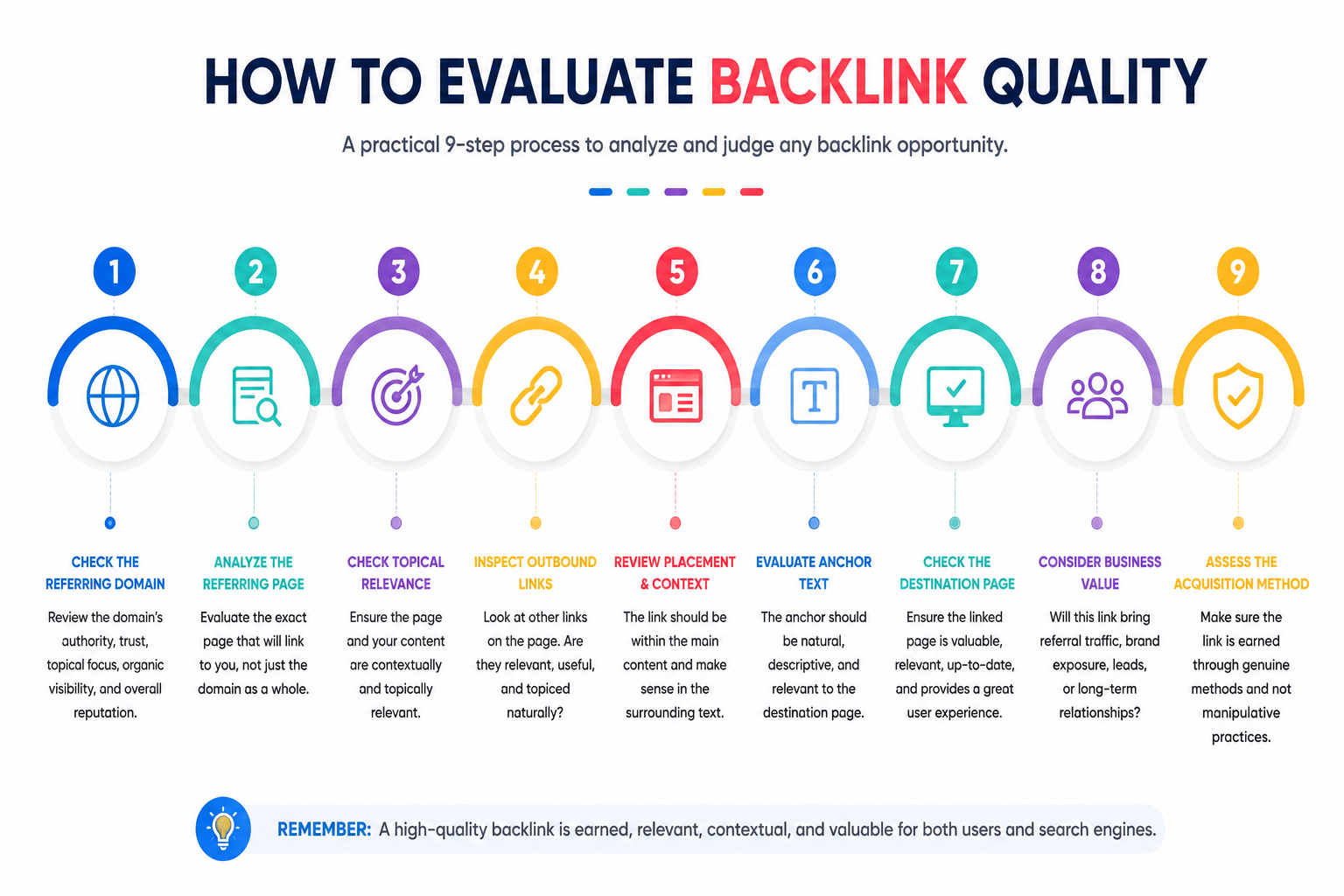
How to Evaluate a Backlink Before Building It
Use this practical checklist before spending time or money pursuing a backlink.
Step 1: Check the Referring Domain
Review the site's reputation, topical focus, content quality, organic visibility, and audience.
Step 2: Check the Exact Referring Page
Do not stop at domain-level metrics. Read the actual article that would contain your link.
Step 3: Evaluate Topical Relevance
Ask whether the source page and your destination page naturally belong in the same conversation.
Step 4: Inspect Existing Outbound Links
Look at what else the source page links to. Are its references curated and useful, or does it link indiscriminately?
Step 5: Review Placement
Determine whether your link will appear in meaningful editorial content or in a low-value template area.
Step 6: Review Anchor Text
Make sure the proposed anchor accurately describes the destination and fits naturally into the sentence.
Step 7: Check the Destination
Make sure the page is useful, current, accessible, indexable, and relevant.
Step 8: Consider Business Value
Would the link bring relevant referral traffic, brand exposure, qualified leads, or industry recognition?
Step 9: Assess the Acquisition Method
Ask how the link is being obtained.
A link earned because your content deserves to be referenced is fundamentally different from a link created solely because money changed hands for ranking purposes.
How to Get High-Quality Backlinks
High-quality backlinks are usually earned by creating something worth referencing and making the right people aware of it.
Create Link-Worthy Content
The strongest linkable assets often provide something difficult to reproduce.
Examples include:
- Original research
- Industry surveys
- Proprietary data
- Detailed guides
- Case studies
- Useful tools
- Calculators
- Templates
- Expert analysis
- Benchmark reports
A publisher is more likely to link to content that adds something meaningful to its own article.
Earn Editorial Mentions
Build relationships with relevant publishers, journalists, industry writers, and subject-matter experts.
The goal should not be:
"Please give me a backlink."
A better approach is:
"We have original research that can support this story."
That changes the relationship from link acquisition to useful editorial contribution.
Use Digital PR
Digital PR is particularly useful when the asset has a newsworthy angle.
For example:
Original data → media story → editorial mention → backlink
The link is a by-product of the story being useful.
Our Digital PR guide covers this approach in greater detail.
Build Relationships With Relevant Websites
Partnerships, industry associations, clients, vendors, communities, and professional organizations can create legitimate opportunities for links.
The key is that the relationship should exist for a reason beyond SEO.
Reclaim Unlinked Mentions
If another website already mentions your brand, product, research, or organization without linking to you, you may have a natural opportunity to request attribution.
This can be one of the easier forms of link reclamation because the source already knows your brand.
Should You Focus on High Domain Authority Backlinks?
Not exclusively.
DA and DR can help you compare sites, but they do not tell you whether a specific backlink is a good fit.
Consider these two opportunities:
Option A
DR 75
Unrelated niche
Low contextual relevance
Poor editorial quality
Option B
DR 45
Highly relevant niche
Real audience
Strong editorial content
Natural placement
Option B may be the more strategically useful backlink even though its third-party metric is lower.
This is why backlink evaluation should prioritize:
Relevance → credibility → context → placement → destination
and use authority metrics as supporting evidence rather than the entire decision.
Do You Need Do-follow Backlinks?
For traditional SEO discussions, do-follow links are generally preferred when the goal is to pass conventional ranking signals.
But that does not make every no-follow link useless.
A no-follow link can still:
- Generate referral traffic
- Increase brand awareness
- Introduce new audiences
- Lead to future editorial coverage
- Support broader brand visibility
Google's documentation also explains that nofollow is a hint rather than a simple absolute command in every search process. (developers.google.com)
Therefore, don't evaluate a link only by its attribute.
Evaluate its complete purpose.
How Link Equity Relates to Backlink Quality
Backlink quality and link equity are related but not identical concepts.
Backlink quality asks:
How valuable is this particular backlink?
Link equity describes the broader value or authority associated with links between pages.
A useful backlink evaluation therefore looks at the elements that can influence the relationship:
Source authority + relevance + context + placement + anchor + destination
Our link equity guide goes deeper into how link-based value and authority relationships work across internal and external links.
How Internal Links Fit Into a High-Quality Backlink Strategy
External backlinks are only one half of the picture.
Suppose a detailed research page earns several strong external backlinks. Leaving that page isolated wastes an opportunity.
Instead, use contextual internal links to connect it with:
- Supporting articles
- Service pages
- Pillar pages
- Related resources
- Important commercial destinations
For example:
Research asset → supporting guide → service page
The internal link should be relevant and useful rather than inserted simply to distribute authority.
This is where anchor text, topical relevance, and website architecture work together.
A Practical Backlink Quality Scoring Framework
There is no official Google backlink score, but an internal scoring system can help your SEO team compare opportunities consistently.
You could evaluate every candidate across six dimensions:
| Factor |
Question |
Suggested range |
| Relevance |
How closely related are the source and destination topics? |
0–5 |
| Credibility |
Is the source trusted and editorially credible? |
0–5 |
| Context |
Does the link naturally support the surrounding content? |
0–5 |
| Placement |
Is it inside meaningful editorial content? |
0–5 |
| Audience |
Could the link reach relevant users? |
0–5 |
| Destination |
Does the destination genuinely satisfy the reader? |
0–5 |
The total score should be treated as an internal decision-making framework, not as a Google metric.
For example:
26–30: Strong strategic opportunity
20–25: Good opportunity worth validating
14–19: Moderate; pursue only if other benefits exist
Below 14: Usually low priority
The framework becomes more useful when combined with qualitative judgment.
How to Audit Your Existing Backlink Profile
You can apply the same principles to links you already have.
Identify the Strongest Referring Domains
Find websites with strong topical relevance, genuine audiences, and credible editorial standards.
Review the Linking Pages
Open the actual source pages rather than relying only on domain-level metrics.
Segment Your Anchors
Group anchors into:
- Branded
- Partial match
- Exact match
- Related
- Generic
- Naked URL
Look for unusually repetitive patterns.
Check Destination URLs
Make sure valuable backlinks still point to live, relevant destinations.
Identify Broken Backlinks
If a previously linked page now returns an error, check whether the link can be reclaimed through an appropriate replacement or redirect.
Look for Topical Gaps
Ask which important subjects your backlink profile is already associated with and which core topics lack credible references.
This helps turn backlink analysis into a broader authority strategy.
Common Backlink Quality Mistakes
Chasing Metrics Instead of Relevance
A high DA or DR does not automatically make a backlink valuable.
Buying Large Volumes of Links
Mass link purchases can create an unnatural profile and conflict with search-engine spam policies.
Using Irrelevant Placements
A link should make sense to the source site's audience.
Repeating Exact-Match Anchors
Do not force the same commercial phrase into every backlink.
Ignoring the Referring Page
Domain-level analysis alone can hide poor content and weak context.
Linking to Weak Destinations
A strong source cannot turn an unhelpful destination into useful content.
Building Links From Sites That Exist Only to Sell Links
If a site publishes low-quality content across hundreds of unrelated categories primarily for paid placements, treat it as a warning sign.
Measuring Only Link Quantity
Track referring domains, relevance, quality, referral traffic, and business outcomes instead.
What Does a High-Quality Backlink Look Like?
Consider this example.
A respected marketing publication publishes an in-depth article about technical SEO audits. The article discusses crawlability problems, indexing issues, Core Web Vitals, and site architecture. Within that discussion, the editor naturally references a detailed technical SEO resource because it gives readers additional information.
That backlink has several strong characteristics:
Relevant source: marketing and SEO topic
Relevant page: technical SEO discussion
Editorial placement: inside the article
Natural anchor: accurately describes the destination
Useful destination: provides deeper information
Audience fit: readers are already interested in SEO
Now compare that with a backlink from an unrelated website that inserts your exact-match commercial keyword into a generic article simply because you paid for placement.
The second link may technically exist, but it lacks several of the characteristics that make the first link useful.
Does a High-Quality Backlink Guarantee Higher Rankings?
No.
A strong backlink can support a website's authority and visibility, but it does not guarantee a specific ranking position.
Search engines evaluate many signals, including content relevance, quality, search intent, technical accessibility, internal linking, user experience, and other factors.
That is why backlink acquisition should be treated as part of a broader SEO strategy rather than a standalone ranking shortcut.
Conclusion
A high-quality backlink is not simply a link from a website with a high authority score.
The strongest backlinks are relevant, credible, naturally placed, contextually useful, and connected to a destination that genuinely deserves the reference. Authority metrics can help you compare opportunities, but they should support your judgment rather than replace it.
When evaluating backlinks, focus on the complete relationship:
Relevant source → useful context → natural placement → descriptive anchor → valuable destination
Then build your backlink profile through useful content, original research, digital PR, publisher relationships, and other legitimate methods of earning editorial references.
The goal is not to collect the most backlinks.
The goal is to earn the backlinks that make the most sense.
For businesses competing in the UK market, backlink quality should be considered as part of a wider search strategy that combines relevance, authority, content, technical foundations, and market-specific targeting. UK SEO services can help bring these areas together into a structured organic growth program.
UK SEO GROWTH
Turn Quality Backlinks Into Sustainable UK Search Growth
A strong backlink profile is built around relevance, trusted sources, useful content, and natural editorial mentions. Our UK SEO strategies combine authority building, content, technical SEO, and search-focused optimization to help businesses compete for valuable organic visibility.
UK Search Visibility Quality Link Building Organic Growth
Explore UK SEO Services →