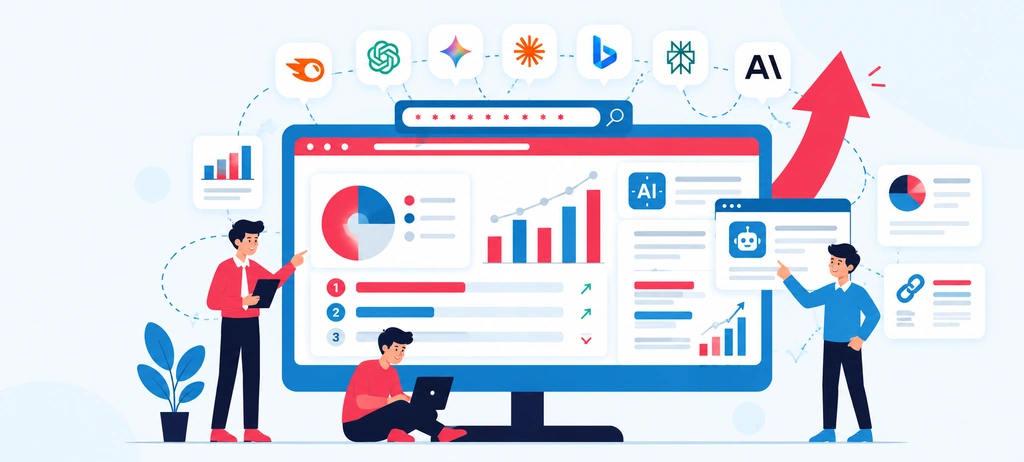
Google AI Overviews appear at the very top of search results — above paid ads, above the Local Pack, above every organic result. Businesses that appear in AI Overviews receive 35% more organic clicks than those that rank in position one without an AI citation. The five most common reasons a business does not appear in AI answers are: inconsistent business information, a Google Business Profile that has not been updated in 30 or more days, no FAQ-formatted content, no schema markup, and no mentions from third-party sources.
You have seen it. Someone searches for "best dentist near me" or "HVAC company in Tampa" and Google shows an AI-generated answer box at the very top of the page — before the ads, before the map, before everything. Sometimes it names specific businesses. Sometimes it recommends a type of business and explains what to look for.
Your business is not in it. Your competitors might be. And you are not sure what to do about it.
This guide explains what is happening, why your business might be missing, and five specific things you can do this week — none of which require a technical background.
What Google AI Overviews Actually Are — In Plain English
Google AI Overviews are the box of text that appears at the very top of certain search results. Google's AI reads multiple websites, pulls out the most relevant information, and shows the user a summary — all before they click on anything.
They appear for questions people type into Google: "what is the best way to whiten teeth," "how do I choose a plumber," "which SEO agency is best for small businesses," "what should I look for in a family dentist."
Here is why this matters for your business.
AI Overviews appear before everything else on the page. Before paid ads. Before the map results. Before the ten blue links. If your competitor is named in an AI Overview answer and you are not, their name appears first — and first is where the decision often happens.
Being cited in an AI Overview results in 35% more clicks than ranking in position one organically without one. Not 35% more from the AI Overview alone — 35% more total. Being mentioned builds trust before the searcher even reads a result.
Zero-click searches are rising — searches where the user gets their answer from the AI box and does not click anything. For businesses, this means your name appearing in the AI answer builds brand recognition even when no click happens. The business that gets named in AI answers consistently becomes familiar. The business that never appears stays invisible.
Why AI Overviews Matter Even More for Local Businesses
Something that surprises most business owners: AI Overviews appear frequently for local searches, not just information questions.
46% of all Google searches have local intent — "near me" searches, city-name searches, searches for specific business types in specific areas. Google's AI increasingly answers these with specific business recommendations or descriptions of what to look for in a local provider.
"Best dentist in Hyde Park Tampa" — AI Overview might describe what credentials to look for or name a practice.
"Plumber open on weekends Dallas" — AI Overview might describe what to expect and cite specific businesses.
"HVAC maintenance check near me" — AI Overview might explain the process and mention local providers.
Your Google Business Profile is now one of the primary sources Google's AI reads when generating these local answers. A GBP that is complete, active, and consistent is a direct input into AI Overview content — not just a Local Pack ranking factor.
The Five Reasons Your Business Is Not Showing Up
Here are the most common reasons businesses are missing from Google AI answers — and the honest truth is that most of them are fixable within a week.
Google's AI needs to be confident that the information it presents is accurate before it will cite your business. If your business name, address, or phone number is different on your website versus your Google Business Profile versus your Yelp page versus your Facebook page, Google's AI interprets this inconsistency as a reliability problem. It is unlikely to recommend a business whose core information it cannot independently verify.
What this looks like in practice:
Your website says "Smith Dental — 245 Main Street, Tampa FL." Your Google Business Profile says "Smith Dental Care — 245 Main St, Tampa." Your Yelp page says "Smith Dental Group — 245 Main St., Tampa, Florida."
Three different business names. Abbreviated street versus full street. Missing zip code. No suite number that is present elsewhere. These are small differences that feel trivial — and to Google's AI, they add up to uncertainty.
The fix: Check your business name, address, and phone number on every platform where you have a listing — Google Business Profile, Yelp, Facebook, your website footer, Apple Maps, Bing Places, and any industry directories. Make them identical everywhere. Exactly the same spelling, exactly the same abbreviation style, exactly the same format.
Reason 2: Your Google Business Profile Has Not Been Updated Recently
This one surprises most business owners. Businesses that have not posted anything on their Google Business Profile in 30 or more days see significant drops in AI Overview visibility. Google's AI gives heavy weight to profile activity and freshness — an active profile signals an operating, engaged business. A dormant one signals the opposite.
What this looks like in practice:
Your GBP was set up two years ago. It has your address, your hours, your phone number. You have not added photos since then. You have not published a post since a promotion six months ago. From Google's perspective, this profile could belong to a business that has closed or reduced operations.
The fix: Publish one GBP post this week. Add three to five new photos from the last 30 days. Check that your hours are current — including any holiday or seasonal variations. Respond to any unanswered reviews. These actions do not need to be elaborate. A photo of your team, a post about a seasonal service, a response to a recent review — any of these signal activity. Target at least one post per week going forward.
Reason 3: Your Website Does Not Have FAQ-Formatted Content
Google's AI is looking for content it can extract and present as an answer. It is specifically looking for content structured as questions followed by direct, clear answers. A website with pages titled "About Us," "Services," and "Contact" gives Google's AI almost nothing it can extract as a specific answer to a specific question.
What this looks like in practice:
A dental practice website that says "We offer comprehensive dental services including cleanings, whitening, and implants" cannot be cited in an AI Overview for the question "how much does teeth whitening cost in Tampa" or "what should I ask a dentist before getting implants." There is no answer-shaped content for Google to pull.
The fix: Add FAQ sections to your key service pages and publish at least one blog post answering a specific question your customers ask regularly. Format it clearly: a question as the heading, a direct answer in the first two sentences below it, then more detail.
You do not need to be a writer. Think of the three questions your customers ask most often when they call you. Write those questions down. Answer each one the way you would answer it on the phone — directly and plainly. That is the content Google's AI can cite.
Examples of questions that generate AI Overview appearances for local businesses:
- "How long does a dental cleaning take?"
- "What is included in an HVAC maintenance check?"
- "How much does drain cleaning cost?"
- "What should I look for when hiring a plumber?"
- "When should I replace my water heater?"
Each one of these, answered clearly on your website, is a potential AI Overview citation.
Reason 4: Your Website Has No Schema Markup
Schema markup is a small piece of code that tells Google's systems exactly what type of business you are, exactly what your services are, and exactly where you operate. Most websites do not have it. Adding it is one of the fastest ways to become eligible for AI Overview citations.
For a business owner, the important thing is not understanding the technical details — it is knowing that it matters and that your web developer can add it in an afternoon.
What schema does in plain English:
Without schema, Google has to guess what your website is about by reading the words on it. With schema, you are directly telling Google: "I am a dental practice. My address is X. I serve patients in Tampa and Clearwater. My services include cleanings, whitening, and implants. My hours are Monday to Friday 8am to 6pm."
Google's AI uses this structured information directly when generating local search answers. A business with schema is providing a clear, machine-readable brief. A business without schema is leaving Google to interpret context.
The fix for business owners: Email your web developer or your website platform support and ask them to add "LocalBusiness schema" and "FAQPage schema" to your website. If you use WordPress, a plugin called Rank Math or Yoast SEO can add the most important schema through a guided setup without any coding. For the LocalBusiness schema, you need: business name, address, phone, hours, and service area. For FAQPage schema, you need the FAQ sections you add based on Reason 3 above.
Reason 5: Your Business Is Not Mentioned Anywhere Else Online
Google's AI builds a picture of your business by reading your own website, your GBP, your reviews — and also by finding mentions of your business on other websites. The more places Google finds consistent, positive mentions of your business, the more confident it becomes that you are a real, credible, operating business worth recommending.
A business that exists only on its own website and GBP has a thin entity profile. Google's AI is cautious about recommending businesses it cannot verify from multiple independent sources.
What this looks like in practice:
A plumbing company with a website, a GBP with 60 reviews, and listings on Angi, HomeAdvisor, the local Chamber of Commerce directory, and a mention in a local news article about emergency plumbing tips has a rich entity profile. Google's AI can verify this business is real, legitimate, and locally active from multiple independent sources.
A competing plumbing company with a website and a GBP but no other presence has a thin entity profile. Google cannot independently verify much beyond what the business says about itself.
The fix: This week, claim and complete your profile on three of these: Yelp, Angi, the Better Business Bureau, your local Chamber of Commerce directory, and any industry-specific directory relevant to your business (Healthgrades for healthcare, Avvo for legal, Houzz for home improvement). Each one creates an independent mention that strengthens your entity profile. You do not need 30 listings — five to ten high-quality, consistent ones make a significant difference.
Not appearing in Google AI answers while your competitors are?
W3Era checks the five things above — your entity consistency, GBP activity, FAQ content, schema markup, and third-party mentions — and tells you exactly which ones are missing or broken for your business.
It takes us 24 hours. It costs you nothing.
The Fix in One Week — Your Action Plan
If you found problems in the five reasons above, here is the sequence to work through this week:
Day 1 — Fix your business information consistency (30 minutes): Check your name, address, and phone number on Google Business Profile, your website, Yelp, Facebook, and Apple Maps. Make them identical. Write down the exact format you will use everywhere and use only that format going forward.
Day 2 — Update your Google Business Profile (20 minutes): Add five new photos. Publish one GBP post — a seasonal tip, a recently completed job, a quick answer to a common customer question. Respond to any unanswered reviews. Set a recurring reminder to post weekly.
Day 3 — Write one FAQ page or section (45 minutes): Pick the three questions your customers ask most often. Write them as question headings with direct answers in the first two sentences. Add this as a FAQ section to your most important service page or as a standalone FAQ page. Keep the language simple — write the way you speak on the phone.
Day 4 — Ask your developer to add schema (10 minutes for you): Send your web developer a note: "Can you add LocalBusiness schema and FAQPage schema to our website? I've heard this helps with Google AI search visibility." If you use WordPress with Yoast or Rank Math, enable the schema features yourself through the plugin settings.
Day 5 — Claim three new directory listings (40 minutes): Choose three directories you are not yet on. Claim and complete your profile with your consistent business information, a photo, and a short description of your services. Prioritise directories that rank in Google for your business type and city.
Total time investment: under three hours. These five actions address every reason Google's AI might be excluding your business from its answers.
What to Expect After Making These Changes
Changes to your AI Overview visibility do not happen overnight. Google's systems need time to recrawl your updated content, re-evaluate your entity signals, and recalibrate your relevance for specific queries.
A realistic timeline:
- GBP activity improvements: visible effect within two to four weeks
- Business information consistency: benefits accumulate over four to eight weeks as Google recrawls all the sources
- New FAQ content: indexed and evaluated within one to three weeks of publication
- Schema additions: indexed and evaluated within one to three weeks
- New directory listings: indexed over four to eight weeks
You will not see overnight results. But if you check your Google Search Console in 60 days and look at the Search Appearance filter for your business, you should see AI Overview impressions appearing or increasing for queries where you previously had none.
The business owners who see the biggest results from these changes are consistently the ones who do all five, not just one or two. Each fix reinforces the others — consistent information helps schema work better, active GBP helps FAQ content work better, FAQ content helps directory mentions work better. The system is cumulative.
One Thing to Check Right Now
Open Google and search for your most important service keyword — "dentist Tampa" or "plumber near me" or "HVAC company Dallas" — whatever a customer would type to find you.
Does an AI Overview box appear at the top? If yes, is your business named in it? If no, do your competitors appear?
Then search for your business name directly — "[Your Business Name] [City]." Does an AI Overview appear for your business name? If yes, does it present the information accurately? If the AI describes your business incorrectly or incompletely, that is a signal your entity information needs strengthening.
What you find in these two searches tells you more about your current AI visibility than any tool or report. Do them now, before making any of the fixes above, so you have a baseline to compare against in 60 days.
PEOPLE ALSO READ