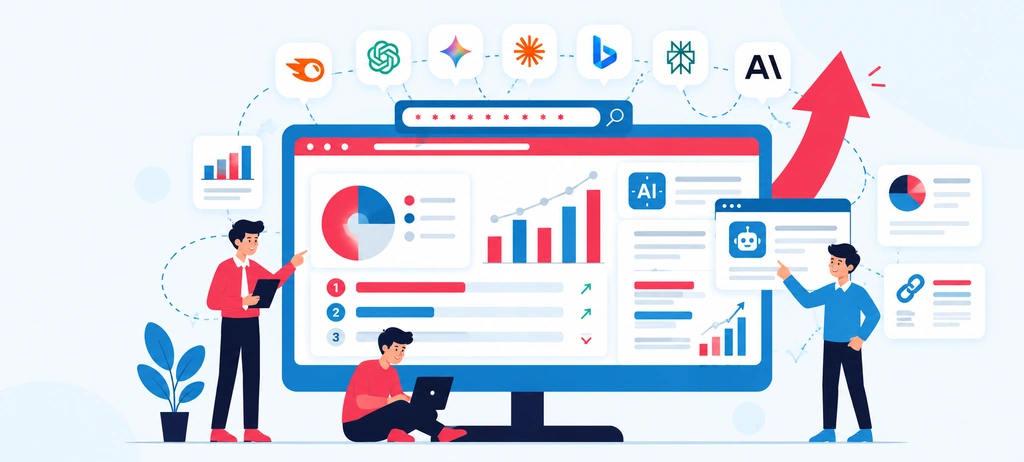
ChatGPT now handles over one billion searches per week. Only 62% of brands that rank on Google's first page appear in ChatGPT responses — meaning ranking well on Google no longer guarantees AI visibility. Businesses that appear in ChatGPT answers have three things in common: consistent brand information across multiple trusted websites, content structured so AI can extract direct answers, and frequent mentions in publications that AI systems treat as authoritative sources. All three are buildable regardless of your business size or budget.
Try this right now. Open ChatGPT and type: "What are the best [your service type] companies in [your city]?"
Or: "Who are the top [dentists / plumbers / SEO agencies / restaurants] in [your area]?"
Look at what comes back. If your competitor's name appears and yours does not, this guide explains exactly why — and what you can do about it.
ChatGPT now handles over one billion searches per week. Perplexity processes over one billion queries monthly. Google Gemini is handling an increasing share of research queries. These are not fringe tools used by tech enthusiasts — they are where a growing share of real buyers are doing real research before making real purchasing decisions.
The businesses that show up in those answers do not have a magic advantage. They have done specific, repeatable things that made them visible to AI systems. This guide shows you what those things are, why they work, and how to do them for your business.
Why ChatGPT Recommends Some Businesses and Not Others
Before the fixes, the explanation — because understanding why is what makes the fixes make sense.
ChatGPT does not have a secret algorithm you can game. It works on a surprisingly logical principle: it recommends businesses that it has encountered frequently, consistently, and positively across many trustworthy sources on the internet.
Think of it this way. Imagine you asked a knowledgeable friend "which plumber should I call in Dallas?" Your friend would recommend the plumber they have heard about most often, in the most credible contexts — mentioned in the neighbourhood Facebook group, reviewed on Google, featured in a local news story about emergency plumbing, listed on Angi and HomeAdvisor, and recommended by a friend who had good experience.
ChatGPT operates the same way — except instead of conversations and memory, it reads websites. It recommends businesses it has read about most often, from the most credible sources, with the most consistent information.
Your competitor is showing up because ChatGPT has encountered them more times, in more trustworthy places, with more consistent information. Not because they have access to something you do not.
The specific signals ChatGPT reads:
How many places mention your business. A business with accurate, consistent information on Google Business Profile, Yelp, Angi, the local Chamber of Commerce directory, three industry publications, and a local news article has given ChatGPT many points of reference. A business that exists only on its own website has given ChatGPT one.
How consistent that information is. If your business name is spelled differently on different sites, if your address is sometimes abbreviated and sometimes spelled out, if your phone number is different on Yelp than on your website — ChatGPT treats this inconsistency as uncertainty. It is less confident about recommending a business whose basic information does not align across sources.
How trustworthy the sources are. A mention in a local newspaper carries more weight than a mention on a directory with 50,000 listings and no editorial standards. A review on a verified platform carries more weight than an unverified blog comment. ChatGPT weighs the authority of each source it reads.
How clearly your content describes what you do. A business whose website says "we offer comprehensive solutions for your needs" has told ChatGPT almost nothing. A business whose website says "emergency plumbing repair, drain cleaning, and water heater installation in Dallas — serving Plano, Frisco, and McKinney" has told ChatGPT exactly what it does, exactly where, and given it specific phrases to match against user queries.
The Real Example — What Your Competitor Did Differently
Here is how to find out exactly what your competitor is doing that you are not.
Step 1: Confirm your competitor is appearing where you are not.
Open ChatGPT and type the query a potential customer would ask:
- "Best dentist in [your neighbourhood]"
- "Top SEO agency in [your city]"
- "Reliable plumber in [your area] with good reviews"
Note which business names appear. If your competitor appears and you do not, proceed to Step 2.
Step 2: Map where your competitor is mentioned.
Go to Google and type this exactly:
"[Competitor Business Name]" -site:[competitorwebsite.com]
This search shows every website that mentions your competitor's name — except their own site. This is your ready-made checklist.
You will typically find your competitor mentioned in:
- Local directories (Yelp, Angi, HomeAdvisor, BBB, Chamber of Commerce)
- Industry-specific directories (Healthgrades for dentists, Avvo for lawyers, Houzz for home improvement)
- Review platforms (Google, Trustpilot, industry review sites)
- Local news articles (sponsorships, business milestones, community involvement)
- Industry publications (guest articles, expert quotes, data citations)
Every source you find is a place where ChatGPT has encountered your competitor's name and built confidence in recommending them. Every source on that list that you are not on is an opportunity.
Step 3: Find the gap.
Compare the list of places mentioning your competitor against the list of places mentioning you (run the same search with your own business name). The difference between the two lists is your AI visibility gap — and it is directly actionable.
The Four Things That Put Your Competitor in ChatGPT
Based on what the research shows about how AI systems select businesses to recommend, four factors explain the gap most clearly.
Factor 1: They are mentioned more places, more consistently
This is the entity signal. ChatGPT's underlying systems build a picture of a business from everything they have read about it. A business with 15 consistent mentions across authoritative sources has a stronger entity signal than one with 3 mentions and inconsistent information.
Your competitor likely has:
- Complete profiles on every major local and industry directory
- Consistent name, address, and phone number everywhere
- Reviews on multiple platforms with responses from the business
- A Wikipedia or Wikidata entry (for larger businesses)
- Mentions in local and industry news
Each of these adds another data point. ChatGPT's confidence in recommending a business increases with each verified, consistent mention it finds.
Factor 2: Their website answers questions directly
44.2% of verified ChatGPT citations came from the top 30% of a page's content. AI systems extract answers from content structured as direct answers — not from content written as a general overview.
Your competitor's website likely has:
- FAQ sections with specific questions answered in two to three sentences
- Content that opens with the answer rather than building up to it
- Specific numbers: prices, timelines, service areas, credentials
- Clear descriptions of what they do and where
A dental practice page that says "Our experienced team provides comprehensive oral care in Tampa, specialising in cosmetic dentistry, dental implants, and teeth whitening for patients throughout Hillsborough County" has given ChatGPT extractable, specific information. A page that says "We are dedicated to your smile" has given it almost nothing.
Factor 3: They have been cited by sources ChatGPT trusts
ChatGPT does not treat all websites as equally trustworthy. Publications with editorial standards, professional directories, government sites, and established industry resources carry more weight than anonymous directories or thin affiliate sites.
Your competitor has likely been:
- Featured in a local newspaper or business journal article
- Listed in their professional or trade association directory
- Included in a "best of" roundup by a local or industry publication
- Mentioned in a guest article on a relevant industry website
- Cited as a source of expertise in a media piece
Each of these creates what researchers call an "off-site citation" — a credible, third-party source confirming that this business exists and is worth knowing about. The more of these a business accumulates, the more frequently and confidently ChatGPT includes them in answers.
Factor 4: They have been doing this longer
ChatGPT's knowledge cutoff for training data and its live web search behaviour both favour businesses with established, long-term digital presences. A business that has accumulated citations, mentions, and reviews over three years has a larger footprint than one that started building six months ago.
This is the most important reason not to wait. Every month that passes without building your AI presence is a month your competitor is extending the lead. The businesses building this in 2026 are establishing citation advantages that become harder to close each year.
Your competitor is in ChatGPT answers because of specific, traceable actions — not magic.
W3Era identifies exactly where your competitors are being cited, builds the same citation presence for your business across the platforms that AI systems trust, and structures your content so ChatGPT, Gemini, and Perplexity can extract and recommend it.
This is what GEO — Generative Engine Optimisation — looks like in practice. Not theory. Actual citation building with tracked results.
How to Fix It — The Practical Steps
These are the specific actions that build ChatGPT visibility. None require a technical background. All are actionable this week.
Your business name, address, and phone number need to be identical on every platform where your business appears. Not similar. Identical.
Check and align these:
- Google Business Profile
- Your website footer and contact page
- Yelp
- Facebook
- Apple Maps
- Bing Places
- Any industry directory where you appear
The exact format matters. "Smith Dental" and "Smith Dental Care" are two different entities to an AI system. "245 Main St" and "245 Main Street" introduce uncertainty. Pick one exact format and make it consistent everywhere this week.
Step 2: Claim and Complete the Directories Your Competitor Is Listed On
Run the competitor search above — "Competitor Name" -site:competitorwebsite.com — and make a list of every directory and publication that mentions them. Then claim and complete your own profile on every one that you are not already on.
Prioritise these if you have not already:
- Yelp (for local service businesses)
- Angi and HomeAdvisor (for home services)
- Healthgrades (for healthcare)
- Avvo and Justia (for legal)
- Clutch and Goodfirms (for professional services and agencies)
- Better Business Bureau
- Your local Chamber of Commerce directory
- Your professional or trade association directory
Each completed profile is a data point that increases ChatGPT's confidence in recommending you. This is not about gaming an algorithm — it is about giving AI systems more verified, consistent information to work from.
Pick the most important page on your website — the one you most want potential customers to find you through. Restructure the opening paragraph to answer the key question a customer would ask in ChatGPT.
Before: "Welcome to Smith Dental. We are committed to providing exceptional dental care in a comfortable and welcoming environment."
After: "Smith Dental is a family dental practice in Hyde Park, Tampa, providing teeth whitening, dental implants, Invisalign, and emergency dental care. Open Monday to Saturday. New patients welcome. 0.3 miles from Hyde Park Village."
The second version answers: who you are, what you do specifically, where you are, when you are available, and who you serve. ChatGPT can extract and repeat all of it. The first version answers almost nothing.
Then add a FAQ section to the same page with three to five specific questions:
- "What does Smith Dental specialise in?"
- "Does Smith Dental accept new patients?"
- "Where is Smith Dental located?"
- "Does Smith Dental offer emergency dental appointments?"
Answer each one directly in two to three sentences. This FAQ content is what ChatGPT pulls when answering conversational queries about your business.
Step 4: Get One New Mention From a Trusted Source This Month
Off-site citations from credible sources are the highest-impact AI visibility action available — and the hardest to shortcut. Competing articles tell you to "get featured in publications." Here is how to actually do it.
The local news route: Contact your local newspaper or business journal. Tell them about a business milestone (years in operation, a new service, a community initiative, a notable client result). Local business journalists need stories. A well-framed pitch about a real business development has a reasonable chance of earning a mention or a brief feature.
The industry directory route: Every professional association and trade organisation has a member directory. If you are a dentist, the ADA directory matters. If you are a lawyer, state bar directories matter. If you are a plumber, PHCC directory listings matter. These are high-authority sources that AI systems trust specifically because of their editorial and membership standards.
The guest article route: Identify one local or industry blog that publishes guest contributions. Pitch an article answering a question your customers ask frequently. A dental practice article on "what to expect at your first orthodontic consultation" published on a local health and wellness blog creates a citation from a third-party source that is relevant, readable, and citable by ChatGPT.
The guest expert route: Reach out to journalists who cover your industry and offer to be a source for future stories. HARO (Help a Reporter Out) and Qwoted list active journalist queries. A quote in an article about your industry, attributed to you by name and business, creates a high-authority citation that AI systems weight heavily.
Step 5: Track Whether It Is Working
After implementing the steps above, monitor your AI visibility with two simple checks:
Check 1 — Monthly prompt audit: Once a month, open ChatGPT, Perplexity, and Google Gemini. Search for five to ten queries a customer would use to find your type of business in your area. Note which sessions mention your business. Note which mention competitors instead. Track month over month.
Check 2 — Branded search volume in GSC: When ChatGPT recommends your business and a user then searches your business name to find your website, that creates branded search traffic. In Google Search Console, track your branded search query volume monthly. Rising branded search volume after building AI presence is a reliable indirect indicator that AI systems are surfacing you to users who then search your name directly.
The Difference Between Being Mentioned and Being Cited
One distinction worth knowing because it affects how you measure success.
A mention is when ChatGPT writes your business name in its answer — recommending you from its training data or live search results.
A citation is when ChatGPT links to a specific URL from your website as a source — pulling and attributing specific content from your pages.
You can be mentioned without being cited (ChatGPT recommends you but does not link to you) and cited without being prominently mentioned (it pulls a statistic from your blog but names another business in the answer).
Both matter. Mentions build brand recognition. Citations drive direct traffic to your website.
The steps in this guide build both. Citation frequency increases as you publish structured, specific content. Mention frequency increases as more trusted sources reference your business name.
How Long Until You Start Appearing
Building ChatGPT visibility is faster than building traditional SEO rankings — but it is not overnight.
Directory citations: The fastest to appear. New directory listings are often indexed and read by AI systems within two to four weeks. If ChatGPT runs a live web search for your query type (which it does for approximately one-third of queries), new directory listings can produce citations within weeks.
Website content restructuring: Indexed by Google and other search engines within one to three weeks. AI systems that use live search can begin referencing restructured content relatively quickly. Training data updates are slower — but live search makes recent content accessible to ChatGPT sooner.
Off-site citations from publications: The most impactful and the longest lead time. An article in a local newspaper needs to be indexed, read, and weighted before it influences AI recommendations. Allow four to eight weeks for off-site citations to begin affecting AI visibility.
Realistic timeline: Most businesses that implement all four steps above see measurable improvement in their monthly prompt audit within 60 to 90 days — either appearing where they did not before or appearing more frequently and prominently in answers where they previously appeared occasionally.
PEOPLE ALSO READ