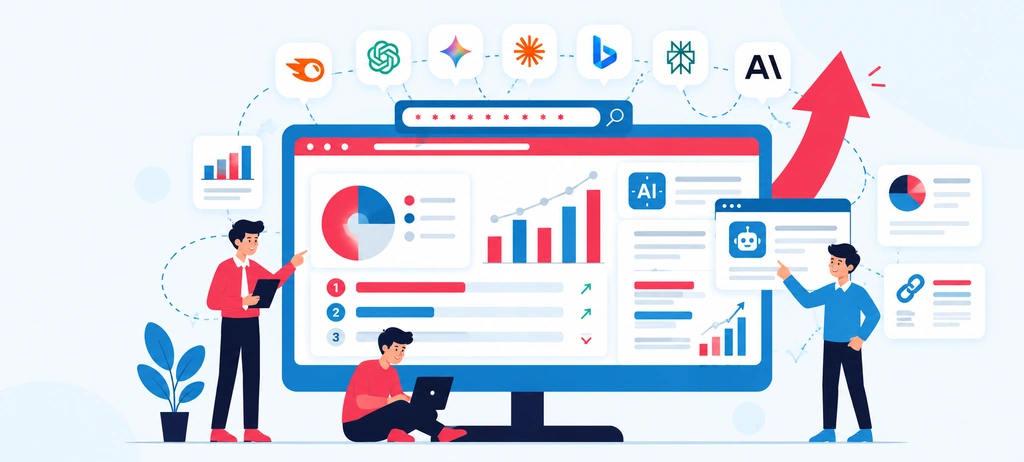
Generative engine optimization is the process of improving your content, brand presence, technical accessibility, entity clarity, and source authority so AI answer engines such as Google AI Overviews, AI Mode, ChatGPT, Gemini, and Perplexity can better understand, summarize, mention, or cite your brand in AI-generated responses.
Search is changing from a list of links into a layer of AI-generated answers. Buyers now ask Google AI Overviews, AI Mode, ChatGPT, Perplexity, Gemini, and other AI answer engines to compare options, summarize topics, recommend brands, and explain next steps. That creates a new visibility challenge: your content must not only rank, but also be easy for AI systems to understand, trust, cite, and summarize. Generative engine optimization helps businesses prepare for this shift. It combines SEO, semantic SEO, AEO, technical accessibility, entity-focused optimisation, credible sourcing, schema-enhanced content, and off-site authority so your brand can become more visible in AI-generated answers. Google’s own guidance says core search optimisation practices remain relevant for generative AI features in Search, including AI Overviews and AI Mode. Google also explains that these features may use retrieval-augmented generation and query fan-out to find supporting web pages. (Google for Developers) This guide explains what GEO is, why it matters, how it differs from SEO and AEO, and how to build a practical GEO strategy for W3era’s clients.
Key Takeaways
- GEO is not a replacement for SEO. For Google Search, GEO and AEO are still connected to foundational SEO, helpful content, crawlability, and technical clarity. (Google for Developers)
- AI answer engines reward content that is clear, structured, source-backed, entity-rich, and easy to extract.
- Google AI Overviews and AI Mode can use query fan-out, which means one user query may trigger several related searches across subtopics and sources. (Google for Developers)
- AI visibility depends on owned content and off-site authority. A 2025 research paper found AI search shows strong preference for earned media and authoritative third-party sources over brand-owned content. (arXiv)
- GEO should never rely on manipulative tactics. Google’s spam policy covers attempts to manipulate generative AI responses in Google Search. (Google for Developers)
- The best GEO strategy combines technical SEO, semantic SEO, answer-first content, structured data, expert review, credible citations, internal links, and AI visibility tracking.
What Is Generative Engine Optimization?
Generative Engine Optimization, or GEO, is the practice of optimizing a brand’s digital presence so generative AI systems can understand, reference, summarize, and cite it accurately. Traditional SEO focuses on helping pages rank in search engine results. GEO focuses on helping brands appear inside AI-generated answers, recommendations, summaries, comparisons, and citations.
A GEO strategy usually includes:
· Crawlable and indexable content
· Clear page structure
· Answer-first writing
· Topic clusters
· Entity optimization
· Internal linking
· Schema markup
· Source citations
· Author and reviewer trust signals
· Third-party authority mentions
· AI visibility monitoring
GEO matters because AI search experiences are becoming part of everyday discovery. OpenAI says ChatGPT search can provide fast, timely answers with links to relevant web sources, while Perplexity’s Search API provides real-time ranked web results from a refreshed index. (OpenAI)
Why Generative Engine Optimization Matters Now
AI search is reshaping how users move from question to decision. Instead of reviewing ten pages manually, users may ask an AI engine to compare providers, summarize the best options, identify pros and cons, or recommend next steps. Google says AI Overviews provide snapshots of key information with links to explore more, and its AI Overviews page states the feature is available in more than 120 countries and territories and 11 languages. (Home) Search behavior is also changing. Semrush analyzed more than 10 million keywords and found that AI Overviews appeared for 6.49% of queries in January 2025, peaked at 24.61% in July, and settled at 15.69% in November 2025. Semrush also found that commercial, transactional, and navigational AI Overview triggers increased during 2025. (Semrush) Click behavior is shifting too. Pew Research Center found that users who saw a Google AI summary clicked a traditional result in 8% of visits, compared with 15% when no AI summary appeared. Pew also found that users clicked a link inside the AI summary in only 1% of visits. (Pew Research Center) For businesses, the takeaway is clear: ranking is still important, but it is no longer the only visibility metric. GEO helps brands compete for mentions, citations, assisted discovery, and trust in AI-powered search journeys.
GEO vs SEO vs AEO vs LLM Optimization
| Strategy |
Main goal |
Where it matters |
What to optimise |
| SEO |
Rank pages in organic search results |
Google, Bing, classic SERPs |
Technical SEO, keywords, content quality, links, internal linking, structured data |
| GEO |
Improve visibility in AI-generated answers |
Google AI Overviews, AI Mode, ChatGPT, Perplexity, Gemini, Copilot |
Extractable content, citations, entity clarity, brand authority, third-party mentions |
| AEO |
Provide direct answers for answer engines |
Featured snippets, People Also Ask, voice search, AI answers |
Question headings, answer blocks, FAQs, concise definitions, schema alignment |
| LLM Optimization |
Improve how LLMs understand and represent the brand |
ChatGPT, Claude, Gemini, Perplexity, AI assistants |
Brand facts, consistent entities, source authority, prompt testing, citation footprint |
| Semantic SEO |
Improve meaning, topical relevance, and entity relationships |
Search engines and AI systems |
Entities, semantic topic mapping, schema, internal links, contextual relevance |
Google’s guidance is especially important here: for Google Search, there are no additional technical requirements to appear in AI Overviews or AI Mode beyond being indexed and eligible to appear in Search with a snippet. Google recommends foundational SEO, crawlability, internal links, page experience, textual content, high-quality media, and structured data that matches visible content. (Google for Developers)
How Generative Engines Understand and Use Content
Generative engines do not all work the same way. Some retrieve live web results, some rely partly on indexed content, some use retrieval-augmented generation, and some generate answers with cited sources when web search is enabled. For Google Search, Google explains that generative AI search features are rooted in core Search ranking and quality systems. These systems may use retrieval-augmented generation to retrieve relevant, up-to-date pages and query fan-out to run multiple related searches across subtopics. (Google for Developers) For ChatGPT search, OpenAI says ChatGPT can search the web to provide timely answers with links to relevant web sources. OpenAI’s help documentation also says search responses may include inline citations or a source panel. (OpenAI) For Perplexity, its Search API documentation says it provides real-time access to ranked web results from a continuously refreshed index, with filtering by domain, language, and region. (Perplexity) This means GEO is not a single trick. It is a multi-layer strategy that improves the chance that AI systems can find, interpret, and trust your content.
Data, Research, and Insights
Insight 1: AI search is moving beyond informational queries Semrush found that the share of AI Overview triggers for commercial, transactional, and navigational queries increased during 2025. Commercial queries rose from 8.15% to 18.57%, transactional queries rose from 1.98% to 13.94%, and navigational queries rose from 0.84% to 10.33%. (Semrush) Business interpretation: GEO should not be limited to blog content. Brands should optimize service pages, comparison pages, product pages, pricing-support content, case studies, and brand FAQs. Insight 2: AI summaries can reduce traditional clicks Pew found that users clicked traditional search results less often when AI summaries appeared, and they rarely clicked links inside the summary itself. (Pew Research Center) Ahrefs separately reported that the presence of an AI Overview correlated with a 58% lower average click-through rate for the top-ranking page in its December 2025 data update. (Ahrefs) Business interpretation: SEO teams should track rankings, but also AI mentions, citations, branded search growth, assisted conversions, and engagement quality. Insight 3: Third-party authority matters A 2025 GEO research paper found that AI search shows strong preference for earned media and authoritative third-party sources over brand-owned and social content. It also found differences across AI search services in domain diversity, freshness, cross-language stability, and query phrasing sensitivity. (arXiv) Business interpretation: A GEO strategy should include digital PR, partnerships, expert mentions, review platforms, industry directories, original research, and credible citations—not just website content. Insight 4: Source-backed writing performs better in GEO research The original GEO research paper introduced GEO-bench and reported that GEO methods can improve visibility by up to 40% in generative engine responses, while also noting that effectiveness varies by domain. (arXiv) Business interpretation: Do not rely on generic AI-written content. Add citations, statistics, expert quotes, clear summaries, and domain-specific evidence. Insight 5: Google is drawing a line between optimization and manipulation Google’s spam policy says spam includes techniques used to deceive users or manipulate Search systems into featuring content prominently, including attempts to manipulate generative AI responses in Google Search. Sites violating these policies may rank lower or not appear in results. (Google for Developers) Business interpretation: Ethical GEO should improve usefulness, clarity, accessibility, and credibility. It should not use hidden text, fake mentions, doorway pages, keyword stuffing, or “recommendation poisoning.”
The W3era CITABLE Framework for Generative Engine Optimization
Use this original CITABLE Framework to build GEO-ready content and brand visibility.
C — Crawlable and indexable source pages
AI search visibility begins with access. If a page cannot be crawled, indexed, or understood, it cannot reliably support AI-generated answers.
Checklist:
· Allow crawling for important pages.
· Check robots.txt, noindex tags, canonical tags, redirects, and sitemap status.
· Make important content available in visible text.
· Avoid hiding key content behind tabs, scripts, images, or gated flows.
· Improve page speed, mobile experience, and content layout.
· Verify pages in Google Search Console.
· Google says pages must meet Search technical requirements and be eligible for a snippet to appear as supporting links in AI Overviews or AI Mode. (Google for Developers)
I — Intent and prompt mapping
Traditional semantic keyword discovery is not enough for GEO. AI search users ask full questions, compare options, and request summaries.
Map prompts such as:
· “What is generative engine optimization?”
· “How do I get my website cited by ChatGPT?”
· “GEO vs SEO vs AEO: what is the difference?”
· “How can a SaaS company improve AI search visibility?”
· “Which brands are best for [category] and why?”
· “What sources does Perplexity cite for [topic]?”
· Turn each prompt cluster into a section, FAQ, comparison table, or supporting article.
T — Topical entity architecture
GEO depends on clear meaning. Search engines and AI systems need to understand your brand, services, topics, authors, and relationships.
For this page, important entities include:
· Generative Engine Optimization
· GEO SEO
· AI search visibility
· AI answer engines
· LLM citations
· ChatGPT
· Google AI Overviews
· Google AI Mode
· Perplexity
· Gemini
· Direct-answer strategy
· Semantic SEO
· Structured data
· Brand mentions
· Source authority
· Use consistent naming across the page, service pages, author bios, schema, internal links, and social profiles.
Every major section should answer the reader’s question immediately, then expand with proof, context, and examples.
Use:
· 40–60 word answer blocks
· Clear H2/H3 headings
· Definitions
· Tables
· Step-by-step workflows
· Short paragraphs
· FAQs
· Summaries
· Source citations
· This supports featured snippets, People Also Ask, AI Overviews, voice-style search, and LLM extraction.
B — Brand authority and earned mentions
AI engines may use third-party sources to validate brand claims. That means a GEO strategy should include both on-site content and off-site authority.
Build authority through:
· Industry publications
· Partner mentions
· Expert interviews
· Case studies
· Review platforms
· Podcasts
· Data reports
· Digital PR
· Reputable directories
· YouTube and forum visibility where relevant
· This matters because AI search may prefer earned media and authoritative third-party sources in some contexts. (arXiv)
L — Linked evidence and structured data
GEO content should be supported by credible evidence. Use source citations for data, official documentation for platform claims, and structured data to clarify page meaning.
Add:
· Article or BlogPosting schema
· WebPage schema
· BreadcrumbList schema
· Organization schema
· Person schema for author and reviewer
· FAQPage schema only if FAQs are visible and appropriate
· SameAs links for W3era social profiles
· Google recommends structured data that matches visible content and notes structured data is not required for generative AI search, but it remains useful as part of an overall SEO strategy. (Google for Developers)
E — Evaluate AI visibility and business impact
GEO measurement should include more than rankings.
Track:
· AI Overview presence
· AI Mode supporting links
· ChatGPT mentions and citations
· Perplexity citations
· Gemini mentions
· Branded search growth
· Referral traffic from AI platforms
· Share of voice in prompt testing
· Sentiment of AI-generated brand answers
· Assisted conversions
· Content refresh impact
· Third-party citation footprint
· Use manual prompt testing, AI visibility tools, Search Console, GA4, server logs, and CRM attribution together.
Practical GEO Workflow for Businesses
1. Step 1: Audit current AI visibility
Test priority prompts across Google AI Overviews, AI Mode, ChatGPT search, Perplexity, and Gemini. Record whether your brand appears, which competitors appear, which sources are cited, and what claims are made.
2. Step 2: Build a prompt and intent map
Group prompts into informational, commercial, comparison, transactional, branded, and troubleshooting categories.
3. Step 3: Identify source gaps
Find which pages AI tools cite instead of your website. Look for missing definitions, weak service pages, thin comparison content, outdated blogs, low authority sources, or poor technical accessibility.
4. Step 4: Upgrade on-site content
Rewrite pages with answer-first sections, stronger entity coverage, credible citations, internal links, examples, schema, and expert review.
5. Step 5: Strengthen off-site authority
Secure credible mentions from industry sites, partners, publications, directories, podcasts, case studies, and review sources.
6. Step 6: Add structured data and trust signals
Use Article, Organization, Person, BreadcrumbList, and WebPage schema. Add author bios, reviewer bios, updated dates, editorial policy, source list, and contact details.
7. Step 7: Measure, refresh, and repeat
Update content quarterly for fast-changing AI search topics. Track prompts, citations, rankings, traffic, conversions, and AI answer accuracy.
GEO Optimization: How to Make Content Citation-Worthy
Generative engines may cite or mention content that is clear, useful, current, credible, and easy to summarize.
How to structure GEO-ready content
Use this pattern for each important section:
· Direct answer
· Short explanation
· Example
· Evidence or citation
· Business implication
· Internal link to deeper resource
· CTA or next step where relevant
Example: weak vs strong GEO content
| Weak content |
Strong GEO content |
| “GEO helps you rank in AI search.” |
“Generative engine optimization helps AI answer engines understand, summarize, mention, or cite your brand by improving content clarity, entity consistency, source authority, structured data, and answer-first formatting.” |
| “Use schema for GEO.” |
“Use Article, WebPage, BreadcrumbList, Organization, and Person schema to clarify page type, author, publisher, breadcrumb path, and brand identity. Keep schema aligned with visible content.” |
| “AI tools like good content.” |
“AI search systems may retrieve, rank, and synthesize content differently, so GEO content should be crawlable, source-backed, entity-rich, and supported by credible third-party mentions.” |
AEO Optimization for GEO
Answer Engine Optimization helps content serve direct answers. GEO and AEO work together because many AI-generated responses are built around concise question-answer patterns.
Use AEO for:
· Definitions
· FAQs
· Featured snippets
· People Also Ask
· Voice-style search
· Conversational prompts
· How-to sections
· Comparison queries
| Element |
Recommendation |
| Answer block |
Add a 40–60 word answer below the introduction |
| H2/H3 headings |
Use question-based headings where useful |
| FAQ answers |
Keep answers around 45–75 words |
| Tables |
Use for comparisons and decision support |
| Lists |
Use for steps, checklists, and criteria |
| Language |
Use natural, direct wording |
| Citations |
Add sources for data and platform claims |
| CTA |
Add a relevant next step after solving the query |
Semantic SEO Optimization for GEO
Semantic SEO improves how search engines and AI systems understand relationships between topics, entities, and user intent.
For this guide, semantic SEO should connect:
· Generative Engine Optimization → AI-first visibility
· GEO → AEO
· GEO → semantic SEO
· GEO → language model discoverability
· GEO → Google AI Overviews
· GEO → ChatGPT search
· GEO → Perplexity citations
· GEO → structured data
· GEO → Entity-focused SEO strategy
· GEO → source authority
NLP Terms to Include Naturally
· citations
· answer extraction
· brand mentions
· source authority
· entity salience
· topical relevance
· AI search visibility
· LLM citations
· retrieval-augmented generation
· query fan-out
· structured data
· answer-first content
· internal linking
· earned media
· prompt testing
AI SEO Optimization Angle
GEO sits inside a broader generative search optimisation plan. AI SEO prepares a website for both classic search and AI-powered discovery.
Google AI Overviews and AI Mode
Google says AI Overviews help users understand complicated topics more quickly, while AI Mode supports deeper exploration, reasoning, and complex comparisons. Google also says both may use query fan-out to issue multiple related searches across subtopics and sources. (Google for Developers)
LLM visibility
LLM visibility focuses on how tools such as ChatGPT, Perplexity, Gemini, Claude, and Copilot represent your brand. It includes citations, mentions, factual accuracy, sentiment, and competitive comparisons.
AI answer readiness
A page is AI-answer-ready when it has:
· Clear definitions
· Direct answers
· Strong topic coverage
· Entity consistency
· Expert authorship
· Updated information
· Credible citations
· Structured data
· Internal links
· Third-party authority signals
Search Intent Mapping Table
| Intent |
Example query |
Recommended content format |
GEO optimisation |
| Definition |
What is generative engine optimization? |
Guide with answer block |
Clear definition, examples, SEO/GEO comparison |
| Strategy |
How to build a GEO strategy |
Framework article |
Step-by-step workflow, checklist, metrics |
| Comparison |
GEO vs SEO vs AEO |
Comparison page or section |
Table, use cases, limitations |
| Commercial investigation |
Best GEO agency |
Service page + case studies |
Proof, reviews, expertise, third-party mentions |
| Technical |
How to optimize for AI citations |
Technical guide |
Crawlability, schema, content structure, source authority |
| Measurement |
How to track AI search visibility |
Analytics guide |
Prompt testing, AI mentions, citations, referrals |
| Brand protection |
Why does ChatGPT show wrong information about my brand? |
Troubleshooting guide |
Entity correction, authoritative profiles, updated pages |
Common Mistakes to Avoid
| Mistake |
Why it hurts |
How to fix it |
| Treating GEO as a quick hack |
AI systems and search engines rely on quality, relevance, and trust signals |
Build a long-term strategy around helpful content, authority, and technical clarity |
| Creating thin AI-generated pages at scale |
Google warns that using generative AI to create many low-value pages may violate scaled content abuse policies |
Use AI for research and structure, but add expert review, original insight, and verified sources |
| Ignoring crawlability |
AI search systems cannot use pages they cannot access or understand |
Fix robots.txt, noindex, canonical, rendering, and sitemap issues |
| Chasing fake mentions |
Inauthentic mentions can be ineffective and risky |
Build legitimate third-party authority through PR, partnerships, reviews, and expert content |
| Overusing schema as a shortcut |
Structured data does not guarantee rich results or AI visibility |
Use accurate schema that matches visible content |
| Forgetting brand entity consistency |
Conflicting names, bios, addresses, or service descriptions can confuse AI systems |
Standardise brand facts across the website, schema, profiles, and directories |
| Writing long content without direct answers |
AI systems and users need clear extraction points |
Add answer blocks, tables, summaries, FAQs, and concise headings |
| Measuring only rankings |
AI search visibility can happen with or without clicks |
Track citations, mentions, prompt share of voice, referrals, and assisted conversions |
| Ignoring off-site authority |
AI tools may rely on third-party sources for validation |
Build earned media, reputable mentions, and citations |
| Overpromising AI citations |
No agency can guarantee inclusion in ChatGPT, Perplexity, Gemini, AI Overviews, or AI Mode |
Position GEO as a visibility and readiness strategy, not a guaranteed citation system |
W3era Expert Tips
· Build content around prompts, not just keywords. Start with how users ask AI tools questions, then map those prompts to content sections, FAQs, and service pages.
· Answer first, then prove. Open each major section with a direct answer, then support it with examples, citations, and implementation steps.
· Create an entity map for every pillar. Define the primary entity, related entities, service entities, tool entities, and proof sources before writing.
· Strengthen third-party validation. Publish expert contributions, earn reputable mentions, update directories, collect reviews, and build partner citations.
· Use schema carefully. Add schema to clarify page type, author, organization, breadcrumbs, and visible FAQs, but do not rely on schema alone for AI visibility.
· Track AI answer accuracy. Monitor whether AI tools describe W3era, services, locations, and expertise correctly. Fix incorrect or missing brand facts at the source.
· Refresh GEO content quarterly. AI search features, citation behavior, and platform policies change quickly. Review data, screenshots, examples, and sources every quarter.
Conclusion
Generative engine optimization is the next layer of search visibility. It helps businesses prepare for a world where customers ask AI systems to explain, compare, recommend, and summarize before they ever visit a website. The goal is not to manipulate AI answers. The goal is to make your brand clearer, more credible, more accessible, and more useful across the sources AI systems may rely on. For W3era, GEO should become an evergreen strategy that connects SEO, AEO, semantic SEO, technical optimization, source authority, structured data, and content quality. Businesses that act now can build stronger visibility across Google AI Overviews, AI Mode, ChatGPT, Perplexity, Gemini, and future AI answer engines. Want to improve your AI search visibility? Talk to W3era’s SEO experts, request a free GEO audit, or build a custom generative engine optimization strategy for your website.