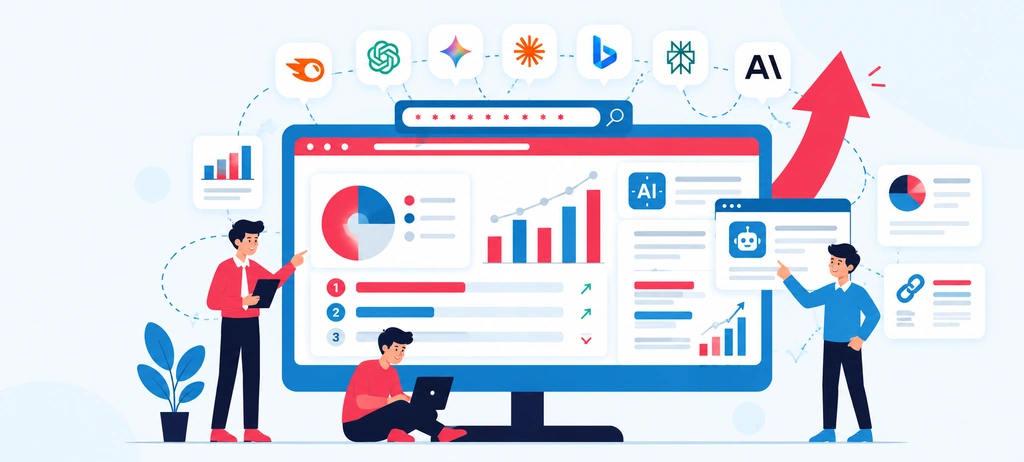
An AI SEO checklist is a structured set of actions used to make a website easier for search engines, AI search systems, and LLM-powered answer engines to crawl, understand, summarise, cite, and trust. It combines technical SEO, semantic SEO, answer-first content, E-E-A-T, structured data, internal linking, and AI visibility measurement.
Search is no longer only about ranking in ten blue links. In 2026, your audience may find answers through Google AI Overviews, Google AI Mode, ChatGPT, Perplexity, Gemini, voice-style queries, featured snippets, and zero-click search results. That changes how businesses need to structure content.
The challenge is not “tricking AI.” Google’s current guidance says its generative AI search features are rooted in core Search ranking and quality systems, using methods such as retrieval-augmented generation and query fan-out to find and synthesize useful information. (Google for Developers)
That means a strong AI SEO checklist should build on real SEO fundamentals: crawlable pages, helpful content, semantic clarity, structured data, expert sourcing, internal links, and measurable visibility. This guide gives you a practical checklist W3era uses to prepare content for Google organic search, AI Overviews, AI Mode, generative engines, answer engines, and LLM-powered discovery.
Key Takeaways
- AI SEO does not replace traditional SEO; it extends it for AI-generated answers, query fan-out, and LLM discovery.
- Google says SEO best practices remain relevant for AI Overviews and AI Mode; there are no special “AI-only” requirements for Google Search.(Google for Developers)
- Content must be clear, answer-first, entity-rich, source-backed, and easy to extract.
- Technical SEO still matters because AI systems need crawlable, indexable, accessible content.
- GEO, AEO, semantic SEO, and AI SEO work best when they support user value rather than manipulative visibility tactics.
- Strong E-E-A-T signals help users and quality systems understand why your page deserves trust.
- AI visibility must be measured separately from rankings, using AI citations, brand mentions, AI referral traffic, and answer accuracy checks.
Why AI SEO Matters in 2026
Google has stated that AI Overviews are used by more than 1.5 billion users monthly, and in major markets such as the U.S. and India, AI Overviews drove more than a 10% usage increase for query types where they appear. Google also said early AI Mode testers asked queries 2–3x longer than traditional searches. (blog.google)
That shift matters because longer AI queries usually include more context, constraints, comparisons, and follow-up intent. For example, a traditional query might be:
“SEO checklist”
An AI-style query might be:
“What should a SaaS company include in an AI SEO checklist to improve visibility in Google AI Overviews, ChatGPT, and Perplexity without violating Google spam policies?”
A 2026 arXiv preprint studying Google AI Overviews reported that AI Overview activation was 13.7% overall and 64.7% for question-form queries in its tested sample, showing why question-led, answer-ready content matters. The paper is under review, so use it as directional research rather than a final industry benchmark. (arXiv)
The 2026 AI SEO Checklist
1. Start With Indexing, Crawlability, and Technical SEO
Before optimising for AI answers, confirm that your page can be discovered and indexed.
Check:
· Page is indexable.
· Canonical tag points to the correct URL.
· Sitemap includes the page.
· Internal links point to the page.
· Important content is not hidden behind blocked JavaScript.
· noindex is not applied accidentally.
· nosnippet is not used on pages where snippet or AI answer inclusion is desired.
· Google says pages must be indexed and eligible to be shown in Search with a snippet to be eligible for generative AI features in Google Search. (Google for Developers)
2. Map Search Intent and AI Fan-Out Queries
AI Mode can break complex prompts into subtopics and issue multiple related searches through query fan-out. (blog.google)
For each target keyword, map:
| Search layer |
Example for “AI SEO checklist” |
| Primary intent |
User wants a step-by-step checklist. |
| AI fan-out queries |
How to optimise for AI Overviews, AI Mode, ChatGPT, Perplexity, schema, E-E-A-T, and answer engines. |
| Business intent |
User may need an AI SEO audit, AI SEO services, or content optimisation support. |
| Content format |
Checklist, table, workflow, FAQ, framework. |
3. Add a Direct Answer Near the Top
AI systems and users both benefit when the page answers the main question early. Add a 40–60 word answer block after the introduction.
Use this format:
Question: What is an AI SEO checklist?
Answer: An AI SEO checklist is a step-by-step framework for optimising pages so search engines and AI answer systems can crawl, understand, summarise, and trust them. It includes technical SEO, semantic entities, direct answers, structured data, citations, E-E-A-T signals, internal links, and AI visibility tracking.
4. Build Topic Clusters Around the Checklist
One checklist page is not enough to prove topical authority. Build a cluster around the parent pillar page.
Recommended AI SEO cluster:
· AI SEO: The Complete Guide
· AI SEO Checklist
· AI SEO Audit
· AI SEO Services
· Google AI Overviews Optimisation
· AI Mode SEO
· GEO Services
· AEO Services
· LLM Optimisation
· Semantic SEO Services
· Entity SEO
· Schema Markup for AI Search
Each supporting page should link back to the AI SEO pillar and to related service pages.
5. Use Semantic SEO to Strengthen Entity Clarity
Semantic SEO helps search systems understand meaning, relationships, and context beyond exact keywords.
Include entities such as:
· AI SEO
· Google AI Overviews
· Google AI Mode
· ChatGPT
· Gemini
· Perplexity
· LLMs
· Generative Engine Optimisation
· Answer Engine Optimisation
· Semantic SEO
· Structured data
· Entity salience
· Topical relevance
· Query intent
· Answer blocks
· Internal linking
· E-E-A-T
· Use these naturally in definitions, examples, FAQs, tables, and internal links.
6. Create Citation-Worthy Content
AI search systems are more likely to reference content that is clear, current, specific, and verifiable.
Add:
· Original expert insights.
· Named author and reviewer.
· Updated date.
· Source links for statistics.
· Screenshots or examples.
· Tables and workflows.
· Definitions with concise language.
· Business-specific use cases.
· Google’s helpful content guidance asks whether content provides original information, substantial value, clear sourcing, and expertise.(Google for Developers)
7. Add E-E-A-T Signals on the Page
For an SEO topic that affects business decisions, trust matters.
Add:
· Author name and SEO credentials.
· Expert reviewer name.
· Author bio.
· Reviewer bio.
· Updated date.
· Editorial policy link.
· Sources section.
· W3era case studies, only where verified.
· Client proof points, only where accurate.
· Contact and consultation CTA.
· Google explains E-E-A-T as experience, expertise, authoritativeness, and trustworthiness, with trust being the most important element.(Google for Developers)
8. Use Structured Data, But Do Not Overpromise It
Use structured data to help search engines understand page context. Google says structured data provides explicit clues about page meaning and can make pages eligible for rich results.(Google for Developers)
For this blog, use:
BlogPosting or Article
WebPage
BreadcrumbList
Organization
Person
FAQPage only if FAQs are visible
HowTo only if true step-by-step instructions are marked up
Important: Google says FAQ rich results are no longer appearing in Google Search as of May 7, 2026, so FAQ schema should not be treated as a guaranteed Google rich-result tactic.(Google for Developers)
Use:
· Descriptive H2s and H3s.
· One main idea per section.
· Short paragraphs.
· Tables for comparisons.
· Bullets for checklists.
· Definitions before deeper explanation.
· Examples after each major concept.
· Clear transitions between SEO, GEO, AEO, semantic SEO, and AI SEO.
10. Manage AI Crawlers Intentionally
For Google Search, do not block important SEO pages from Googlebot. For broader AI visibility, review crawler access for AI systems carefully.
OpenAI’s crawler documentation separates OAI-SearchBot for ChatGPT search features and GPTBot for training-related crawling controls. (OpenAI Developers) Perplexity says PerplexityBot is designed to surface and link websites in Perplexity search results.(Perplexity) Google says Google-Extended is a standalone control token for Gemini/Vertex AI model training and grounding, and it does not affect inclusion or ranking in Google Search. (Google for Developers)
Also remember: robots.txt is mainly for managing crawler access, not for hiding sensitive pages. Google says pages blocked by robots.txt can still appear in Search if linked elsewhere. (Google for Developers)
11. Avoid AI SEO Spam Tactics
Do not create doorway pages, fake mentions, AI-generated mass pages, hidden text, keyword-stuffed content, or manipulative “recommendation poisoning” tactics.
Google’s spam policies now explicitly include attempts to manipulate generative AI responses in Google Search. Sites violating spam policies may rank lower or not appear in results.(Google for Developers)
12. Measure AI Visibility Separately
Track:
· Google Search Console impressions and clicks.
· AI referral traffic where visible.
· ChatGPT, Perplexity, Gemini, and Copilot brand mentions.
· AI citation frequency.
· Accuracy of AI answers about your brand.
· Rankings for the main keyword and fan-out queries.
· Assisted conversions from informational pages.
· Internal link clicks to pages focused on AI search discoverability and audit-driven optimization strategies.
Traditional SEO vs AI SEO
| Area |
Traditional SEO |
AI SEO |
| Main goal |
Rank pages in organic results |
Be discoverable, understandable, citable, and useful in AI-assisted search |
| Query style |
Short keywords |
Long, conversational, multi-part questions |
| Content format |
Blogs, service pages, landing pages |
Answer blocks, FAQs, tables, frameworks, source-backed sections |
| Optimisation focus |
Keywords, links, technical SEO |
Entities, intent, source clarity, E-E-A-T, structured answers |
| Measurement |
Rankings, clicks, traffic |
Rankings, clicks, AI citations, mentions, referral traffic, answer accuracy |
| Risk |
Keyword stuffing and thin content |
Manipulative AI visibility tactics, fake mentions, mass-generated pages |
GEO Optimisation: How This Checklist Helps Generative Engines
Generative Engine Optimisation focuses on making content understandable and useful for AI-generated responses. For W3era, GEO should not mean “gaming” AI systems. It should mean making your content more extractable, factual, and source-worthy.
To improve GEO readiness:
· Add clear answer blocks.
· Use verifiable claims.
· Link to credible sources.
· Include original frameworks.
· Add expert commentary.
· Use consistent brand and entity information.
· Keep definitions concise.
· Update content when AI search behaviour changes.
· Add supporting cluster pages that reinforce topical depth.
· For Google specifically, be careful with “AI hacks.” Google says you do not need special AI text files or special markup to appear in generative AI search, and overfocusing on structured data is not required for generative AI features.(Google for Developers)
AEO Optimisation: How This Checklist Helps Answer Engines
Answer Engine Optimisation focuses on direct, concise, question-led answers.
Use these AEO formats:
| AEO element |
How to use it |
| Direct answer block |
Put a 40–60 word answer after the introduction. |
| Question H2s |
Use headings like “What is an AI SEO checklist?” |
| PAA-style FAQs |
Add questions users actually search. |
| Tables |
Compare SEO vs GEO vs AEO vs AI SEO. |
| Numbered steps |
Use checklist steps for implementation. |
| Voice-style answers |
Keep answers conversational and direct. |
| Source-backed claims |
Link statistics and platform claims to credible sources. |
Semantic SEO Optimisation
Semantic SEO makes this page easier to understand as part of W3era’s AI SEO cluster.
Use the primary entity AI SEO checklist consistently, then connect it to related entities:
- AI SEO → parent topic
- Google AI Overviews → Google AI search feature
- AI Mode → conversational Google Search experience
- GEO → generative answer visibility
- AEO → direct answer optimisation
- Semantic SEO → meaning, entities, topical relevance
- Structured data → machine-readable page context
- E-E-A-T → trust and credibility
- Internal linking → cluster authority
Recommended semantic structure:
- Define the topic.
- Explain why it matters in 2026.
- Provide the checklist.
- Add examples and tables.
- Add GEO, AEO, semantic SEO, and AI SEO sections.
- Link to theAI SEO guide and AI SEO services.
· Add FAQs and schema.
AI SEO Optimisation for Google AI Overviews, AI Mode, and LLM Search
AI SEO should prepare content for both search engines and AI answer experiences.
Focus on:
· AI Overviews: concise answers, strong sourcing, topical authority, crawlable pages.
· AI Mode: deeper context, multi-step explanations, comparison tables, follow-up questions.
· ChatGPT Search: allow relevant crawlers where business policy supports it and keep brand facts clear.
· Perplexity: source-backed content with current data and strong page accessibility.
· Gemini: strong Google Search fundamentals and clear entity signals.
· LLM visibility: consistency across your website, profiles, reviews, third-party mentions, and social channels.
· Google’s AI Mode page describes AI Mode as an AI-powered response experience with follow-up questions and helpful web links, powered by advanced reasoning and multimodal understanding.
W3era AI-READY Framework
Use this original framework for every AI SEO page.
| Step |
Meaning |
Action |
| A — Access |
Can search and AI systems access the content? |
Check indexing, robots.txt, rendering, canonical tags, sitemap, internal links. |
| I — Intent |
Does the page match real search and AI prompts? |
Map primary intent, fan-out questions, PAA queries, business intent. |
| R — Retrieval-ready answers |
Can AI extract a clean answer? |
Add answer blocks, definitions, tables, and concise summaries. |
| E — Entities |
Are key topics and relationships clear? |
Add related entities, schema, internal links, and semantic headings. |
| A — Authority |
Can users trust the source? |
Add author, reviewer, sources, examples, case studies, proof points. |
| D — Data |
Are claims supported? |
Cite official docs, studies, platform documentation, and verified data. |
| Y — Yield |
Does visibility create business value? |
Add CTAs, track AI referrals, measure conversions, update quarterly. |
Common Mistakes to Avoid
| Mistake |
Why it hurts |
Fix |
| Treating AI SEO as separate from SEO |
Google says SEO fundamentals still matter for AI features. |
Start with technical SEO, helpful content, and crawlability. |
| Creating thin FAQ-only pages |
They lack depth and originality. |
Add examples, frameworks, data, and expert insights. |
| Blocking important crawlers accidentally |
Pages may not be discoverable for some AI search systems. |
Review robots.txt, WAF, CDN, and server logs. |
| Using fake AI citations or fake mentions |
This risks spam and trust issues. |
Build real authority with useful content and credible sources. |
| Overusing schema without visible content |
Structured data must match visible page content. |
Add schema only for real on-page elements. |
| Ignoring entity consistency |
AI systems may misread brand or topic relationships. |
Keep names, service descriptions, and social profiles consistent. |
| Publishing without an update plan |
AI search changes quickly. |
Review AI SEO pages quarterly. |
| Optimizing only for Google |
Users also search in ChatGPT, Perplexity, Gemini, and Copilot. |
Track visibility across multiple answer engines. |
W3era Expert Tips
Put the most important answer in the first 150 words.
Add one original framework so the page has information gain competitors cannot copy.
Build internal links from the AI SEO pillar, semantic SEO services, technical SEO services, and schema markup pages.
Use examples for multiple business types: SaaS, ecommerce, local services, healthcare, finance, and agencies.
Add a “last updated” date and update when Google AI Mode or AI Overview documentation changes.
Use source-backed claims only; mark experience-based points as expert insights.
Add a CTA after the checklist and again in the conclusion.
Conclusion
AI SEO in 2026 is not about chasing shortcuts. It is about making your content easier to access, understand, trust, summarise, and act on across Google Search, AI Overviews, AI Mode, ChatGPT, Perplexity, Gemini, and other AI-powered discovery systems.
The best AI SEO checklist starts with strong SEO fundamentals, then adds answer-first writing, semantic entity coverage, structured data, credible sources, E-E-A-T, internal links, and continuous measurement. That combination helps your pages serve people first while giving search and AI systems clearer signals about what your content means and why it deserves trust.
W3era helps businesses build AI-ready SEO strategies that connect technical SEO, semantic SEO, GEO, AEO, and conversion-focused content. To improve your AI search visibility, talk to W3era’s SEO experts or request a free AI SEO audit.