Tiered link building is an SEO strategy where you build backlinks in multiple layers. Tier 1 links point directly to your website from high-authority sources like guest posts, niche edits, and editorial placements. Tier 2 links point to your Tier 1 sources to strengthen them. Tier 3 links point to your Tier 2 sources to pass additional authority upward. The result is a compounding link equity flow that amplifies the ranking power of your Tier 1 backlinks.
If you've ever wondered why some websites rank effortlessly on Google while others with similar on-page SEO can't seem to break into the top 10, the answer often comes down to one thing, If you're still building your foundational backlinks, exploring free business listing sites usa can help you create a strong base before scaling into tiered strategies.
Tiered link building is not a new concept. But in 2026, with Google's algorithms more sophisticated than ever and AI-powered search changing how authority is evaluated, knowing how to execute a tiered link building strategy correctly and safely is the difference between sustainable rankings and a penalty that sets you back months.
In this guide, we break down exactly how a 3-tier backlink system works, which link types belong in each tier, how to build each tier step by step, and what mistakes to avoid so you rank faster without risking your domain.
Key Takeaways
- Tiered link building boosts rankings by strengthening your backlinks—not just building them.
- Tier 1 links (guest posts, PR, niche edits) are the most critical and must be high-quality and relevant.
- Tier 2 and Tier 3 links amplify authority and help scale link building safely without risking your main domain.
- Always follow the correct sequence (Tier 1 → Tier 2 → Tier 3) to maintain a natural and penalty-free profile.
- Consistent tracking, proper anchor text distribution, and unique content at every tier are essential for long-term SEO success.
What Is Tiered Link Building?
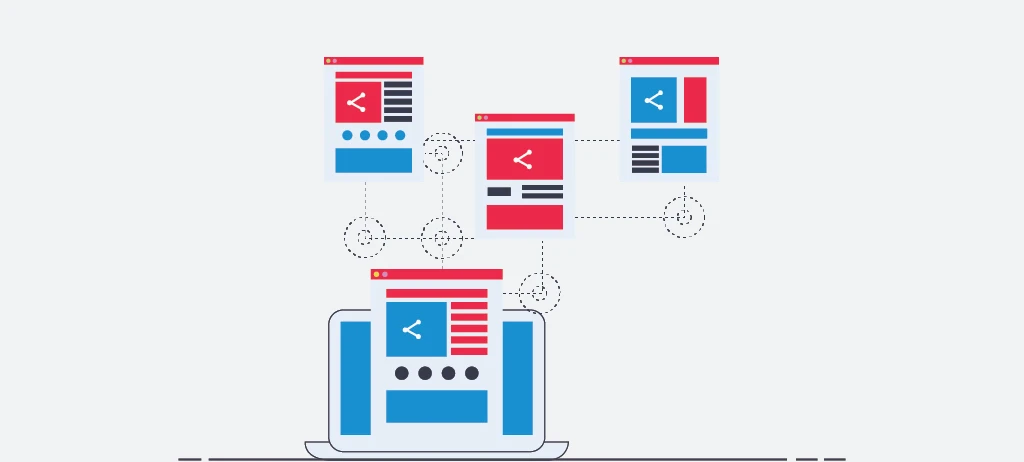
Tiered link building is a multi-layer approach to building backlinks where links are organised into tiers — each tier feeding authority into the one above it. Rather than only building links directly to your website, you also build links to your links, creating a compounding flow of link equity.
Here's the core idea in simple terms:
- Tier 1: High-quality links that point directly to YOUR website
- Tier 2: Links that point to your Tier 1 sources — strengthening them
- Tier 3: Links that point to your Tier 2 sources — adding volume and depth
Think of it like a pyramid. Your website sits at the very top. Every tier below it exists to funnel more authority, trust, and relevance upward.
This approach is used by some of the fastest-growing websites in competitive niches because it allows you to scale your link building safely — concentrating high-quality effort at the top while using less intensive methods in the lower tiers.
How Does a 3-Tier Backlink System Work?
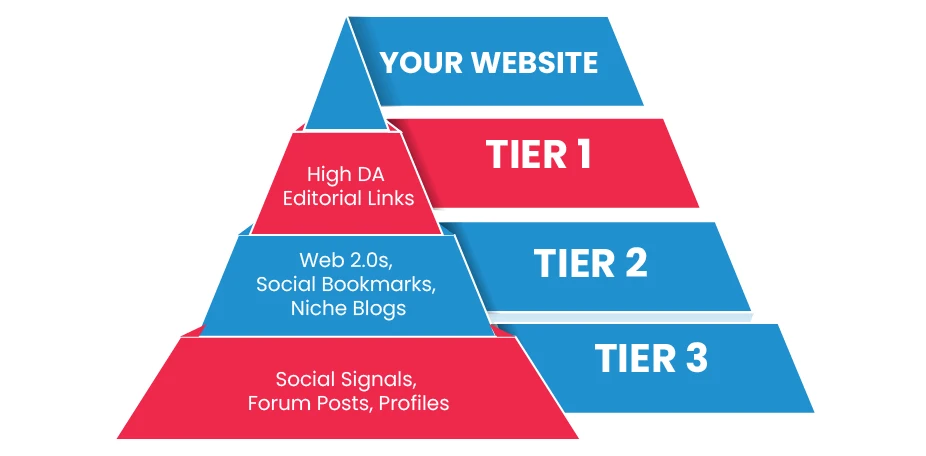
To understand the flow of link equity in a tiered system, picture three layers:
[Your Website] ← Tier 1 (High DA Editorial Links)
↑
[Tier 1 Sources] ← Tier 2 (Web 2.0s, Social Bookmarks, Niche Blogs)
↑
[Tier 2 Sources] ← Tier 3 (Social Signals, Forum Posts, Profiles)
Each backlink passes a portion of its authority — what SEOs call link juice — to the page it links to. When you build a link to your Tier 1 source, that Tier 1 source becomes stronger, meaning the link it passes to your website carries more weight.
A practical example:
- You publish a guest post on a DA 60 marketing blog (Tier 1 link to your site)
- You build 5 Web 2.0 articles pointing to that guest post URL (Tier 2)
- You bookmark and share those Web 2.0 articles on social platforms and forums (Tier 3)
The guest post — which already links to your website — is now being supported by 5 Web 2.0 articles, each of which has social and forum signals pointing to them. The authority chain flows upward, making that guest post link significantly more powerful than if it were standing alone.
Why Tiered Link Building Works in 2026?
You might be wondering: does this still work with today's Google? The short answer is yes, when done with white-hat content at every tier. If you’re new to off-page SEO, start with a complete link building guide to understand how different strategies work together before implementing tiered structures.
Here's why tiered link building remains one of the most effective SEO strategies in 2026:
1. Google Values Links to Links Google has always considered the authority of a linking page as a core ranking signal. A backlink from a strong page is worth more than one from a weak page. By building Tier 2 links to your Tier 1 sources, you're actively increasing the authority of those linking pages, and therefore the value of the link they pass to you.
2. It Scales Your Link Building Without Increasing Risk Instead of building 50 direct links to your website (which can look unnatural), you build 10 excellent Tier 1 links and then scale your efforts across Tiers 2 and 3. The result is a much larger link building operation with less risk of over-optimisation penalties.
3. AI Search Rewards Topical Depth In 2026, Google's AI systems and models like Gemini evaluate topical authority, not just individual page authority. When your content is referenced from multiple sources across multiple platforms (even lower-tier ones), it signals that your content is genuinely valuable and widely referenced. This is exactly what tiered link building creates naturally.
4. It Protects Your Core Domain Because lower-tier, higher-volume activities happen on external properties (Web 2.0s, social bookmarks, profile pages), any algorithmic scrutiny falls on those properties first, not on your main domain. This is one of the core reasons why ethical link building practitioners favour tiered structures, the risk stays away from the asset that matters most.
Tier 1 Links — The Foundation
Tier 1 links are the most important links in your entire system. These are the links that point directly to your website, so they must come from genuine, high-quality, topically relevant sources.
What belongs in Tier 1:
|
Link Type
|
Why It Works
|
| Guest posts on DA 40–80+ niche blogs |
Editorial content, dofollow, topically relevant
|
| Niche edits (contextual link insertions) |
Placed in existing high-ranking articles
|
|
Digital PR placements (news, media)
|
High-authority, editorial, trusted sources
|
|
HARO / journalist outreach links
|
Journalist-sourced, highly credible
|
|
Resource page links
|
Curated by humans, contextually valuable
|
|
Podcast mentions with links
|
Growing authority in AI-evaluated content
|
|
Broken link replacements on niche sites
|
White-hat, editorial, often DA 40+
|
What does NOT belong in Tier 1:
- Automated link blasts
- Low-quality directory spam
- PBN links (private blog network links used solely for SEO)
- Forum signature links in bulk
- Links from irrelevant niches
Key metrics to target for Tier 1:
- Domain Authority (DA): 35 minimum, ideally 50+
- Domain Rating (DR): 30+
- Referring domains to the linking page: 5+
- Topical relevance: Must match your niche
- Traffic: The linking page should receive some organic traffic
- Anchor text: Mix of branded, partial match, and naked URL anchors
How many Tier 1 links do you need?
This depends on your niche competitiveness. For moderately competitive keywords, 10–20 strong Tier 1 links can be enough to break into the top 10. For highly competitive terms (like "SEO services USA"), you may need 30–60+ Tier 1 links built consistently over 6–12 months.
Tier 2 Links — The Amplifiers
Tier 2 links point to your Tier 1 sources, your guest posts, digital PR articles, niche edits, and make them stronger. This is where you start to scale your link building effort.
What belongs in Tier 2:
|
Link Type
|
Purpose
|
|
Web 2.0 blog posts (Medium, Blogger, Tumblr, WordPress.com)
|
Create content-rich pages that link to your Tier 1
|
|
Social bookmarking (Diigo, Mix, Reddit, Pinterest)
|
Social signals + dofollow/nofollow diversity
|
|
Niche forum posts
|
Topical relevance, human-written content
|
|
Article directory submissions
|
Volume at low risk since they point to Tier 1, not your site
|
|
Video descriptions (YouTube, Vimeo, Dailymotion)
|
Embed videos linking to Tier 1 URLs
|
|
PDF/document submissions (SlideShare, Scribd)
|
Content variety pointing to Tier 1 sources
|
|
Quora / Q&A answers
|
Topically relevant links from Q&A platforms
|
|
Profile creation links
|
Diverse link types, point to Tier 1
|
Using a verified dofollow forum posting sites list helps diversify Tier 2 backlinks naturally while strengthening your Tier 1 sources safely.
How to create Tier 2 content:
Every Tier 2 property should have unique, readable content, not spun, not duplicated. This is a critical point many SEOs get wrong. Tier 2 content doesn't need to be as thorough as a Tier 1 guest post, but it should be:
- At least 400–600 words
- Unique (written from scratch, not copied from your main site)
- Topically related to the Tier 1 content it links to
- Human-readable (not AI-generated gibberish)
Tier 2 ratio: Aim for 4–8 Tier 2 links per Tier 1 link. So if you have 10 Tier 1 links, you want 40–80 Tier 2 links spread across those 10 sources.
Tier 3 Links — The Supporters
Tier 3 is the widest, most volume-heavy tier of the system. These links point to your Tier 2 properties. Because there are two layers of separation between these links and your main website, Tier 3 allows you to use higher-volume, lower-effort link types that would be risky if applied directly to your domain.
What belongs in Tier 3:
|
Link Type
|
Notes
|
|
Social media profile links
|
Facebook, Twitter/X, LinkedIn, Pinterest profiles
|
|
Social sharing (shares, repins, bookmarks)
|
Creates natural sharing signals
|
|
Blog comment links
|
Pointing to your Tier 2 Web 2.0s
|
|
Forum profile links
|
Low-value individually, fine at Tier 3
|
|
Image sharing sites
|
Imgur, Flickr with links to Tier 2
|
|
Google Business Profile citations
|
Pointing to Tier 2 local pages
|
|
RSS submissions
|
Submit Tier 2 blog RSS feeds
|
|
Ping services
|
Ping your Tier 2 and Tier 3 URLs for faster indexing
|
The goal at Tier 3 is not quality — it's volume and diversity. You want Google to find and index your Tier 2 properties quickly, and you want those Tier 2 properties to accumulate enough signals that they carry real authority when they link to your Tier 1 sources.
Tier 3 ratio: 5–15 Tier 3 signals per Tier 2 property.
Step-by-Step: How to Build Your 3-Tier Backlink System
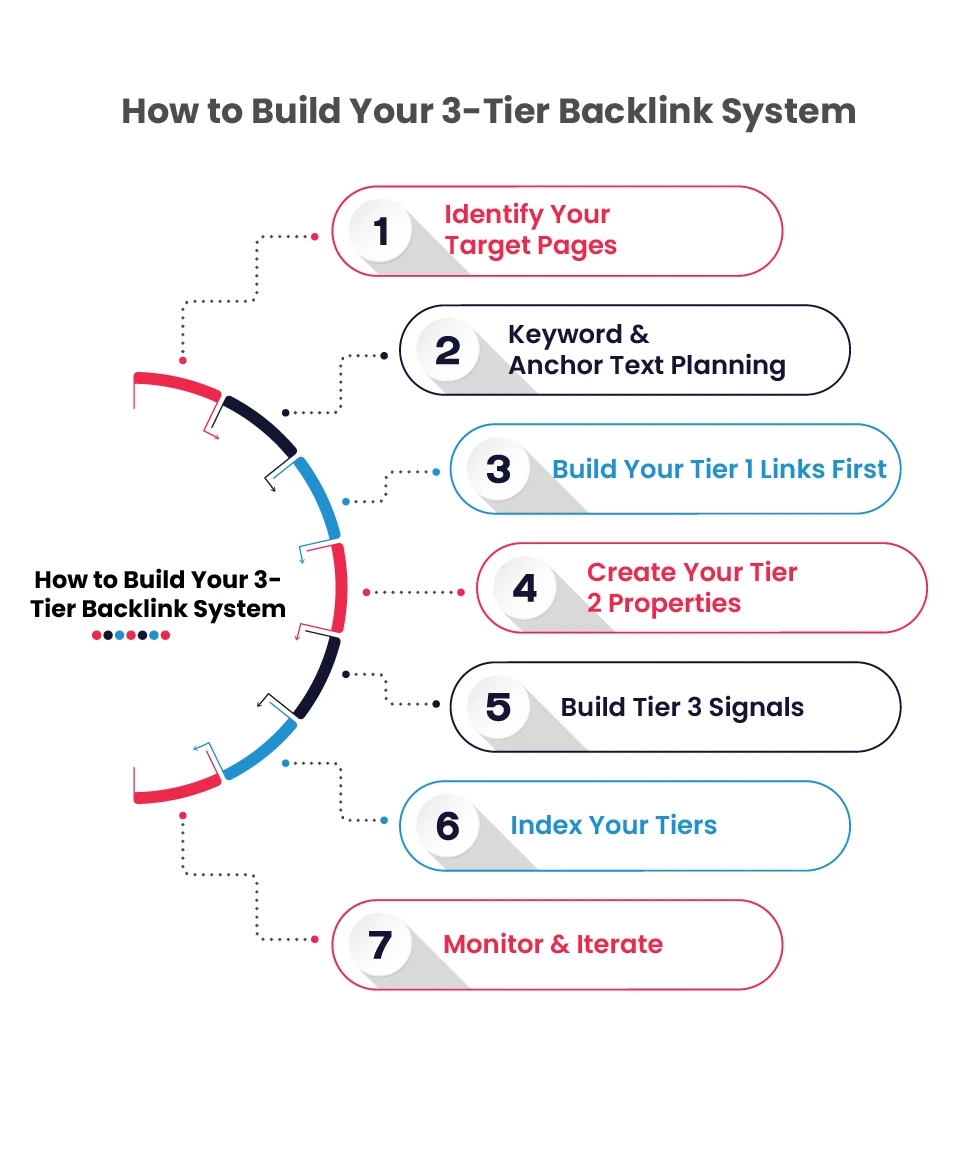
Here's the exact process W3Era follows when implementing tiered link building for client websites.
Step 1: Identify Your Target Pages
Before building a single link, decide which pages on your website you want to rank. These are your money pages, the ones that drive leads, sales, or traffic. For most businesses this includes:
- Homepage (for brand terms)
- Service pages (for commercial keywords)
- Key blog posts (for informational keywords)
Step 2: Keyword & Anchor Text Planning
Plan your anchor text distribution before you start. A natural Tier 1 anchor text profile looks like this:
|
Anchor Type
|
Percentage |
|
Branded (e.g. "W3Era")
|
30–40%
|
|
Naked URL (e.g. "w3era.com")
|
15–20%
|
|
Generic (e.g. "click here", "read more")
|
10–15%
|
|
Partial match (e.g. "link building services")
|
15–20%
|
|
Exact match (e.g. "tiered link building")
|
5–10%
|
Keep exact match below 10% at Tier 1 to avoid over-optimisation penalties. If you're still building your initial Tier 1 pipeline, our guide on 7 ways to gain quality backlinks covers the best acquisition methods to start with before scaling into a tiered system.
Step 3: Build Your Tier 1 Links First
Start by securing your Tier 1 links. This is the most time-intensive step. At W3Era, our recommended Tier 1 link building methods in order of priority are:
1. Guest Posting Identify niche-relevant blogs that accept guest posts. Write genuinely useful, in-depth articles (1500+ words minimum). Place your link naturally within the body content, never in the author bio alone. Use a partial match or branded anchor.
2. Niche Edits / Link Insertions Find existing high-ranking articles in your niche and reach out to editors offering to add a contextual link to your page where relevant. This is often faster than guest posting and links from established, indexed pages carry immediate authority.
3. Broken Link Building Use tools like Ahrefs or Screaming Frog to find broken links on niche websites. Create a matching replacement page on your site, then email the webmaster offering your live page as the replacement. Response rates of 5–15% are common.
4. Digital PR Create data-driven studies, original research, or newsworthy content that journalists want to cite. Use HARO (Help A Reporter Out) or Connectively to respond to journalist queries in your niche. Links from news sites (even DA 40–50 regional publications) are extremely powerful Tier 1 links.
5. Resource Page Links Search Google for: [your keyword] + "resources" or [your keyword] + "useful links". Email the resource page owner requesting inclusion. These links are editorially curated and Google trusts them highly.
Step 4: Create Your Tier 2 Properties
Once your Tier 1 links are live and indexed, start building Tier 2 support. For each Tier 1 link:
- Create 2–3 Web 2.0 posts (Medium, WordPress.com, Blogger) with unique 500-word articles on a related topic, linking to the Tier 1 page URL
- Submit to 2–3 social bookmarking sites (Mix, Diigo, Flipboard) with the Tier 1 URL and a short description
- Create a PDF / SlideShare summarising the Tier 1 article, with a link back to it
- Answer a relevant Quora question and reference the Tier 1 article as a source
Important: All Tier 2 content must use the URL of the Tier 1 page (e.g. the guest post URL on the external site) — not your website URL directly.
Step 5: Build Tier 3 Signals
For each Tier 2 property you created:
- Share the Tier 2 URLs on your social media profiles (Facebook, Twitter/X, LinkedIn, Pinterest)
- Submit to social bookmarking sites you haven't used yet
- Ping the URLs using a ping service (Pingomatic or similar) to ensure Google crawls them
- Leave topical blog comments on niche blogs linking to the Tier 2 URL where appropriate
Step 6: Index Your Tiers
Use these methods to ensure Google indexes all your links:
- Google Search Console URL Inspection — Submit Tier 1 URLs for indexing directly
- Pinging — Ping Tier 2 and Tier 3 URLs to signal their existence to search engines
- Internal linking — Link from your site's other indexed pages to the pages receiving Tier 1 links (boosts crawl priority)
- Social sharing — Share Tier 2 properties from your real social accounts for fast indexing
Step 7: Monitor & Iterate
Track your link building progress monthly. Start with W3Era's free Backlink Checker Tool to get a quick snapshot of which Tier 1 links are live and indexed before diving into deeper analysis with Ahrefs or Semrush for lost links and DR monitoring.
- Ahrefs / Semrush — Monitor Tier 1 backlinks (new links, lost links, DR of linking pages)
- Google Search Console — Track ranking improvements for target keywords
- Rank tracking tools — Monitor keyword positions weekly
Give your Tier 2 and Tier 3 links 4–8 weeks to be indexed and start passing authority. Tier 1 links typically show ranking impact within 4–12 weeks depending on competition.
Tiered Link Building for Local SEO (USA Focus)
If your goal is to rank for local keywords in the USA, like "SEO agency Houston", "SEO Agency Dallas", or "local SEO services Chicago", tiered link building works brilliantly when combined with local signals.
Tier 1 for Local SEO:
- Guest posts on local business blogs, city news publications, and regional industry sites
- Mentions in local directories that have editorial review (not auto-submit directories)
- Local digital PR, press releases picked up by local news outlets
- Niche edits on city-specific resource pages
Tier 2 for Local SEO:
- Web 2.0 articles specifically about your city + service (e.g. "Top SEO Tips for Houston Businesses")
- Local forum posts on city subreddits or community platforms (Nextdoor, local Facebook groups)
- Local citation submissions (Yelp, YellowPages, BBB) pointing to your Tier 1 local content
Tier 3 for Local SEO:
- Social shares from local community pages
- Google Business Profile posts that reference your Tier 1 and Tier 2 content
- Local image submissions with geo-tagged metadata
Cities with the highest local SEO competition in the USA (where tiered building is most needed): Houston, Chicago, Los Angeles, Dallas, Austin, Seattle, Denver, Atlanta, New York, Miami, Phoenix
For these cities, expect to need 15–25 strong Tier 1 links per target page before breaking into the local pack top 3.
Tools You Need for Tiered Link Building
|
Tool
|
Purpose |
Tier |
| Ahrefs |
Prospect research, competitor backlink analysis, monitoring
|
All |
| Semrush |
Backlink audit, keyword tracking, Tier 1 prospecting
|
All |
|
Screaming Frog
|
Broken link finding for Tier 1 opportunities
|
Tier 1
|
|
Hunter.io
|
Find contact emails for outreach
|
Tier 1
|
|
Pitchbox / Respona
|
Automate outreach campaigns
|
Tier 1
|
|
BuzzStream
|
Relationship-based outreach management
|
Tier 1
|
|
Canva / Visme
|
Create infographics for Tier 2 submissions
|
Tier 2
|
|
IFTTT
|
Automate social sharing of Tier 2 and Tier 3 properties
|
Tier 2–3
|
|
Pingomatic
|
Ping Tier 2/3 URLs for faster indexing
|
Tier 2–3
|
|
Google Sheets
|
Track all tiers, anchor texts, and link status
|
All
|
|
Google Search Console
|
Monitor indexed links, GSC performance
|
All |
Common Mistakes to Avoid
Even experienced SEOs make these errors when implementing tiered link building. Avoid these at all costs:
Mistake 1: Pointing Tier 2 Links to Your Website Instead of Tier 1 Sources This is the most common mistake. All Tier 2 links must point to the Tier 1 page URL (the external guest post, the media article), not to your main website. If you point a mass of lower-quality Tier 2 links directly to your site, you risk a penalty.
Mistake 2: Using Spun or AI-Generated Content at Tier 2 Tier 2 content must be readable and unique. Google's quality raters now flag low-value, AI-generated content even on Web 2.0 platforms. Always write original Tier 2 content, even if it's brief.
Mistake 3: Building All Tiers Simultaneously Build in the correct sequence: Tier 1 first, then Tier 2 after Tier 1 links are indexed (wait 1–2 weeks), then Tier 3. Building all tiers at the same time creates an unnatural pattern that looks like a coordinated manipulation campaign.
Mistake 4: Over-Optimised Exact Match Anchors at Tier 1 Keeping exact match anchors above 10% at Tier 1 is one of the fastest ways to trigger a Google over-optimisation filter. Use branded and partial match anchors the majority of the time.
Mistake 5: Ignoring Topical Relevance Every link, at every tier, should be topically relevant to your website or the content it is linking to. A fitness blog linking to a law firm (even at Tier 3) adds no value and can raise red flags. Keep your entire link profile niche-relevant.
Mistake 6: Not Tracking Your Links A tiered system has many moving parts. Without proper tracking, you won't know which Tier 1 links got indexed, which Tier 2 properties are live, or which links got removed. Maintain a detailed Google Sheet tracking every link at every tier.
Tiered Link Building vs. Other Link Building Methods
|
Method
|
Speed
|
Risk |
Scalability
|
Cost |
|
Tiered Link Building
|
Medium |
Low (if done right)
|
High |
Medium |
|
Guest Posting Only
|
Slow |
Low |
Low |
Medium–High
|
|
PBN Links
|
Fast |
Very High
|
High |
High |
|
Broken Link Building
|
Medium |
Very Low
|
Medium |
Low–Medium
|
|
Digital PR
|
Slow |
Very Low
|
Low |
High |
|
Social Bookmarking Only
|
Fast |
Low
|
High |
Low |
Tiered link building offers the best balance of speed, safety, and scalability, which is why it's the preferred approach for growing websites in competitive niches.
Final Thoughts
Tiered link building, when executed with care, consistency, and quality at every level, is one of the most powerful and scalable SEO strategies available in 2026.
The fundamental principle, building links to your links to make them stronger, is grounded in how Google's PageRank algorithm has always worked. You're not trying to trick Google. You're giving your best Tier 1 placements the support they deserve to pass maximum authority to your pages.
Here's a quick recap of the 3-tier system:
- Tier 1: High-quality, niche-relevant editorial links pointing directly to your website. Guest posts, digital PR, niche edits, broken link replacements.
- Tier 2: Mid-quality content (Web 2.0s, social bookmarks, forum posts, video descriptions) pointing to your Tier 1 sources to strengthen them.
- Tier 3: High-volume, lower-effort signals (social shares, profile links, pings, blog comments) pointing to your Tier 2 properties to accelerate their indexing and authority.
Build the tiers in sequence. Track everything. Keep content real at every level. And be patient, this system works, but it rewards consistency over shortcuts.
If you want W3Era to build a tiered link building strategy for your website and target keywords, get in touch with our SEO team today.