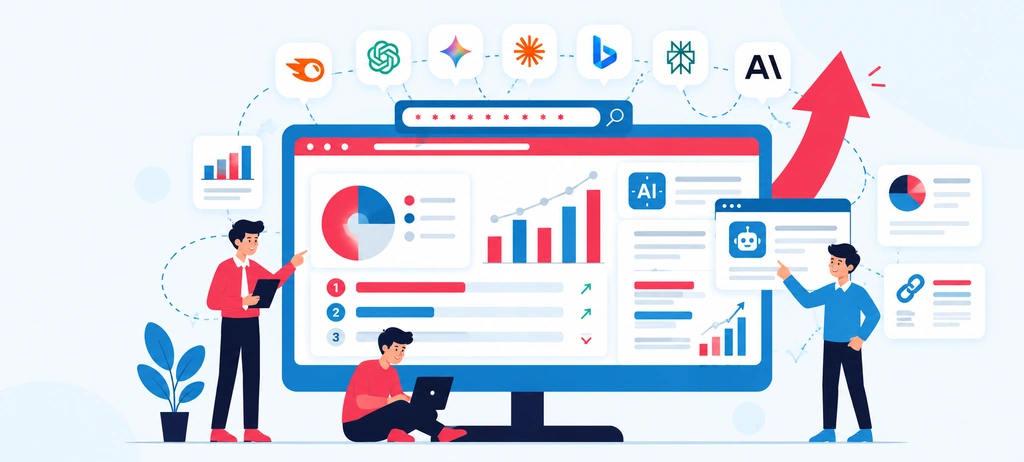
AI search is changing how people discover brands, compare services, and get answers. A user may now find your business through Google organic results, Google AI Overviews, AI Mode, ChatGPT Search, Perplexity, Gemini, featured snippets, or zero-click answers. That makes schema markup for AI search more important—but also more misunderstood.
Schema markup does not guarantee rankings, AI Overview inclusion, or chatbot citations. Google says its AI features still rely on foundational SEO, crawlability, indexability, helpful content, and structured data optimisation that matches visible content. It also says no special schema.org markup is required just for generative AI features. (Google for Developers)
So what does structured data actually do? It gives search engines and AI systems clearer machine-readable context about your content, entities, authors, organization, products, services, FAQs, breadcrumbs, and relationships.
This guide explains how to use schema markup correctly for AI search, semantic content optimisation, enhanced search result visibility, answer engines, and long-term search visibility.
Key Takeaways
- Schema markup helps machines understand meaning. It labels page content using structured data so search engines and AI systems can interpret entities and relationships more accurately.
- JSON-LD is the recommended format for Google Search. Google supports JSON-LD, Microdata, and RDFa, but recommends JSON-LD because it is easier to implement and maintain. (Google for Developers)
- Schema is not an AI visibility guarantee. Google says no special schema.org markup is required for its generative AI features, and structured data should not be treated as an AI-citation shortcut. (Google for Developers)
- Structured data must match visible content. Google’s structured data guidelines warn against marking up hidden, misleading, irrelevant, or inaccurate content. (Google for Developers)
- AI search increases the value of clarity. As more searches become answer-led or zero-click, clear entities, author signals, source credibility, and structured context become more important.
- FAQ schema has changed for Google Search. Google says FAQ rich results are no longer appearing in Search as of May 7, 2026, so FAQPage schema should be used only when FAQs are visible and useful—not for guaranteed rich results. (Google for Developers)
- The best schema strategy combines technical SEO audit, semantic SEO, AEO, GEO, and E-E-A-T. Schema works best when the page itself is helpful, crawlable, authoritative, and well structured.
What is schema markup for AI search?
Schema markup for AI search is structured data, usually JSON-LD, that labels visible page information so search engines and AI systems can better understand content, entities, authors, organizations, products, services, FAQs, and relationships. It improves machine-readable clarity and rich-result eligibility, but it does not guarantee AI Overview or chatbot citations.
What Is Schema Markup?
Schema markup is structured data added to a webpage to help search engines understand what the page is about. It uses a shared vocabulary, most commonly Schema.org, to describe entities such as articles, authors, organizations, products, services, reviews, events, videos, FAQs, and breadcrumbs.
Google defines structured data as a standardized format for providing information about a page and classifying page content. For example, a recipe page can use structured data to identify ingredients, cooking time, calories, and ratings. (Google for Developers)
In SEO, schema markup helps with:
· Rich-result eligibility.
· Better entity understanding.
· Search result enhancements.
· Content classification.
· Breadcrumb display.
· Product details.
· Review information.
· Article metadata.
· Organization and author clarity.
In AI search, schema can also help systems parse page meaning more consistently, especially when the content contains multiple entities, services, authors, products, locations, or question-answer sections.
What Is Structured Data for AI Search?
Structured data for AI search is the use of schema markup to make page context easier for AI-powered search systems to interpret. This includes labeling who published the content, who wrote or reviewed it, what the main topic is, what questions are answered, what products or services are described, and how the page connects to other trusted entities.
For example, a page about schema markup for AI search may include:
· Article or BlogPosting schema for the blog itself.
· Person schema for the author or expert reviewer.
· Organization schema for W3era.
· BreadcrumbList schema for site hierarchy.
· FAQPage schema if visible FAQs are present.
· WebPage schema for the page entity.
· Service schema on related service pages, not necessarily the blog.
· sameAs links for official brand social profiles.
The purpose is not to “force” AI systems to cite the page. The purpose is to reduce ambiguity and make the page’s visible facts easier to understand.
How Schema Markup Helps Search Engines and AI Systems
Schema markup helps by converting unstructured text into labeled, machine-readable information.
For example, without schema, a page may mention “W3era,” “AI-powered search optimisation,” “John,” “technical SEO,” and “structured data.” A search system must infer which entity is the publisher, which person is the author, which topic is the main subject, and which services are being discussed.
With schema, the page can explicitly say:
· W3era is the publisher.
· The page is a BlogPosting.
· The author is a specific Person.
· The topic is schema markup for AI search.
· The page belongs to the SEO blog category.
· The organization has official social profiles.
· The page contains visible FAQs.
· The page is part of a breadcrumb path.
· This helps search systems and AI systems connect content to entities, topics, and context.
What Schema Markup Can and Cannot Do for AI Search
| Schema can help with |
Schema cannot guarantee |
| Clarifying page entities |
Google rankings |
| Improving machine-readable context |
AI Overview inclusion |
| Supporting rich-result eligibility |
ChatGPT Search citations |
| Connecting author, publisher, and page information |
Perplexity citations |
| Labelling products, services, articles, breadcrumbs, FAQs, and reviews |
Traffic increases |
| Reducing ambiguity around names, topics, and page purpose |
Replacement for helpful content |
| Strengthening semantic SEO signals |
Recovery from poor technical SEO |
| Helping Google understand structured page elements |
Visibility if the page is blocked from crawling |
Google’s guidance is clear: structured data can make a page eligible for relevant Search features, but it does not guarantee rich results. Google also says its AI features do not require special schema.org markup beyond standard SEO and structured data best practices. (Google for Developers)
Does Schema Markup Help With Google AI Overviews?
Schema markup may help Google better understand page context, but it does not guarantee AI Overview visibility. Google says AI Overviews and AI Mode are part of Search, and that SEO fundamentals remain relevant. A page must be crawlable, indexable, eligible to show with a snippet, and useful for the query to appear in AI features. (Google for Developers)
Google also says there are no additional technical requirements for AI features beyond its normal Search requirements. That means businesses should not search for a special “AI Overviews schema” that guarantees inclusion. Instead, they should focus on:
· Helpful, unique content.
· Crawlable text.
· Clear page structure.
· Semantic HTML.
· Structured data matching visible content.
· Internal links.
· Page experience.
· Accurate business and product information.
· E-E-A-T signals.
· Structured data supports this foundation, but it is not a standalone AI SEO strategy.
Why Schema Matters More in the AI Search Era
Schema matters more because AI search relies heavily on understanding context. Users are no longer typing only short keywords. They ask complex, conversational, comparison-based, and decision-oriented questions.
Examples:
· “What schema should a SaaS blog use for AI search?”
· “Does structured data help AI Overviews?”
· “How do I mark up author and reviewer information for E-E-A-T?”
· “What is the best schema for service pages?”
· “Should I use FAQ schema now that Google changed FAQ rich results?”
These queries require more than keyword matching. Search and AI systems need to understand entities, relationships, sources, and page purpose.
Independent research also shows that AI summaries can affect click behavior. Pew Research found that users clicked traditional search result links in 8% of visits when an AI summary appeared, compared with 15% when no AI summary appeared. (Pew Research Center)
For businesses, this means visibility is no longer only about ranking. It is also about being understandable, trustworthy, and useful across search surfaces.
Schema Markup and Rich Results
Schema markup is best known for helping pages qualify for rich results. Rich results can display enhanced information such as ratings, prices, breadcrumbs, images, event details, recipes, videos, or FAQs, depending on the page type and Google’s current supported features.
Google lists case studies showing that structured data can improve search experience and engagement in specific cases. For example, Google’s structured data documentation cites Rotten Tomatoes, Food Network, Rakuten, and Nestlé case studies showing CTR, visit, interaction, or engagement improvements after structured data implementation. These are case studies, not universal guarantees. (Google for Developers)
For AI search, the same principle applies: structured data can improve clarity and eligibility, but results depend on query intent, content quality, authority, technical access, and search system behavior.
JSON-LD vs Microdata vs RDFa
| Format |
What it is |
Best use |
| JSON-LD |
JavaScript-based structured data placed separately from visible HTML content |
Recommended for most SEO implementations because it is easier to add, edit, and maintain |
| Microdata |
Structured data added directly inside HTML elements |
Useful when markup needs to be embedded inline, but can be harder to maintain |
| RDFa |
HTML attribute-based structured data format |
Less common for general SEO use cases |
Google supports JSON-LD, Microdata, and RDFa, but recommends JSON-LD where possible. (Google for Developers)
For W3era and most business websites, JSON-LD should be the default format because it is easier to manage across blog posts, service pages, product pages, author pages, and templates.
Best Schema Types for AI Search and SEO
| Schema type |
Best for |
AI search value |
Important caveat |
| Article |
News, guides, thought leadership |
Labels headline, author, date, publisher, and image |
Use when the page is article-style content |
| BlogPosting |
Blog posts |
Helps classify blog content and connect author/publisher |
Often suitable for W3era blog pages |
| WebPage |
Any webpage |
Defines the page as a web entity |
Should support, not replace, the primary page schema |
| Organization |
Brand/entity information |
Clarifies publisher, logo, website, and social profiles |
Use accurate sameAs links |
| Person |
Author or reviewer |
Supports author/reviewer clarity and E-E-A-T |
Must match visible author/reviewer details |
| BreadcrumbList |
Site navigation path |
Helps search systems understand hierarchy |
Breadcrumbs should be visible or aligned with page structure |
| FAQPage |
Visible FAQ sections |
Helps identify question-answer content |
Google FAQ rich results no longer appear in Search as of May 7, 2026, but schema may still be useful for clarity |
| HowTo |
Step-by-step instructional pages |
Labels ordered steps |
Use only when the page has genuine visible steps |
| Product |
Product pages |
Labels price, availability, reviews, and product identity |
Must reflect visible product info |
| Service |
Service pages |
Labels service category, provider, and area served |
Better for service pages than blog pages |
| LocalBusiness |
Local businesses |
Clarifies business location, contact, opening hours |
Use only when local business info is visible and accurate |
| VideoObject |
Pages with videos |
Labels video title, thumbnail, upload date, duration |
Use when a real video is embedded |
| Review / AggregateRating |
Reviews and ratings |
Can support review-rich results where eligible |
Must follow Google’s review snippet rules and visible content requirements |
| Dataset |
Data-heavy resources |
Helps identify datasets |
Use only for genuine datasets |
Schema selection should depend on page purpose, not keyword preference.
Recommended Schema for This W3era Blog Page
For W3era’s Schema Markup for AI Search blog page, use:
· BlogPosting or Article.
· WebPage.
· BreadcrumbList.
· Organization.
· Person for author.
· Person for reviewer, if visible.
· FAQPage only if FAQs are visible on the page.
· HowTo only if the implementation framework is presented as a genuine step-by-step process.
The page should not add Product, Review, AggregateRating, LocalBusiness, or Service schema unless that information is visibly present and appropriate.
How to Implement Schema Markup for AI Search
Step 1: Audit the visible content
Start by listing what is actually visible on the page. Google’s structured data guidelines warn against marking up content that users cannot see. (Google for Developers)
For this blog, visible content may include:
· Title.
· Meta description.
· Author.
· Reviewer.
· Date published.
· Date modified.
· Publisher.
· Breadcrumb path.
· FAQs.
· Article body.
· Featured image.
· Sources.
· CTA.
· Internal links.
Step 2: Identify the main page entity
Every page should have a clear primary entity.
For this page, the main entity is:
· Schema Markup for AI Search
The page should consistently connect this topic to structured data, JSON-LD, AI Overviews, semantic search, AI SEO, AEO, GEO, and rich results.
Step 3: Choose schema types based on page purpose
Use this decision table:
| Page purpose |
Recommended schema |
| Blog guide |
BlogPosting, Article, WebPage, BreadcrumbList |
| Service page |
Service, Organization, WebPage, BreadcrumbList |
| Product page |
Product, Offer, AggregateRating, BreadcrumbList |
| FAQ page |
FAQPage, WebPage, BreadcrumbList |
| Author bio page |
Person, ProfilePage where appropriate |
| Local office page |
LocalBusiness, Organization, BreadcrumbList |
| How-to guide |
HowTo, Article, BreadcrumbList |
| Video page |
VideoObject, WebPage, BreadcrumbList |
Step 4: Use JSON-LD
JSON-LD keeps structured data separate from visible HTML, making it easier to edit without disrupting page layout.
Google recommends JSON-LD for structured data when possible. (Google for Developers)
Step 5: Connect entities with stable IDs
Use @id values to create consistent entity references.
Example:
· https://www.w3era.com/#organization
· https://www.w3era.com/blog/seo/schema-markup-for-ai-search/#webpage
· https://www.w3era.com/blog/seo/schema-markup-for-ai-search/#article
· https://www.w3era.com/team/example-author/#person
· This helps search engines understand that the publisher, page, article, author, and breadcrumb are connected.
Step 6: Add author and reviewer signals
If the blog has a visible author and expert reviewer, reflect that in schema.
For E-E-A-T, the page should show:
· Author name.
· Role.
· Short bio.
· Areas of expertise.
· Reviewer name.
· Reviewer role.
· Review date.
· Links to author/reviewer profile pages.
· Source list.
· Do not add a reviewer in schema if the page does not visibly show one.
Step 7: Validate the markup
Use:
· Google Rich Results Test.
· Schema.org Schema Markup Validator.
· Google Search Console Enhancements report.
· Manual source-code inspection.
· Crawl testing with SEO tools.
Yoast also recommends validation through tools such as the Rich Results Test, Schema Markup Validator, and Search Console.
Step 8: Monitor results
Google recommends comparing performance before and after adding structured data, using Search Console to measure pages over time. (Google for Developers)
Track:
· Indexed pages.
· Rich result eligibility.
· Search impressions.
· CTR.
· Average position.
· Snippet changes.
· Branded search demand.
· Engagement metrics.
· Conversions.
· AI search referral traffic where visible.
· Manual checks for AI Overviews and AI answer engines.
Example JSON-LD for a Blog Page
Use this as a starter framework, not a copy-paste final version. Replace placeholders with live W3era author, reviewer, image, date, and organization details.
<script type="application/ld+json">
{
"@context": "https://schema.org",
"@graph": [
{
"@type": "Organization",
"@id": "https://www.w3era.com/#organization",
"name": "W3era",
"url": "https://www.w3era.com/",
"logo": {
"@type": "ImageObject",
"url": "https://www.w3era.com/path-to-logo.png"
},
"sameAs": [
"https://www.facebook.com/w3eradigital/",
"https://www.instagram.com/w3eradigital/",
"https://www.linkedin.com/company/w3eradigital/",
"https://x.com/w3eradigital/",
"https://www.pinterest.com/w3eradigital/"
]
},
{
"@type": "Person",
"@id": "https://www.w3era.com/team/author-name/#person",
"name": "Author Name",
"jobTitle": "SEO Strategist",
"worksFor": {
"@id": "https://www.w3era.com/#organization"
}
},
{
"@type": "WebPage",
"@id": "https://www.w3era.com/blog/seo/schema-markup-for-ai-search/#webpage",
"url": "https://www.w3era.com/blog/seo/schema-markup-for-ai-search/",
"name": "Schema Markup for AI Search",
"isPartOf": {
"@id": "https://www.w3era.com/#website"
},
"about": [
{
"@type": "Thing",
"name": "Schema Markup"
},
{
"@type": "Thing",
"name": "Structured Data"
},
{
"@type": "Thing",
"name": "AI Search"
}
]
},
{
"@type": "BlogPosting",
"@id": "https://www.w3era.com/blog/seo/schema-markup-for-ai-search/#article",
"mainEntityOfPage": {
"@id": "https://www.w3era.com/blog/seo/schema-markup-for-ai-search/#webpage"
},
"headline": "Schema Markup for AI Search: How Structured Data Helps AI and SEO",
"description": "Learn how schema markup and structured data help search engines and AI systems understand content, entities, authors, organizations, and page context.",
"image": "https://www.w3era.com/path-to-featured-image.jpg",
"author": {
"@id": "https://www.w3era.com/team/author-name/#person"
},
"publisher": {
"@id": "https://www.w3era.com/#organization"
},
"datePublished": "2026-05-19",
"dateModified": "2026-05-19"
},
{
"@type": "BreadcrumbList",
"@id": "https://www.w3era.com/blog/seo/schema-markup-for-ai-search/#breadcrumb",
"itemListElement": [
{
"@type": "ListItem",
"position": 1,
"name": "Home",
"item": "https://www.w3era.com/"
},
{
"@type": "ListItem",
"position": 2,
"name": "Blog",
"item": "https://www.w3era.com/blog/"
},
{
"@type": "ListItem",
"position": 3,
"name": "SEO",
"item": "https://www.w3era.com/blog/seo/"
},
{
"@type": "ListItem",
"position": 4,
"name": "Schema Markup for AI Search",
"item": "https://www.w3era.com/blog/seo/schema-markup-for-ai-search/"
}
]
}
]
}
</script>
Schema Markup for Blogs vs Service Pages
| Element |
Blog page |
Service page |
| Main schema type |
BlogPosting or Article |
Service and WebPage |
| Primary goal |
Explain, educate, answer, support topical authority |
Convert users into leads or clients |
| Author schema |
Important |
Optional but useful if expert content is present |
| Organization schema |
Important as publisher |
Important as provider |
| FAQ schema |
Use only if visible FAQs exist |
Use only if visible FAQs exist |
| Review schema |
Usually not appropriate |
Use only if genuine visible reviews follow guidelines |
| CTA |
Strategy review, audit, service link |
Consultation, quote, audit, proposal |
| AI search value |
Source clarity and answer extraction |
Brand/service clarity and commercial-intent support |
For this W3era blog, do not overload the page with service-specific markup unless the service content is clearly visible.
Data, Research, and Insights
AI search is changing click behavior
AI summaries can reduce traditional click activity for some queries. Pew Research found that users clicked traditional search result links in 8% of visits when an AI summary appeared, compared with 15% when no AI summary appeared. (Pew Research Center)
Ahrefs reported that AI Overviews reduced clicks to top-ranking content in its studied dataset, while Semrush found that AI Overviews expanded and fluctuated across keyword sets during 2025. (Ahrefs)
SparkToro’s zero-click research also shows that many Google searches do not result in clicks to the open web.
What this means for businesses
Schema markup cannot solve every zero-click challenge. However, it can help your content become clearer, more structured, and more machine-readable.
That matters because AI search experiences often summarize information before a user clicks. If your page is hard to understand, poorly structured, thin, or missing entity clarity, it becomes harder for search systems to interpret it confidently.
Google’s AI search guidance matters more than hype
Google says that AI Overviews and AI Mode use Search systems, and that existing SEO best practices remain relevant. It also says that pages must be indexed and eligible to show with a snippet to appear in AI features. (Google for Developers)
Google’s 2026 generative AI optimization guidance also warns against chasing AEO/GEO hacks. It states that no special schema.org markup is needed for Google’s generative AI features, although structured data remains useful for supported Search features and machine-readable context. (Google for Developers)
Structured data should support, not replace, E-E-A-T
Schema markup can label an author, publisher, reviewer, organization, and date. But it cannot create expertise where none exists.
For example:
· Adding Person schema does not make an author credible unless the page also shows a credible author bio.
· Adding Organization schema does not prove brand authority unless the business has real trust signals.
· Adding FAQPage schema does not make thin answers useful.
· Adding Review schema does not help if reviews are fake, hidden, or guideline-violating.
Google’s spam policies also apply to attempts to manipulate search results or generative AI responses in Google Search. (Google for Developers)
GEO Optimization: Schema Markup and Generative Engine Optimization
How generative engines may interpret structured data
Generative engines may use different retrieval and ranking systems, but they generally benefit from clear, accessible, well-structured, credible information.
For schema markup, the GEO goal is to help AI systems understand:
· Who published the page.
· Who wrote or reviewed it.
· What the page is mainly about.
· Which entities are central.
· Which claims are supported.
· Which page sections answer which questions.
· How the page connects to broader topical authority.
· Whether the brand has consistent entity signals.
Google describes AI-powered search features as using techniques such as retrieval-augmented generation and query fan-out, where related subtopics and supporting information may be explored before generating a response. (Google for Developers)
How to make schema citation-worthy for AI search
Schema alone does not make a page citation-worthy. A page becomes more citation-worthy when structured data supports content that is:
· Accurate.
· Helpful.
· Original.
· Source-backed.
· Well organized.
· Entity-rich.
· Expert reviewed.
· Updated.
· Crawlable.
· Aligned with visible content.
For W3era, this means the blog should include original frameworks, implementation examples, official-source citations, and practical business recommendations.
AI crawler access matters for non-Google AI search
For ChatGPT Search, OpenAI documents OAI-SearchBot as a crawler used for search features and explains that webmasters can manage it through robots.txt. OpenAI recommends allowing OAI-SearchBot if sites want to appear in ChatGPT search answers. (OpenAI Developers)
Perplexity documents PerplexityBot as a crawler designed to surface and link websites in Perplexity search, and recommends allowing it in robots.txt and security tools when publishers want visibility. (Perplexity)
Schema markup is useful only if the page can be accessed, crawled, and interpreted.
AEO Optimization: Schema Markup and Answer Engine Optimization
AEO, or Answer Engine Optimization, focuses on making content easier to extract as direct answers.
Schema supports AEO when paired with answer-first content. For example, this page should include:
· Direct definitions.
· Question-based headings.
· Short answer blocks.
· FAQ sections.
· Tables.
· Step-by-step implementation guidance.
· Clear examples.
· Source-backed explanations.
| Query |
Recommended answer format |
| What is schema markup for AI search? |
40–60 word definition block |
| Does schema help AI Overviews? |
Direct answer + caveat + Google source |
| What is structured data for AI search? |
Definition + examples |
| Which schema type is best for blogs? |
Table with BlogPosting, Article, WebPage, BreadcrumbList |
| Is JSON-LD better than microdata? |
Short comparison table |
| Does FAQ schema still work? |
Direct answer with 2026 Google update |
| How do I add schema for AI search? |
Numbered step-by-step process |
| Can schema guarantee AI citations? |
Direct no + explanation |
People Also Ask opportunities
Target these questions naturally throughout the page:
· What is schema markup for AI search?
· Does schema markup help AI Overviews?
· What structured data is best for AI search?
· Is JSON-LD important for AI SEO?
· Does schema markup help ChatGPT?
· Does schema markup help Perplexity?
· What schema should a blog use?
· What schema should a service page use?
· Does FAQ schema still matter?
· Can schema markup improve rankings?
· How do I validate schema markup?
· What are common schema markup mistakes?
Semantic SEO Optimization
Semantic SEO is about helping search engines understand meaning, entities, relationships, and topical depth.
Schema markup directly supports semantic SEO because it labels entities in a structured way.
Important entities to include
The page should naturally mention and connect:
· Schema markup.
· Structured data.
· JSON-LD.
· Schema.org.
· Google Search.
· Google AI Overviews.
· Google AI Mode.
· AI search.
· Generative AI.
· Semantic search.
· Semantic SEO.
· AI SEO.
· GEO.
· AEO.
· Rich results.
· Featured snippets.
· People Also Ask.
· Organization schema.
· Person schema.
· Article schema.
· BlogPosting schema.
· BreadcrumbList schema.
· FAQPage schema.
· HowTo schema.
· Product schema.
· Service schema.
· LocalBusiness schema.
· Google Search Console.
· Rich Results Test.
· Schema Markup Validator.
· Crawlability.
· Indexability.
· E-E-A-T.
· Visible content.
· Machine-readable context.
Topical relationships
| Topic |
Related concepts |
| Schema markup |
Structured data, JSON-LD, Schema.org, rich results |
| AI search |
AI Overviews, AI Mode, ChatGPT Search, Perplexity, Gemini |
| Semantic SEO |
Entities, topical authority, internal links, knowledge graph clarity |
| Technical SEO |
Crawlability, indexability, validation, robots.txt, JavaScript rendering |
| AEO |
Direct answers, FAQs, featured snippets, People Also Ask |
| GEO |
AI source visibility, citation readiness, entity clarity, source credibility |
| E-E-A-T |
Author, reviewer, publisher, sources, proof, transparency |
AI SEO Optimization
AI SEO is the practice of making content easier to discover, understand, trust, summarize, and convert across traditional search and AI-powered search surfaces.
For schema markup, AI SEO includes:
· Crawlable pages.
· Clear HTML structure.
· Accurate structured data.
· Visible author and reviewer details.
· Organization and publisher clarity.
· Entity-rich content.
· Helpful answers.
· Source citations.
· Internal links.
· Freshness signals.
· Schema validation.
· AI crawler access where relevant.
· Conversion paths.
Traditional SEO vs AI SEO for schema markup
| Area |
Traditional SEO |
AI SEO |
| Primary goal |
Improve rankings, rich results, and organic clicks |
Improve discoverability, clarity, answer readiness, and AI-source understanding |
| Schema role |
Rich-result eligibility and content classification |
Entity clarity, source clarity, machine-readable context, and answer support |
| Content structure |
Headings, keywords, metadata, internal links |
Answer blocks, semantic entities, source-backed claims, expert signals |
| Measurement |
Rankings, impressions, CTR, rich results |
Rankings, rich results, AI referrals, brand mentions, observed AI citations, conversions |
| Technical checks |
Indexability, crawlability, validation |
Same checks plus AI crawler access and entity consistency |
| Risk |
Invalid markup or missed rich-result eligibility |
Overpromising AI citations or marking up hidden/misleading content |
AI Overview structured data: what to know
There is no guaranteed “AI Overview schema.”
Google says no special schema.org markup is needed for generative AI features. The better approach is to use structured data correctly for the page type, align it with visible content, and build a helpful page that satisfies the user’s query. (Google for Developers)
W3era C.L.A.R.I.F.Y. Framework for Schema Markup for AI Search
Use this original framework to optimize schema for SEO, AI search, semantic SEO, GEO, and AEO.
C — Crawl Access
Before adding schema, confirm the page can be crawled and indexed.
Check:
· Robots.txt.
· Meta robots.
· Canonical tags.
· Server status codes.
· JavaScript rendering.
· Internal links.
· XML sitemap.
· WAF or firewall rules.
· OpenAI and Perplexity crawler access where relevant.
L — Label Visible Facts
Only mark up content that users can see or verify on the page.
Label:
· Headline.
· Author.
· Reviewer.
· Publisher.
· Date published.
· Date modified.
· Breadcrumbs.
· FAQs.
· Services.
· Products.
· Reviews.
· Organization details.
· Do not mark up hidden, exaggerated, or unrelated information.
A — Align Entities
Connect the page to its important entities.
Use:
· @id.
· sameAs.
· author.
· publisher.
· mainEntityOfPage.
· about.
· mentions.
· Internal links.
· Author profile links.
· Service page links.
R — Reference Credible Sources
Schema does not replace evidence. Support factual claims with credible sources.
For this topic, link to:
· Google Search Central.
· Google structured data guidelines.
· Schema.org.
· OpenAI crawler documentation.
· Perplexity crawler documentation.
· Reputable SEO studies.
· Research papers where appropriate.
I — Implement JSON-LD
Add JSON-LD in a clean, maintainable way.
Implementation options:
· CMS template.
· SEO plugin.
· Tag manager with caution.
· Developer-inserted JSON-LD.
· Programmatic schema generation.
· Manual JSON-LD for high-value pages.
F — Fix Validation Issues
Validate before and after publishing.
Check:
· Required properties.
· Recommended properties.
· Syntax errors.
· Duplicate markup.
· Conflicting schema.
· Missing images.
· Invalid URLs.
· Invisible content markup.
· Inaccurate dates.
· Wrong page type.
Y — Yield Measurement
Measure impact over time.
Track:
· Search Console impressions.
· CTR.
· Rich result eligibility.
· Average ranking.
· Engagement.
· Organic conversions.
· AI search referrals.
· Branded search growth.
· Schema errors.
· Manual AI-search visibility checks.
Schema Markup Readiness Scoring Model
| Area |
0 points |
1 point |
2 points |
| Crawlability |
Blocked or inconsistent |
Mostly accessible |
Fully crawlable and indexable |
| Page intent |
Unclear |
Partially clear |
Clear page purpose and primary entity |
| Visible content match |
Hidden or misleading markup |
Mostly aligned |
Fully aligned with visible content |
| Schema type selection |
Wrong schema type |
Basic schema type |
Specific and accurate schema type |
| Entity connections |
No @id or relationships |
Some relationships |
Strong entity graph with author, publisher, page, breadcrumbs |
| E-E-A-T signals |
No author or sources |
Basic author/source info |
Named author, reviewer, sources, dates, proof |
| Validation |
Errors present |
Valid but incomplete |
Valid, complete, and monitored |
| Measurement |
Not tracked |
Basic Search Console checks |
Before/after tracking and conversion reporting |
Recommended target before publishing: 14–16 points.
Tables and Comparison Blocks
Schema Types by Page Type
| Page type |
Recommended schema |
Avoid |
| Blog post |
BlogPosting, Article, WebPage, BreadcrumbList |
Product or Review schema unless genuinely relevant |
| SEO service page |
Service, Organization, WebPage, BreadcrumbList |
FAQ schema if no visible FAQs exist |
| Author page |
Person, profile-related markup where appropriate |
Fake credentials or invisible experience claims |
| Product page |
Product, Offer, AggregateRating where eligible |
Fake reviews or hidden ratings |
| Local landing page |
LocalBusiness, Organization, Service |
Locations not actually served |
| FAQ page |
FAQPage, WebPage |
FAQ markup for content not visible to users |
| How-to page |
HowTo, Article, BreadcrumbList |
HowTo schema for vague advice without steps |
| Video page |
VideoObject, WebPage |
Video schema if no video exists |
Before vs After Schema Optimization
| Before |
After |
| Page has generic blog content |
Page has a clear primary entity and article schema |
| No visible author details |
Named author and expert reviewer are visible |
| Organization not connected |
Organization schema includes logo, URL, and sameAs links |
| FAQs exist but are not structured |
Visible FAQs are clearly formatted and optionally marked up |
| No breadcrumb schema |
BreadcrumbList clarifies site hierarchy |
| JSON-LD has missing fields |
JSON-LD includes required and useful recommended properties |
| Schema conflicts with visible content |
Schema accurately reflects page content |
| No measurement |
Search Console and analytics track changes |
Schema Markup Mistakes vs Fixes
| Mistake |
Fix |
| Adding schema to hidden content |
Mark up only visible, user-facing information |
| Using too many schema types |
Choose schema based on page purpose |
| Treating schema as an AI citation guarantee |
Position schema as a clarity and eligibility layer |
| Ignoring validation |
Use Rich Results Test and Schema Markup Validator |
| Missing author/publisher details |
Add visible author, reviewer, and Organization signals |
| Using FAQ schema for thin FAQs |
Add real, useful FAQs or remove FAQ schema |
| Not connecting entities |
Use @id, sameAs, author, publisher, and mainEntityOfPage |
| Forgetting measurement |
Track before/after Search Console and conversion data |
Common Mistakes to Avoid
1. 1. Treating schema as an AI ranking shortcut
Schema does not guarantee rankings, AI Overview inclusion, ChatGPT citations, or Perplexity citations. Use it to clarify page meaning, not to manipulate AI systems.
2. 2. Adding markup that does not match visible content
If users cannot see the author, reviewer, FAQ, rating, price, or service information, do not mark it up. Google warns against misleading or invisible structured data. (Google for Developers)
3. 3. Using the wrong schema type
A blog should usually use BlogPosting or Article, not Product or Service. A service page may use Service, but only when the page visibly describes that service.
4. 4. Ignoring JSON-LD maintenance
Schema can break after CMS updates, theme changes, plugin conflicts, or content edits. Validate schema after major website changes.
5. 5. Forgetting author and publisher clarity
AI search and semantic search rely heavily on entity understanding. Add visible author, reviewer, publisher, and organization details where appropriate.
Overusing FAQ schema
FAQ schema should match visible FAQs and should not be added only to chase rich results. Google says FAQ rich results are no longer appearing in Search as of May 7, 2026. (Google for Developers)
Do not assume schema worked because it validates. Track impressions, CTR, rich-result eligibility, errors, conversions, and page engagement.
Blocking crawlers accidentally
If important bots cannot access the content, structured data may not help. Check robots.txt, security tools, server responses, and relevant AI crawler settings.
Adding unsupported claims
Do not say “schema guarantees AI citations” or “structured data guarantees AI Overview rankings.” Unsupported claims weaken trust and E-E-A-T.
Ignoring content quality
Schema cannot fix thin, outdated, duplicate, or unhelpful content. It should support strong content, not compensate for weak content.
W3era Expert Tips
Start with the page’s main entity. Before writing schema, define what the page is primarily about and how it connects to W3era’s AI SEO and semantic SEO clusters.
Use JSON-LD with stable @id values. Entity consistency helps connect the article, author, publisher, breadcrumb, and webpage into a cleaner semantic graph.
Add schema after content optimization, not before. A well-structured, helpful page with clear headings and visible facts is easier to mark up accurately.
Use FAQPage schema carefully. Visible FAQs are still useful for AEO and user experience, but do not rely on FAQ rich results for Google Search.
Connect schema with internal links. Link the blog to AI SEO, Semantic SEO, Technical SEO, Content SEO, Schema Markup, and SEO Consulting pages to support topical authority.
Validate every high-value page manually. Automated plugins can miss context, duplicate schema, or create conflicts. High-value pages deserve manual review.
Measure business impact, not just schema validity. A valid schema test is not the final goal. Track rankings, impressions, CTR, conversions, and AI-search visibility where observable.
Does FAQ schema still matter?
FAQ schema can still help clarify question-answer content, but it should not be used only for Google FAQ rich results. Google says FAQ rich results are no longer appearing in Search as of May 7, 2026. Use FAQs because they help users, AEO, and content structure—not because they guarantee rich results.
Can schema markup improve rankings?
Schema markup is not a direct ranking guarantee, but it can improve search understanding and rich-result eligibility. Better search presentation may support engagement in some cases, but rankings still depend on content quality, intent match, authority, technical SEO, internal links, user experience, and overall site trust.
Does schema markup help ChatGPT or Perplexity?
Schema markup may help AI systems interpret page context, but each platform works differently and citations are not guaranteed. For ChatGPT Search and Perplexity, crawler access also matters. OpenAI and Perplexity publish crawler documentation that site owners can review when managing AI search visibility.
What is the best schema for service pages?
Service pages should usually use Service, Organization, WebPage, and BreadcrumbList schema. If the page includes visible FAQs, FAQ schema may be added. If it includes reviews, only mark them up when they are genuine, visible, and compliant with Google’s review structured data guidelines.
How do I validate schema markup?
Validate schema markup with Google’s Rich Results Test, Schema.org Schema Markup Validator, and Google Search Console. The Rich Results Test shows Google-supported rich result eligibility, while Schema.org validation checks broader structured data syntax. Search Console helps monitor enhancement reports and errors over time.
What are common schema markup mistakes?
Common schema mistakes include marking up hidden content, using the wrong schema type, adding fake reviews, missing required properties, duplicating schema, and ignoring validation. Another major mistake is claiming schema guarantees AI visibility. Structured data should clarify content, not misrepresent it.
How often should schema markup be updated?
Schema markup should be updated whenever visible page information changes. Update schema after changing authors, reviewers, dates, products, prices, FAQs, breadcrumbs, organization details, services, images, or page URLs. Also audit schema after CMS, plugin, theme, or template updates.
Conclusion
Schema markup for AI search is valuable because it gives search engines and AI systems clearer machine-readable context. But it is not a shortcut, ranking guarantee, or AI citation hack. The strongest strategy is to combine accurate JSON-LD, visible content alignment, semantic SEO, technical SEO, answer-first formatting, source credibility, and E-E-A-T.
For W3era, this page should educate readers while showing practical expertise: how to select schema types, implement JSON-LD, validate markup, connect entities, avoid mistakes, and measure outcomes. That makes the content useful for business owners, SEO managers, content teams, and CMOs who need a reliable AI search strategy.
To improve your website’s structured data, AI SEO readiness, and semantic SEO performance, talk to W3era’s SEO experts or request a free AI SEO and schema markup audit.
Need help implementing structured data across your website? W3era’s technical enterprise SEO growth services, semantic SEO services, Content SEO services, on-page semantic SEO services, semantic keyword research services, SEO consulting services, and SEO services can help you turn schema guidance into a practical search strategy.