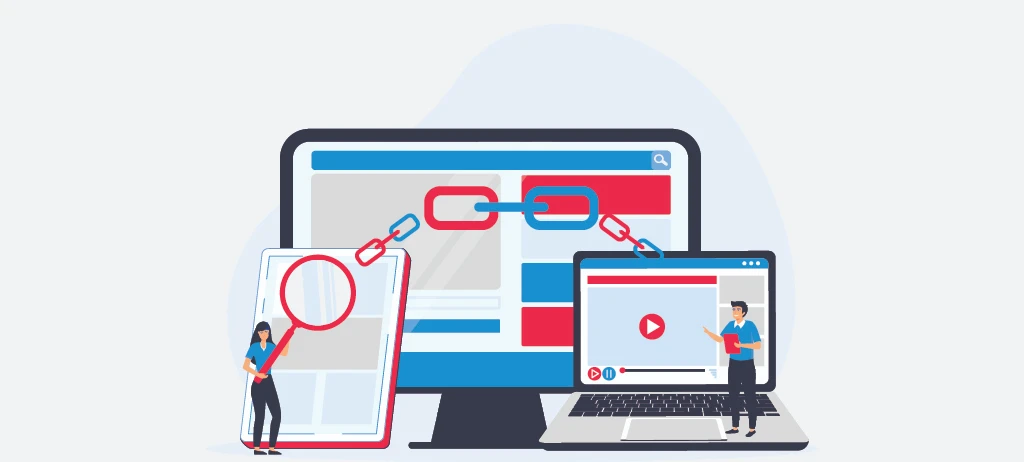
Broken link building is a white-hat SEO strategy where you find dead (404) links on other websites, create or identify a matching replacement page on your own site, then contact the webmaster to suggest your live page as the replacement. When the webmaster updates the link, you earn a high-quality backlink. The process has four stages: find broken links on niche-relevant websites → assess the link's quality and backlink profile → create or match replacement content → send a personalised outreach email offering your page as the fix.
There is a version of link building where you don't create content from scratch, don't pay for placements, don't cold-pitch strangers with zero context, and still land backlinks from high-authority, niche-relevant websites.
That version is broken link building — and in 2026, it remains one of the most underutilised white-hat link acquisition strategies available. It is also one of the safest forms of ethical link building, aligned with Google’s quality guidelines.
Broken link building is powerful on its own, but combining it with complementary link building methods like these 7 ways to gain quality backlinks can accelerate your results.
The reason most SEOs overlook it isn't because it doesn't work. It's because doing it properly takes more thought than blasting a guest post template to 200 sites. You need the right tools, the right prospecting system, and most importantly — the right outreach scripts. Generic emails get ignored. Personalised, helpful, problem-solving emails get replies.
This playbook gives you everything: the full step-by-step process, six proven outreach email templates with line-by-line breakdowns, the best tools at every budget, the exact Google search operators to find opportunities your competitors haven't found yet, and the common mistakes that kill response rates before you even start.
By the time you finish reading, you'll have a complete, repeatable broken link building system ready to deploy.
Key Takeaways
- Broken link building earns white-hat editorial backlinks by helping site owners replace dead links with relevant live content from your website.
- The strategy works best when you follow the full process: find broken links, vet the opportunity, create a strong replacement, and send personalised outreach.
- Relevance matters more than volume—target niche-related sites, recently broken pages, and links placed in meaningful content sections.
- Outreach succeeds when it feels helpful, not promotional, so specific, problem-solving emails consistently outperform generic link requests.
- In 2026, broken link building remains one of the safest and highest-converting link acquisition methods for earning quality backlinks without paying for placements.
What Is Broken Link Building?
Broken link building is a white-hat link acquisition strategy where you:
- Find links on other websites that return a 404 error (the page they link to no longer exists)
- Identify or create a replacement page on your own site that matches what the broken link was pointing to
- Contact the website owner to let them know their link is broken and suggest your live page as the replacement
When the webmaster updates the broken link to point to your page instead, you earn a backlink — one the website owner is usually happy to give you, because you've just solved a real problem for them.
This is what makes broken link building fundamentally different from most link building tactics. You're not asking for a favour. You're providing a service. A broken link damages the website owner's user experience, hurts their SEO, and reflects poorly on their content quality. You're fixing that — and asking for nothing unusual in return.
The win is mutual, which is exactly why response rates for broken link building outreach (when done correctly) are among the highest of any link building method.
Broken link building is just one method within a larger backlink strategy. For a complete overview of modern off-page SEO techniques, explore our link building pillar guide.
Why Broken Link Building Works in 2026

Before diving into the process, it's worth understanding why this tactic remains relevant even as Google's algorithms become more sophisticated.
The internet is full of broken links — and getting worse Websites shut down. Pages get deleted, moved, or restructured. Content that was valuable in 2018 goes offline. Domains expire. Based on current web estimates, roughly 5–10% of all links on established websites are broken at any given time. On older sites — those published before 2020 — the percentage is significantly higher. The opportunity is not shrinking; it's growing.
Webmasters genuinely want to fix their broken links A site with broken links loses credibility with visitors, loses trust signals with Google, and creates a poor experience for everyone. When someone emails a website owner with a polite, helpful note pointing out a broken link, the response is often gratitude — not scepticism.
You're earning editorial links, not buying them Google's algorithm places enormous weight on editorial links — links placed voluntarily by a human editor because the content genuinely deserves to be referenced. Broken link building earns editorial links because the webmaster makes an active choice to update their content. These links carry the same weight as a natural inbound link.
Conversion rates beat cold outreach From experience, broken link building can yield strong results — sometimes sending 50 emails and scoring 20 links, though results vary. Compare this to cold guest post pitching, where a 3–5% reply rate is considered good. The difference is context: a broken link outreach email opens with a real, verifiable problem the recipient already has. It's not a pitch — it's a solution.
AI search rewards topically relevant backlinks In 2026, Google's AI systems evaluate the topical relevance of your entire link profile, not just individual link metrics. Getting links from pages that were specifically about your topic — which is exactly what broken link building targets — sends stronger topical authority signals than general directory or social links.
The 4-Stage Broken Link Building Process
Every successful broken link building campaign follows the same four stages. Each stage has specific actions, tools, and quality checkpoints. Skipping or rushing any stage reduces your results significantly.
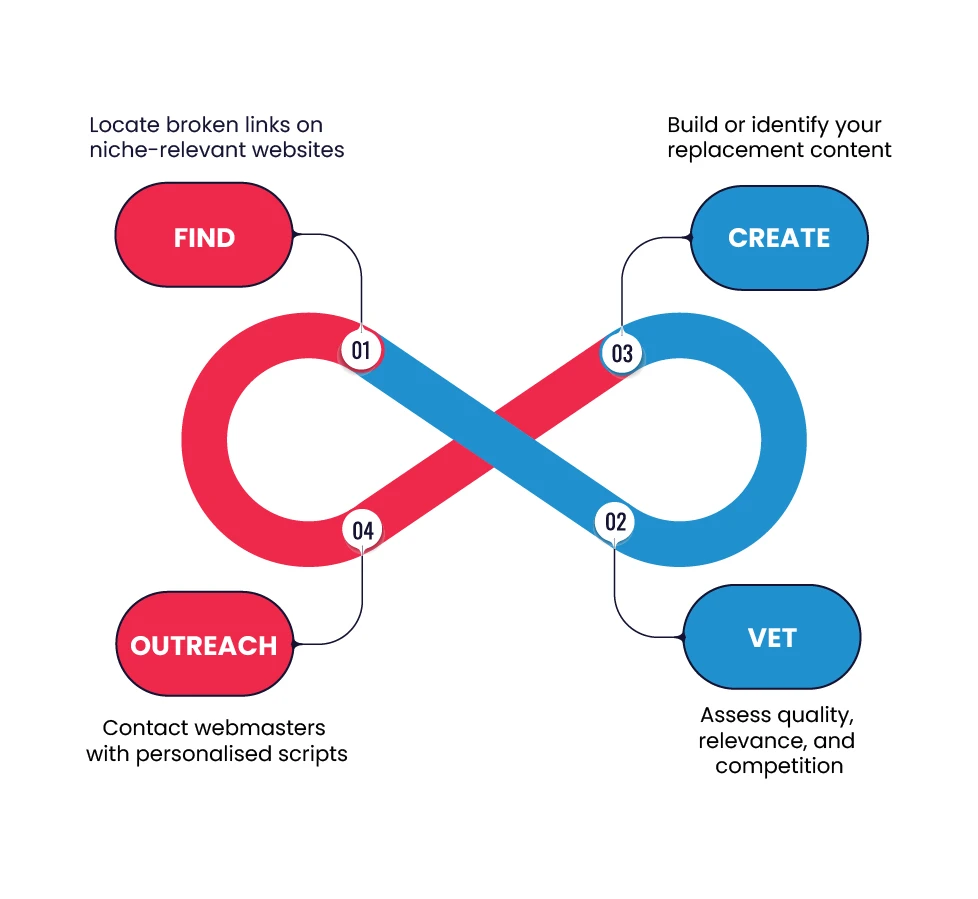
Stage 1: FIND → Locate broken links on niche-relevant websites
Stage 2: VET → Assess quality, relevance, and competition
Stage 3: CREATE → Build or identify your replacement content
Stage 4: OUTREACH → Contact webmasters with personalised scripts
Let's go through each in depth.
Stage 1 — Finding Broken Link Opportunities
This is where most SEOs either do too little (and miss the best opportunities) or go too broad (and waste time on irrelevant sites). There are five prospecting methods, ranked by quality of opportunity:
Method 1: Competitor Backlink Analysis (Highest ROI)
The fastest way to find broken link opportunities that are directly relevant to your niche is to look at your competitors' backlink profiles and find links pointing to their dead pages.
Step-by-step with Ahrefs:
- Go to Ahrefs Site Explorer
- Enter your competitor's domain
- Click Pages → Best by Links
- In the HTTP filter, select 404 Not Found
- Sort by Referring Domains (highest first)
- Export the list
You now have a list of your competitor's dead pages that other websites are still linking to. These are your prime targets — the linking sites are already in your niche, and they're currently linking to nothing.
Step-by-step with Semrush:
- Enter the competitor domain in Backlink Analytics
- Go to Indexed Pages
- Filter by Broken Pages
- Sort by Backlinks
Why this method wins: The backlinks are already proven to be niche-relevant (they were linking to your competitor's content). The linking sites are actively publishing in your space. And the content topic is clearly defined by what your competitor's dead page was about.
These search strings find pages in your niche that are resource pages, link lists, or reference guides — the types of pages most likely to contain broken links and to add your replacement if you reach out.
Most effective search operators for broken link prospecting:
[your keyword] + "resources"
[your keyword] + "useful links"
[your keyword] + "further reading"
[your keyword] + "recommended sites"
intitle:[your keyword] "links"
[your niche] + "page not found"
[your niche] + "404"
inurl:links [your keyword]
[your keyword] + "top tools" -site:[yourdomain.com]
Example for an SEO agency:
seo "useful resources"
link building "recommended tools"
digital marketing "further reading"
intitle:seo "resources"
Run these searches, find the resource pages, then use the Check My Links Chrome extension (free) to instantly highlight all broken links on each page in red.
Method 3: Niche Website Crawl with Screaming Frog
For finding broken outbound links across an entire domain you want links from:
- Open Screaming Frog SEO Spider
- Go to Configuration → Spider → Crawl Linked XML Sitemaps
- Enter the target domain
- After the crawl, click Response Codes → Client Error (4xx)
- Export — you have every broken link on that domain
This is especially useful for large sites with thousands of pages (major industry blogs, news sites, resource hubs) where manual checking is impossible.
Free version limitation: Screaming Frog's free version crawls up to 500 URLs. For larger sites, the paid version ($259/year) is worth every penny.
Method 4: Ahrefs Content Explorer (Find Dead Pages Worth Targeting)
This method works differently — instead of finding broken links on a target site, you find dead pages across the web that used to rank for your keywords and still have backlinks pointing at them.
- Open Ahrefs Content Explorer
- Search: [your keyword]
- Filter: Only broken
- Sort by Referring Domains
You now have a list of dead pages that were once valuable enough for others to link to. These are your replacement content targets — create a better version of what those pages contained, then reach out to everyone linking to the dead page.
Method 5: Check My Links + Manual Browsing (Quick Wins)
For smaller-scale prospecting or when you're just starting out:
- Install the Check My Links Chrome extension (free)
- Browse niche-relevant websites manually — focus on resource pages, "useful tools" pages, blog post reference sections
- Run the extension — it highlights broken links in red instantly
- Note the broken URL, the page URL, and the anchor text
This method is slower but requires zero paid tools and gives you a feel for the types of opportunities in your niche before investing in paid tools.
Stage 2 — Vetting & Qualifying Opportunities
Not every broken link is worth pursuing. The number one reason broken link building fails is creating mediocre content that doesn't deserve the links — and pursuing opportunities where your replacement content won't genuinely match the broken link's purpose.
Before adding any broken link to your outreach list, check these five criteria:
1. Domain Authority / Domain Rating Only pursue opportunities from sites with DA 30+ (or DR 30+ in Ahrefs). Links from DA 20 or below provide minimal ranking benefit and often aren't worth the outreach time.
|
DA Range
|
Priority |
|
DA 70+
|
High priority — pursue immediately
|
|
DA 50–69
|
Strong — include in main campaign
|
|
DA 30–49
|
Good — include in secondary campaign
|
|
DA 20–29
|
Low — only pursue if highly relevant
|
|
Below DA 20
|
Skip |
2. Topical Relevance The linking page must be topically relevant to your website. A link from a cooking blog about broken links on their SEO tool recommendations page is borderline. A link from a marketing blog's resource page about SEO tools is perfect.
3. The Broken Page's Backlink Profile Before pursuing an opportunity, check how many sites are linking to the broken page. Pages with 10+ referring domains are worth significant effort. Pages with 1–2 referring domains are lower priority. You can use a backlink checker to quickly analyse referring domains and link strength before prioritising opportunities.
In Ahrefs: Site Explorer → enter the broken URL → check Referring Domains. The higher the number, the more valuable the replacement will be for the sites you'll be contacting.
4. Link Placement Where on the linking page does the broken link appear?
- In the body content of an article = highest value (editorial placement)
- On a resource/links page = high value (curated human list)
- In a sidebar = moderate value
- In a footer = low value
Prioritise body and resource page placements.
5. Competition Level For high-competition opportunities — broken pages with many referring domains that are well-known in your niche — your replacement content must be 2x better and your outreach must be exceptionally personalised. Otherwise, you're the 50th person pitching, and webmasters have already ignored 49 emails.
Use Ahrefs to check when the page first went dead (under Overview → First seen as broken). Pages that broke in the last 3–6 months are low-competition opportunities. Pages that have been broken for 2+ years have likely been pitched by dozens of other SEOs.
Stage 3 — Creating or Matching Your Replacement Content
Once you've qualified an opportunity, you need a live page on your site that legitimately replaces what the broken link was pointing to.
You have three options:
Option A: You already have a matching page If the broken link pointed to a guide about keyword research and you have a published keyword research guide on your site — great. Use it as your replacement. Just ensure your page is genuinely comparable in depth and quality to what the original page offered.
Option B: Update an existing page to be a better fit If you have a related page but it doesn't fully cover the broken page's topic, add a section or update the content to address the gap. This is often faster than creating from scratch.
Option C: Create new replacement content If you don't have a matching page, you need to create one before reaching out. Research the original page using the Wayback Machine (web.archive.org) to see what the dead page looked like. Create a better, more current, more comprehensive version of that content.
The Wayback Machine method:
- Copy the broken URL
- Go to web.archive.org
- Paste the URL and browse the archived version
- Understand what the original page covered
- Create a replacement that improves on it
Content quality standard: Your replacement content must be at least as good as the original — ideally better. If the dead page was a 500-word article, a 200-word replacement will not be accepted by thoughtful webmasters. If the dead page was a comprehensive guide with examples and data, your replacement needs to match that depth.
Stage 4 — Outreach (With 6 Proven Email Scripts)
This is where most broken link building campaigns succeed or fail. The difference between a 3% reply rate and a 15%+ reply rate comes down entirely to how you write the outreach email.
The anatomy of a high-converting broken link outreach email:
| Element |
Purpose |
|
Subject line
|
Get the email opened (personalised, specific, not clickbaity)
|
|
Opening line
|
Establish context — how you found them
|
|
The problem
|
Point out the specific broken link (URL, anchor text)
|
|
The solution
|
Offer your replacement page
|
|
The close
|
One soft ask — no pressure, no multiple CTAs
|
Universal rules for all outreach scripts:
- Keep emails under 150 words whenever possible
- Never attach files
- Always address the recipient by first name
- Always reference the specific page and broken URL (not a generic mention)
- Include only ONE call to action
- Never use the word "backlink" in the email — you're fixing their site, not building links
- Send from a professional email address, not a Gmail
Script 1 — The Standard Fix (Most Used, 8–12% Reply Rate)
Best for: General niche blogs, resource pages, mid-authority sites
Subject: Broken link on [Page Title]
Hi [Name],
I was reading your article on [brief topic description] at [Page URL] and noticed one of the links is returning a 404 error.
The broken link is: [Broken URL] Anchor text: "[Anchor Text]"
I thought I'd let you know because we recently published a [guide/article/resource] covering exactly the same topic that might work as a replacement:
→ [Your Replacement URL]
No worries either way — just wanted to flag it in case it was useful.
[Your Name] [Your Company] | [Website]
Why it works: Short, respectful, non-pushy. Identifies the problem with specifics. Offers a clear solution without demanding anything. The "no worries either way" line removes pressure and paradoxically increases response rates.
Script 2 — The Resource Page Specialist (12–18% Reply Rate)
Best for: Curated resource pages, "useful tools" lists, recommended reading pages
Subject: Quick update for your [Topic] resources page
Hi [Name],
Found your [Topic] resources page while researching [related topic] — really useful list, especially the section on [specific section they'll recognise].
One of the links appears to be broken:
→ [Broken URL] (currently 404)
We have a [comprehensive guide / updated tool / complete list] on this topic that your readers might find useful as a replacement:
→ [Your Replacement URL]
It covers [2–3 bullet points of what your page covers — specific, not generic].
Happy to help if useful — let me know if you need anything else.
[Your Name] [Company] | [Website]
Why it works: Opens with a genuine compliment about the specific page (not the site generally — that reads as flattery). The bullet points prove your replacement is actually relevant. The close is helpful, not demanding.
Script 3 — The Authority Site Approach (For DA 70+ Sites)
Best for: Major industry blogs, high-DA news sites, established publications
Subject: Link issue on [Publication Name] — [Article Title]
Hi [Name],
I'm a [your role] at [Your Company] and came across your article "[Article Title]" while working on a piece about [related topic].
One of the external links appears to be dead:
URL: [Broken URL] Status: 404 Not Found
The link pointed to content about [what the broken page covered]. We've published an updated guide on this same topic that may be a suitable replacement for your readers:
[Your Replacement URL]
The piece covers [key topic 1], [key topic 2], and [key topic 3] — and the data has been updated for 2026.
Thank you for the great content on [Publication Name].
[Full Name] [Title], [Company] [Email] | [Phone if appropriate]
Why it works: More formal tone matches high-authority publications. Mentioning your role adds credibility. Referencing what the broken page covered demonstrates you actually looked at the dead page — this matters enormously to editors at major sites who receive dozens of generic requests.
Script 4 — The Competitor's Dead Page Approach
Best for: Sites linking to a competitor's dead page
Subject: The [Competitor Page Title] link on your site is broken
Hi [Name],
Just a quick heads-up — a link to [Competitor Domain] on your [Page Title / URL] is currently returning a 404:
Broken URL: [Competitor's Dead Page URL]
We actually have a [more comprehensive / regularly updated] resource on this same topic:
→ [Your Replacement URL]
It covers [topic] in depth and is kept current — might be a useful replacement for your readers.
Either way, thought you'd want to know about the broken link.
[Your Name] | [Company]
Why it works: Never mention the competitor negatively — just state the factual status of their page. Framing your page as "regularly updated" is a strong differentiator since the old page is dead precisely because it was abandoned. The tone is helpful, not competitive.
Script 5 — The SEO Niche / Technical Site Approach
Best for: SEO blogs, digital marketing sites, tech resources
Subject: 404 on [Page Title] — possible fix
Hey [Name],
Spotted a broken link while reading through [Page Title]:
[Broken URL] → 404
It looks like the page was a [describe what the broken page was — e.g., "link building tools list / SEO guide / keyword research tutorial"]. We published an updated version of exactly this type of resource last month:
[Your Replacement URL]
[1–2 sentences on what makes your page specifically better/more current than the original]
Could be a good fix — or feel free to just remove the dead link if you'd prefer. Either way, hope this helps.
[Name] | W3Era
Why it works: SEO-savvy audiences respond to peers, not salespeople. The "either way" close shows you're not desperate for the link — which, counter-intuitively, makes them more likely to give it to you. Keeping it conversational matches the tone of the SEO community.
Script 6 — The Follow-Up Email (For Non-Responders)
Best for: Anyone who didn't reply to Script 1–5 after 5–7 days
Subject: Re: [Original Subject Line]
Hi [Name],
Just following up on my note from [Day, Date] about the broken link on [page title/URL].
Quick recap:
Broken link: [URL] Possible replacement: [Your URL]
No pressure at all — just wanted to make sure it didn't get buried.
[Your Name]
Why it works: Short. No repetition of the full pitch. Just a clear, respectful reminder. Research consistently shows that 35–50% of replies to broken link outreach come from follow-up emails, not the original message. One follow-up is standard and expected. Two follow-ups is the absolute maximum before you move on.
Follow-Up Strategy — The Sequence That Gets Replies
| Day |
Action |
|
Day 1
|
Send initial outreach email (Script 1–5)
|
|
Day 6
|
Send first follow-up (Script 6)
|
|
Day 12
|
Send second and final follow-up (2-line reminder only)
|
|
Day 13+
|
Mark as closed — move on
|
Never follow up more than twice. Three follow-up emails transforms you from a helpful SEO into a nuisance, and you risk being marked as spam — which damages your email domain's deliverability for all future outreach.
Day 12 final follow-up (2-line only):
Hi [Name] — last note on this. The broken link on [page] is still live if you want to fix it: [your URL]. Happy to help if useful.
The Moving Man Method (Advanced Variation)
Broken link building focuses on 404 errors — pages that are completely dead. The Moving Man Method is a related but distinct tactic that targets links which still technically "work" but no longer deliver relevant content.
This happens when:
- A company rebrand redirects their old content to a homepage
- A tool or service is discontinued and the page now shows a "we've shut down" notice
- A resource page redirects to something completely unrelated
- An old blog post still exists but the information is significantly outdated
How to find Moving Man opportunities:
Search for:
- Companies in your niche that have recently rebranded, merged, or shut down
- Tools or services that have been discontinued
- Old statistics or data pages where the original source is no longer maintained
Example: If a popular SEO tool shut down and dozens of marketing blogs still link to their "free SEO checklist" page (which now redirects to a homepage or shows an error), you can create an updated version of that checklist and reach out to every site still linking to the dead tool.
This method often yields higher response rates than standard broken link building because the replacement need is even more obvious — no one wants to link to a shutdown company's homepage.
Broken Link Building for Local SEO — USA Focus
Broken link building is particularly powerful for local SEO in competitive US markets, especially when combined with structured listings from local seo citations usa. because local resource pages and city-specific guides tend to accumulate broken links faster than national sites.
How to find local broken link opportunities:
Use these search operators with your target city:
"[city] + resources" + [your niche]
"[city] + [niche] + "recommended"
"best [niche] in [city]" + "resources"
intitle:"[city] seo" + "links"
"[city] business resources" + [industry]
Example for an SEO agency targeting Houston:
"houston business resources" seo
"houston marketing" "useful links"
intitle:"houston seo" resources
Local link targets to prioritise:
|
Source Type
|
Why It's Valuable
|
|
City Chamber of Commerce sites
|
High local trust, curated links
|
|
Local news publication resource pages
|
City-specific authority
|
|
Regional business blogs
|
Niche-relevant local audience
|
|
Local university resource pages
|
.edu authority
|
|
City government business resource pages
|
.gov authority
|
|
Local industry association sites
|
High topical relevance
|
Additionally, platforms from free business listing sites usa can help you build foundational local authority before scaling outreach campaigns. for cities like Houston, Chicago, Dallas, Austin, and Los Angeles — all high-competition local SEO markets — a broken link campaign targeting local resource pages can earn you 5–15 city-specific backlinks per month that competitors are unlikely to have pursued.
These city-specific backlinks are particularly powerful for ranking in the Google Local Pack and Google Maps results, where local topical relevance is a primary ranking factor.
If you're targeting competitive US regions, our SEO services USA can help turn these backlinks into real local rankings and leads.
Free Stack (Zero Budget)
| Tool |
Use Case
|
|
Check My Links (Chrome extension)
|
Instantly spot broken links on any page
|
|
Wayback Machine (web.archive.org)
|
See what broken pages originally contained
|
|
Google Search operators
|
Find niche resource pages
|
|
Hunter.io (free tier — 25 searches/month)
|
Find contact emails
|
| Gmail |
Outreach (BCC yourself for follow-up tracking)
|
|
Google Sheets
|
Track all opportunities and statuses
|
Realistic output with free stack: 5–15 qualified opportunities per week, 3–8 outreach emails per week
Mid-Budget Stack (~$130–160/month)
| Tool |
Cost |
Use Case
|
|
Ahrefs Lite
|
$129/mo
|
Broken page discovery, competitor backlink analysis, DR checking
|
| Hunter.io (Starter) |
$49/mo
|
Bulk email finding, verification
|
|
Screaming Frog
|
$259/year (~$22/mo)
|
Full-site crawls for broken links
|
Realistic output: 50–100 qualified opportunities per week, 25–50 outreach emails per week
Full Scale Stack (~$250–350/month)
| Tool |
Cost |
Use Case
|
|
Ahrefs Standard
|
$249/mo
|
Full broken link discovery suite
|
|
Pitchbox or Respona
|
$99–$195/mo
|
Automated outreach sequences with personalisation
|
|
Hunter.io Growth
|
$99/mo
|
Bulk verified email finding
|
|
Screaming Frog
|
$22/mo
|
Site-wide crawls
|
Realistic output: 200–500 opportunities per month, 100–200 outreach emails per week, 8–20 links per month
Tracking Your Campaign (Free Template)
Maintain this spreadsheet for every broken link building campaign. Without tracking, you can't improve your approach, can't follow up properly, and can't report results.
Required columns:
|
Column
|
What to Record
|
|
Target Domain
|
The site you're outreaching to
|
|
Target Page URL
|
The specific page containing the broken link
|
|
Broken Link URL
|
The exact 404 URL
|
|
Anchor Text
|
The anchor text used for the broken link
|
|
Domain Authority
|
DA of the target site
|
|
Referring Domains to Broken Page
|
How many sites link to the dead page
|
|
Your Replacement URL
|
Your matching live page
|
|
Contact Name
|
First name of the editor/webmaster
|
|
Contact Email
|
Verified email address
|
|
Outreach Date
|
Date of initial email
|
|
Follow-Up 1 Date
|
Day 6
|
|
Follow-Up 2 Date
|
Day 12
|
|
Response
|
Yes / No / Not yet
|
|
Link Placed
|
Yes / No
|
|
Link URL
|
URL of the page that now links to you
|
|
Notes
|
Any context about the exchange
|
Common Mistakes That Kill Response Rates
Mistake 1: Sending generic, non-specific emails "I found a broken link on your website" with no specific URL, no anchor text, and no page reference is the most common broken link email in every editor's inbox. It signals immediately that you're using automation and haven't actually looked at their site. Always include the specific broken URL and anchor text.
Mistake 2: Using the word "backlink" in your email The moment your email mentions "backlink", "SEO", or "link building", you've shifted the entire framing from "helpful person fixing a problem" to "SEO wanting something". Webmasters who receive hundreds of link building requests react immediately to these keywords. Never mention your SEO intent in the email.
Mistake 3: Offering a replacement page that doesn't match If the broken link pointed to a keyword research tool and you offer a blog post about link building strategies as the replacement, the webmaster will see immediately that you're just trying to get a link — not actually helping them. Your replacement must genuinely cover the same topic as the broken page.
Mistake 4: Only sending one email and giving up As noted earlier, a significant portion of all replies come from follow-up emails. Sending one email and treating the campaign as complete means leaving 35–50% of your potential links on the table.
Mistake 5: Targeting broken links that are too old Broken links that have been dead for 3+ years have usually already been removed, replaced by the site owner, or pitched by many other SEOs. Focus on recently broken pages — those that went 404 in the last 3–6 months — as these are low-competition opportunities that others haven't yet discovered. In Ahrefs, filter by First seen as broken to identify fresh opportunities.
Mistake 6: Not checking if the linking page still has traffic A broken link on a page that receives zero traffic and has never been updated since 2017 is not worth pursuing. Check the linking page's traffic in Ahrefs or Semrush before adding it to your outreach list. Pages with at least some organic traffic are actively maintained and the broken link is more likely to get fixed.
Mistake 7: Pitching sites that are way outside your niche Relevance matters more than DA. A DA 45 site in your exact niche is more valuable than a DA 80 site that has nothing to do with your industry. Don't chase big numbers at the expense of topical fit.
Broken Link Building vs. Other Link Building Methods
|
Method
|
Avg Reply Rate
|
Avg Link Conversion
|
Risk Level
|
Cost
|
Time Investment
|
|
Broken Link Building
|
8–18%
|
5–12%
|
Very Low
|
Low–Medium
|
High (prospecting)
|
|
Guest Posting
|
3–8%
|
2–5%
|
Low
|
Medium–High
|
Very High (content)
|
|
HARO / Journalist Outreach
|
5–12%
|
Variable
|
Very Low
|
Low
|
Medium
|
|
Skyscraper Technique
|
5–10%
|
3–8%
|
Very Low
|
Medium
|
Very High
|
|
Niche Edits
|
10–25%
|
8–20%
|
Low
|
Medium
|
Medium
|
|
Digital PR
|
2–8%
|
1–5%
|
Very Low
|
High
|
Very High
|
|
Resource Page Links
|
6–14%
|
4–10%
|
Very Low
|
Low
|
Medium
|
Broken link building consistently delivers some of the highest reply rates in white-hat link building precisely because the outreach is grounded in a real, demonstrable problem. It's not the fastest method in terms of setup, but the conversion rate from reply to placed link is strong.
Unlike dofollow social bookmarking sites, broken link building focuses on earning contextual editorial backlinks rather than directory-style links.
Final Thoughts
Broken link building is one of the most genuine link building strategies in SEO — because it starts with a real problem and offers a real solution. You're not asking for a favour. You're fixing someone's website.
Done right, it earns you:
- Editorial backlinks from niche-relevant, high-authority sites
- Higher reply rates than almost any other cold outreach method
- Zero risk of Google penalties (you're replacing dead links, not buying or exchanging them)
- Scalable results that compound over time with consistent effort
The playbook is straightforward:
- Find broken links using Ahrefs, Screaming Frog, Google operators, or Check My Links
- Vet opportunities by DA, relevance, competition level, and backlink count to the broken page
- Create or match replacement content that genuinely covers the same topic
- Outreach with the personalised scripts above — specific, short, helpful, zero pressure
- Follow up once at Day 6, once more at Day 12, then move on
- Track everything in a campaign spreadsheet and optimise based on what's working
If you'd like W3Era's team to run a managed broken link building campaign for your website, explore our professional link building services — including prospecting, content creation, and personalised outreach. — contact us here.