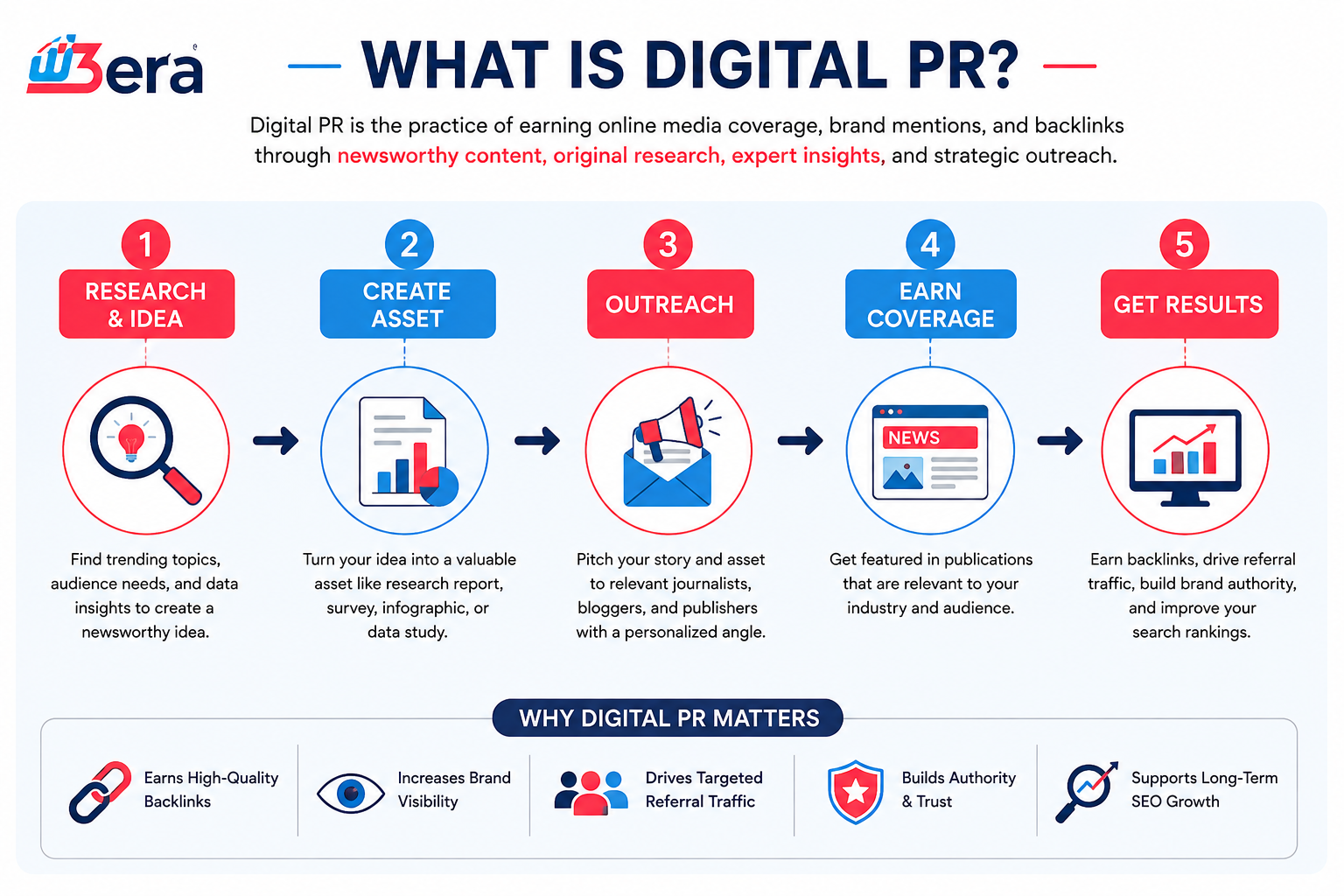
Digital PR is a strategy for earning online media coverage, brand mentions, referral traffic, and editorial backlinks by creating newsworthy content, original research, expert insights, data, and stories that publishers want to reference.
Digital PR supports SEO because successful campaigns can earn relevant editorial backlinks and increase brand visibility across trusted websites. A typical campaign involves finding a strong story, researching the audience and media landscape, creating a useful asset, identifying relevant journalists and publications, preparing personalized pitches, earning coverage, and measuring the resulting links, mentions, traffic, visibility, and conversions. The most effective campaigns focus on original information and genuine news value, rather than creating content simply to place backlinks.
Key Takeaways
- Digital PR combines public relations, content marketing, and SEO.
- The goal is to earn attention and coverage rather than simply request links.
- Original research and proprietary data can create highly linkable PR assets.
- Newsjacking helps brands respond to relevant events while journalists are actively covering them.
- Expert commentary can help businesses become useful sources for journalists.
- Digital PR can generate editorial backlinks, brand mentions, and referral traffic.
- Topical relevance matters when selecting publications.
- A successful campaign should be measured using more than backlink volume.
- Digital PR can strengthen brand visibility and authority over time.
- The strongest campaigns give journalists something genuinely useful to report.
What Is Digital PR?
Digital PR is the practice of increasing a brand's online visibility and reputation through media coverage, publisher relationships, newsworthy content, expert commentary, original research, and other digital communication channels. It is essentially the online evolution of public relations. Traditional PR may focus heavily on newspapers, television, radio, magazines, and offline media.
Digital PR extends those activities into:
- Online news publications
- Industry websites
- Digital magazines
- Blogs
- Podcasts
- Online communities
- Social platforms
- Specialist publications
- Influencer channels
The SEO connection comes from what happens when these publications find your content valuable enough to reference.
For example, imagine an SEO company analyzes 50,000 websites and discovers that a particular technical issue is causing a measurable loss in organic visibility.
Instead of publishing that finding as a normal article and waiting for search traffic, the company could turn the research into a Digital PR campaign.
The process might look like this:
Research → finding → story → visual asset → journalist outreach → media coverage → backlinks → referral traffic → brand visibility
The research gives journalists something new to discuss.
The publication provides the audience.
The coverage creates visibility. And the editorial references can create valuable links back to the original research. This is why Digital PR sits between SEO, content marketing, and public relations rather than belonging exclusively to one discipline. The ranking material you provided follows this same intersection of PR, content, SEO, media coverage, and authority.
How Does Digital PR Work?
A Digital PR campaign normally follows a structured process rather than random media outreach.
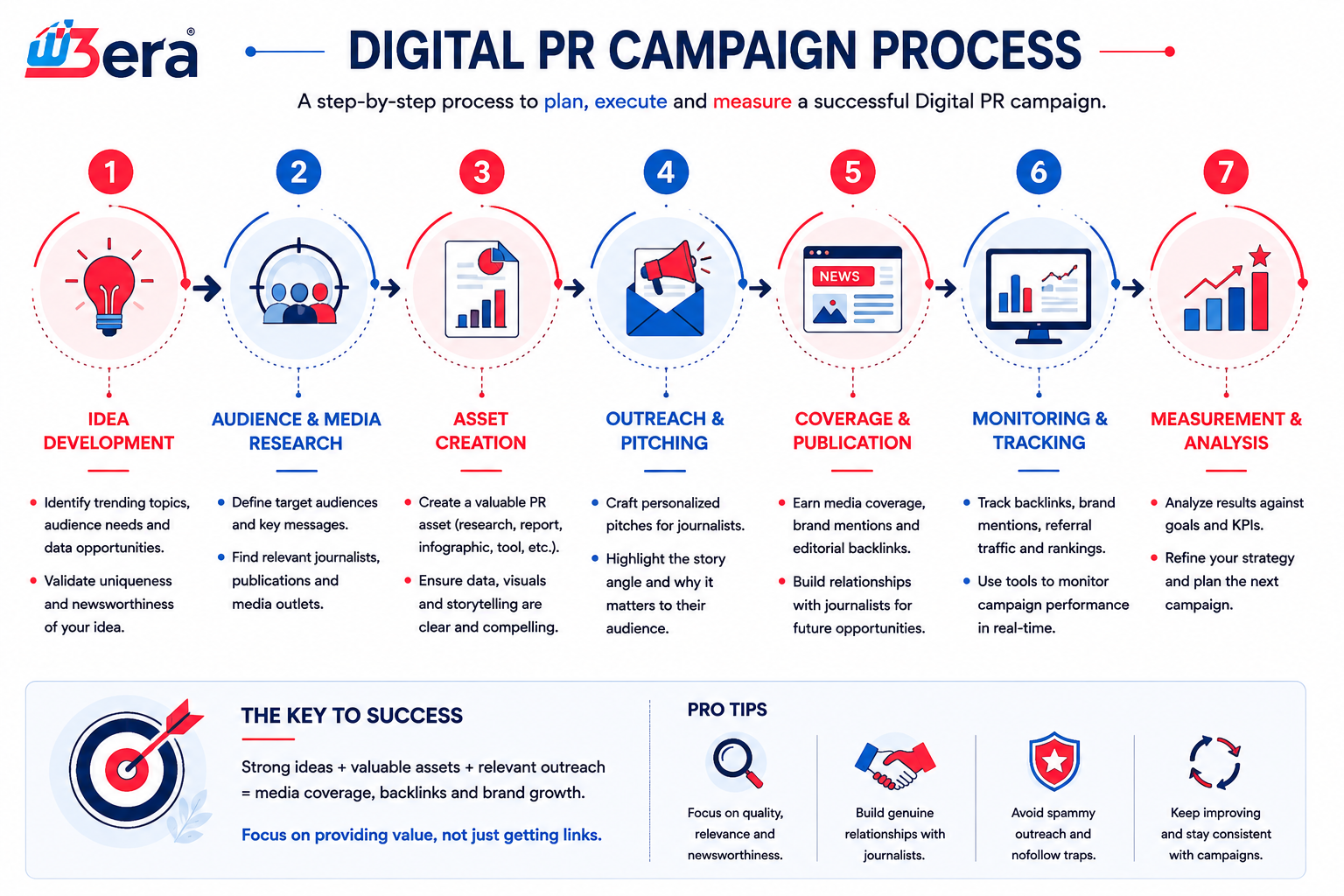
Step 1: Find a Strong Story
The campaign starts with an idea that has genuine value.
This could be:
- Original research
- New statistics
- A survey
- Industry trends
- Consumer behavior
- Expert analysis
- A new study
- A surprising comparison
- A data visualization
- A timely news reaction
The strongest ideas answer a question that people already care about while providing information they cannot easily find elsewhere.
Step 2: Define the Audience
You need to know who should care about the story.
For example, a cybersecurity campaign might target:
- Technology journalists
- Cybersecurity publications
- Business publications
- SaaS websites
- IT decision-makers
A campaign about ecommerce consumer behavior may instead target:
- Retail publications
- Ecommerce websites
- Business journalists
- Consumer media
- Marketing publications
Targeting the wrong audience can make a strong campaign look irrelevant.
Tank's campaign framework similarly emphasizes defining campaign goals and understanding the target audience before beginning outreach.
Step 3: Create the PR Asset
The idea needs to become something journalists can actually use.
That could be:
- A research report
- Original statistics
- An interactive tool
- A survey
- A visual report
- A map
- An expert commentary page
- A trend analysis
Step 4: Find Relevant Publications
The next step is identifying publications and journalists who regularly cover the subject. This is where topical relevance becomes important. A link from a highly relevant industry publication can be more useful than a link from a large but unrelated website. The competitor research specifically emphasizes selecting publications based on authority, readership, topical relevance, and linking behavior.
Step 5: Create the Pitch
The pitch should quickly explain:
- What happened
- Why it matters
- What is new
- Why the journalist's audience would care
- What information you can provide
A journalist should not have to read five paragraphs before discovering the story.
Step 6: Earn Coverage
If the idea is relevant and the pitch reaches the right journalist, the publication may cover the story.
That coverage can include:
- Brand mentions
- Expert quotes
- Research statistics
- Editorial backlinks
- Referral traffic
Step 7: Measure the Campaign
Finally, measure what happened.
Look at:
- Referring domains
- Editorial backlinks
- Brand mentions
- Referral traffic
- Organic visibility
- Rankings
- Brand searches
- Leads
- Conversions
This makes Digital PR a measurable marketing channel rather than simply a media activity.
Digital PR vs Traditional PR
Digital PR and traditional PR share the same basic objective: build awareness, credibility, and relationships around a brand. The main difference is the environment in which those activities happen.
Traditional PR commonly focuses on:
- Newspapers
- Television
- Radio
- Magazines
- Offline events
- Print publications
Digital PR expands that into:
- Online publications
- Industry websites
- Blogs
- Podcasts
- Social platforms
- Digital magazines
- Online communities
Digital PR also makes it easier to track certain outcomes.
You can monitor:
- Backlinks
- Referral traffic
- Online mentions
- Social engagement
- Publication coverage
- Brand searches
- Organic visibility
However, Digital PR does not mean traditional PR should be ignored.
For larger campaigns, the two approaches can work together. For example, a product launch might receive coverage in a newspaper while the company simultaneously publishes original research online and pitches the findings to industry publications. That creates multiple routes for the same story to reach the audience.
Digital PR vs Link Building
This is one of the most important distinctions to understand.
Link building focuses primarily on acquiring backlinks.
Digital PR focuses on creating something worth covering and earning attention, mentions, and links as a result.
For example, a traditional link-building campaign may identify a relevant website and contact its owner about adding a link.
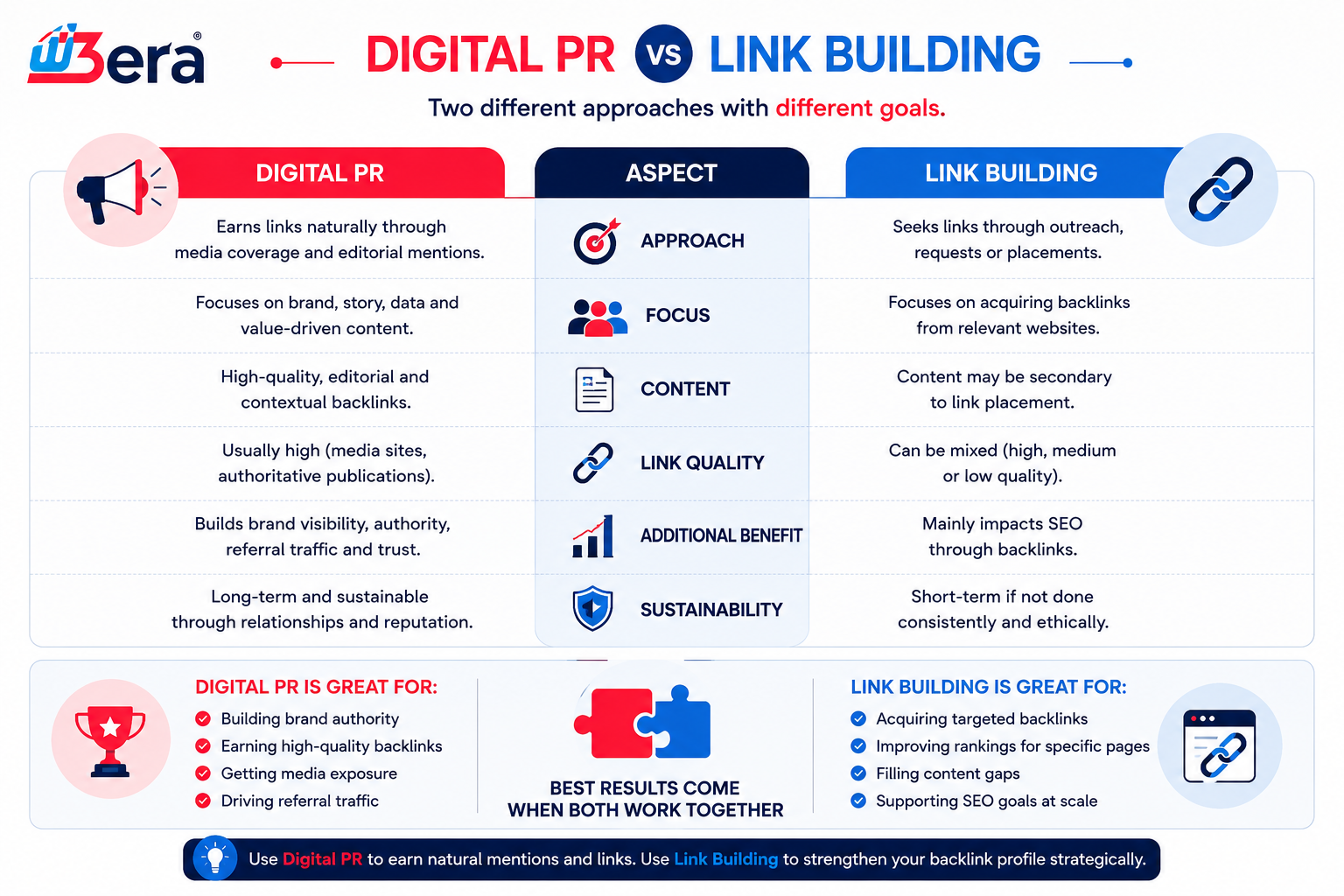
A Digital PR campaign might instead:
- Conduct an original study.
- Publish the findings.
- Create useful charts.
- Identify journalists covering the subject.
- Pitch the most interesting findings.
- Earn media coverage.
- Receive editorial references and backlinks.
The backlink is therefore a result of the story, not the entire purpose of the campaign. Your existing guide to link building is a strong supporting resource here because readers who want to understand the broader backlink acquisition process can move from Digital PR into the dedicated link-building topic. The Semrush competitor makes this distinction directly: Digital PR generates links while also building broader brand awareness and publisher relationships.
Why Digital PR Matters for SEO
Digital PR can support SEO through several connected outcomes.
Editorial Backlinks
When a journalist references your original research, they may link to the source. These editorial links can strengthen your backlink profile.
Referral Traffic
Readers may click the link in the publication and visit your website. This traffic can be particularly valuable when the publication has an audience closely related to your business.
Brand Mentions
A publication may mention your company, founder, product, research, or expert without linking. Even when a direct link is not earned, the exposure can increase brand awareness.
Brand Searches
Someone might discover your company through a media article and later search for the brand directly. This creates another pathway through which PR can contribute to broader search visibility.
Authority and Recognition
Repeated coverage can help establish a business as a recognizable source within its industry. That is particularly valuable for businesses competing in crowded search results. The ranking sources repeatedly connect Digital PR with backlinks, brand visibility, referral traffic, authority, and measurable marketing outcomes.
Digital PR and Topical Authority
Digital PR can also support a broader topical authority strategy.
Suppose an SEO agency publishes research about:
How AI is changing ecommerce search behavior.
The campaign may earn coverage from:
- Ecommerce publications
- SEO publications
- AI publications
- Marketing websites
- Business media
Now the brand is being discussed across several closely related areas.
That external recognition can complement the site's own content architecture. For W3era, this connects naturally with your existing entity SEO and topical authority guide.
The relationship is:
Expert content → Digital PR campaign → relevant media coverage → external recognition → stronger topical ecosystem
Digital PR should therefore not be treated as a completely separate activity from content strategy. The best campaigns are connected to the subjects a brand already wants to be known for. Building topical authority also requires consistent optimization across the website, not just external media coverage. For companies competing in the UK search market, combining Digital PR with seo service in UK can help connect external authority, relevant content, and organic search growth.
What Makes a Digital PR Campaign Successful?
A campaign does not become successful simply because it contains statistics.
The story needs to satisfy several conditions.
It should be original
If every publication has already reported the same information, there is little reason to cover it again.
It should be useful
Journalists should be able to use the research, statistics, quote, or insight in their stories.
It should be relevant
The campaign needs a clear connection to the publication and its audience.
It should be easy to understand
A journalist should quickly understand the main finding.
It should have a strong angle
"Company publishes new report" is weak.
"Study reveals a major change in consumer behavior" is much stronger.
It should have evidence
Strong claims need reliable data and methodology.
This is one area where the competitor material is particularly useful: successful Digital PR depends on research that provides genuine information rather than simply confirming obvious conclusions.
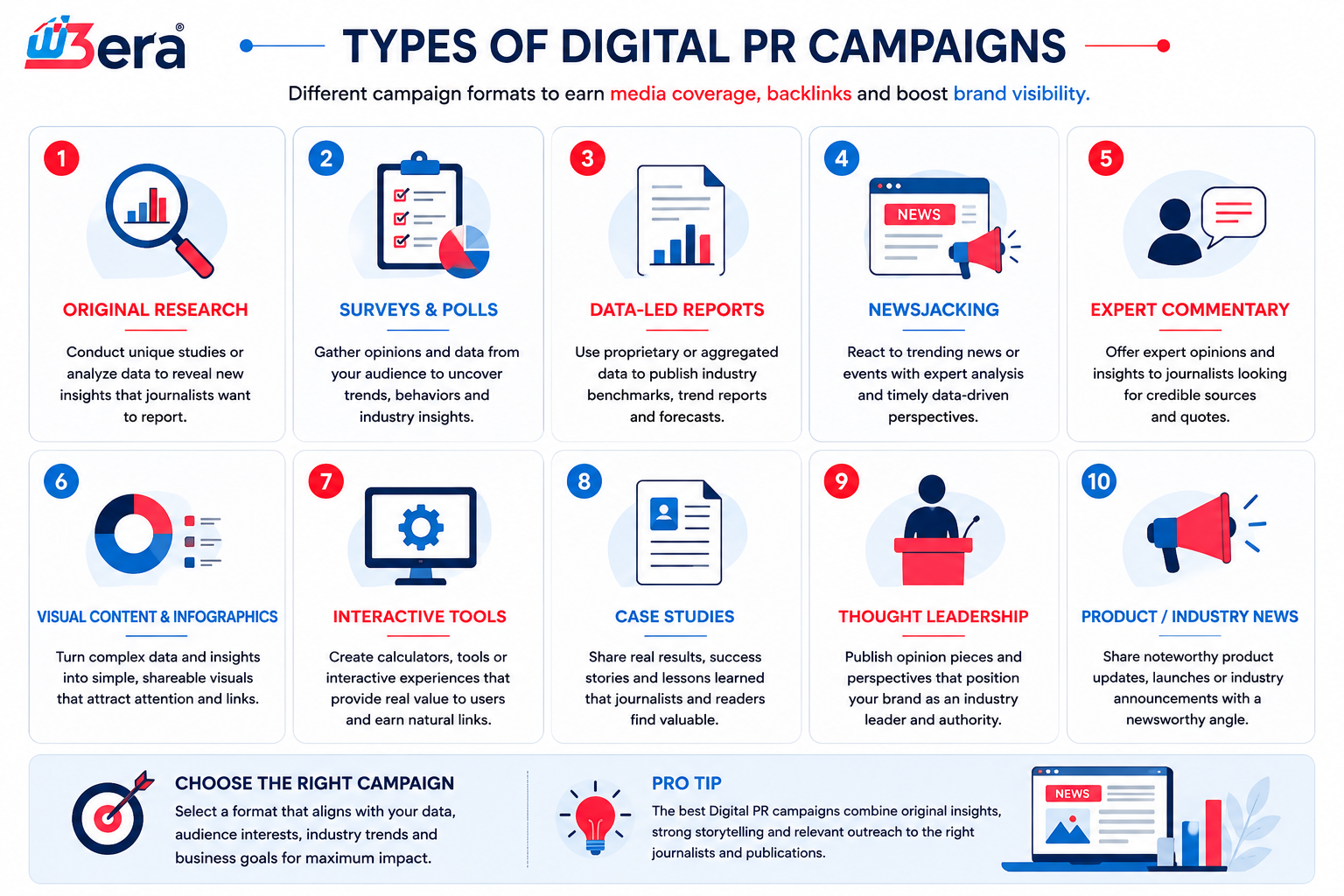
What Types of Digital PR Campaigns Work Best?
There is no single Digital PR format that works for every industry.
The best format depends on:
- Audience
- Industry
- Available data
- Business expertise
- News cycle
- Media landscape
- Campaign objective
The following formats are among the most useful.
1. Original Research
Original research is one of the strongest Digital PR formats because it gives journalists something they cannot simply copy from another publication.
You can conduct:
- Customer surveys
- Industry surveys
- Consumer studies
- Website analysis
- Market research
- Data analysis
- Experiments
For example:
An SEO agency could analyze thousands of websites to determine which technical SEO problems appear most frequently on high-growth websites.
The campaign could publish:
- Top technical issues
- Industry differences
- Before-and-after data
- Charts
- Expert analysis
- Practical recommendations
The original data becomes the news asset. Ingenious Hitech similarly identifies original data and research studies as a core Digital PR asset because journalists can use the findings as primary sources.
2. Surveys and Consumer Data
Surveys can turn audience opinions into usable statistics.
For example:
"68% of small businesses say generating qualified organic traffic is their biggest SEO challenge."
A statistic like this gives a journalist a reason to reference the study.
But survey quality matters.
You should clearly document:
- Number of respondents
- Audience type
- Survey period
- Questions asked
- Methodology
- Geographic coverage
Without this information, journalists may question the reliability of the data.
3. Data-Led Reports
If your business has access to useful proprietary or aggregated data, turn it into an industry report.
Useful data reports can analyze:
- Year-over-year changes
- Consumer trends
- Industry benchmarks
- Regional differences
- Search behavior
- Pricing trends
- Product usage
- Market growth
The more specific the finding, the stronger the story can become.
4. Newsjacking
Newsjacking means responding to a current news event with useful expert insight.
For example, if Google announces a major search change, an SEO agency could quickly provide:
- Expert analysis
- Practical implications
- Initial data
- Recommendations
- Industry commentary
Timing is critical.
A journalist writing a story today may not need the same commentary two weeks later.
This means newsjacking requires:
Monitoring → fast analysis → expert response → targeted outreach
The competitor material specifically treats newsjacking and timely commentary as an important Digital PR tactic.
You do not always need a massive research campaign.
Sometimes your expertise is the asset.
For example, a journalist writing about:
"Why ecommerce websites are losing organic visibility"
may need an SEO expert to explain:
- What changed
- Why it happened
- What businesses should do
- What mistakes to avoid
A useful expert quote can earn:
- Brand exposure
- Author visibility
- Media mentions
- Potential backlinks
This is particularly useful for agencies because expertise can be packaged into a repeatable PR process.
6. Visual Data Assets
Data becomes easier to understand when presented visually.
Useful Digital PR visuals include:
- Infographics
- Charts
- Maps
- Timelines
- Comparison graphics
- Industry dashboards
- Interactive tools
A visual asset can also make the journalist's job easier.
Instead of explaining complicated findings from scratch, the publisher can reference the visual or use it to support their story.
Interactive tools can be particularly strong linkable assets.
Examples include:
- Calculators
- Benchmark tools
- Industry comparison tools
- ROI calculators
- Assessment tools
- Data explorers
These assets can attract links because publishers have a reason to reference something their audience can actually use.
How to Find a Digital PR Campaign Idea
Start with questions rather than formats.
Ask:
What does our business know that other people want to know?
Then investigate:
Industry trends
What is changing?
Customer behavior
What are customers doing differently?
Internal data
What proprietary information do we have?
Public data
What datasets can we analyze differently?
Contradictions
What common assumption could our data challenge?
News events
What current event connects to our expertise?
Gaps
What information do journalists repeatedly need but struggle to find?
The strongest ideas often appear where business expertise + original information + current interest overlap.
How to Validate a PR Idea Before Creating It
One of the biggest Digital PR mistakes is creating an expensive campaign before checking whether anyone cares.
Before building the asset, ask:
Has this already been covered?
Search Google and major publications.
Is there a stronger angle?
The topic may be useful, but the current angle may be weak.
Who would publish it?
Identify actual publications before investing heavily.
What statistic would become the headline?
If you cannot identify a strong headline finding, the research may not be strong enough.
If the campaign only summarizes existing sources, it may be difficult to earn coverage.
Is the topic connected to our expertise?
The campaign should strengthen the brand's positioning rather than attract irrelevant attention.
Your media list should be based on relevance first.
Divide prospects into tiers.
Tier 1
High-authority publications with strong relevance.
Tier 2
Industry publications and specialist media.
Tier 3
Regional publications, niche websites, and smaller relevant publishers.
Do not assume that the largest publication is always the best target.
A niche publication can provide:
- Strong topical relevance
- Better audience alignment
- Higher journalist responsiveness
- Qualified referral traffic
Ingenious Hitech specifically recommends a tiered publication strategy and notes that industry-specific, regional, and niche publications can be valuable alongside major media outlets.
How to Write a Digital PR Pitch
A good pitch should be short.
The journalist needs to understand the story quickly.
A basic structure is:
Subject: Strong finding or story angle
Opening: Why you are contacting them.
Main finding: The most interesting piece of information.
Evidence: Supporting statistic or data.
Why it matters: Explain the broader relevance.
Asset: Link to the research, visual, or report.
Expert: Offer an expert available for commentary.
Avoid sending a generic pitch to hundreds of journalists.
Personalization matters.
A journalist covering ecommerce should receive an ecommerce angle.
A journalist covering finance should receive the financial implication.
The same campaign can have multiple angles.
Tank's research emphasizes that a good campaign can be repositioned for different audiences and publication types rather than using one generic story everywhere.
How to Follow Up With Journalists
Following up is normal.
Repeatedly sending the same message is not.
A practical approach is:
- Initial pitch
- One useful follow-up
- Move on if there is no response
The goal is to preserve the relationship.
A journalist who does not need your story today may become valuable for a future campaign.
The competitor guidance also warns against aggressive follow-ups and emphasizes relationship building rather than treating journalists as one-time link prospects.
SEO Impact, Measurement and Long-Term Strategy
What Makes a Good Digital PR Backlink?
Not every backlink generated by a PR campaign has the same value.
Look beyond raw link count.
Evaluate:
- Topical relevance
- Publication quality
- Editorial context
- Referring page quality
- Audience relevance
- Traffic potential
- Link placement
- Natural context
For example, imagine two backlinks.
Link A: A relevant industry publication that discusses your research and links to the original study.
Link B: An unrelated website that publishes thousands of generic articles and adds your link to one of them.
The first is much more aligned with the purpose of Digital PR.
Your existing [guide to backlinks] can support readers who want to understand backlink quality in more detail.
Why Relevance Matters More Than Link Volume
A common mistake is judging PR campaigns only by how many links they generate.
Suppose Campaign A earns:
100 unrelated backlinks
while Campaign B earns:
15 highly relevant editorial backlinks
Campaign B may be more valuable for a business trying to build authority in a specific subject.
This is because contextual relevance matters.
Digital PR should therefore focus on:
Right publication + right audience + right story + right context
rather than:
Maximum number of links
This aligns with the broader off-page SEO approach in your existing material, where relevant backlinks and digital PR are treated as stronger authority-building methods than simply accumulating large volumes of links.
Digital PR and E-E-A-T
Digital PR can also support how a brand demonstrates expertise and credibility across the web.
For example, imagine an SEO company publishes an original study and its experts are quoted by several respected industry publications.
The company is now associated externally with:
- Original research
- Industry expertise
- Expert commentary
- Data
- Professional knowledge
That external recognition can complement the site's own expertise signals.
Digital PR should therefore work together with strong on-site content rather than replacing it.
Your topical authority guide is relevant here because both strategies focus on building stronger connections between expertise, entities, content, and authority.
How to Measure Digital PR Results
Digital PR needs a measurement framework.
Do not report only:
"We earned 25 backlinks."
Instead, separate performance into several categories.
Backlink Metrics
Track:
- New referring domains
- Editorial backlinks
- Relevant backlinks
- Link quality
- Link placement
- Followed and nofollow links
- Lost links
Brand Metrics
Track:
- Brand mentions
- Publication coverage
- Brand search activity
- Social mentions
- Expert citations
Traffic Metrics
Track:
- Referral sessions
- Engaged sessions
- New users
- Pages per session
- Conversions from referral traffic
SEO Metrics
Track:
- Keyword rankings
- Organic clicks
- Organic impressions
- Organic traffic
- Search visibility
- New ranking keywords
Business Metrics
Ultimately, connect PR activity to:
- Leads
- Sales
- Assisted conversions
- Revenue
- Cost per acquisition
Ingenious Hitech's measurement section similarly recommends tracking backlinks, organic rankings, traffic, referral quality, brand searches, and conversions rather than relying only on link volume.
What Are the Biggest Digital PR Mistakes?
Creating Content Nobody Cares About
A beautiful report cannot compensate for a weak story. Always validate the idea before investing heavily in production.
Mass-Pitching Journalists
Sending the same pitch to hundreds of unrelated journalists damages response rates and can hurt relationships.
Chasing Authority Scores Alone
A high third-party authority metric does not automatically mean a publication is relevant.
Look at:
Relevance + audience + editorial quality + authority.
Making the Story About Your Company
Journalists usually care more about the story than your company's sales message.
Instead of:
"W3era launches a new SEO service."
A stronger angle might be:
"New study reveals the technical SEO issues most commonly affecting growing ecommerce websites."
The brand becomes the source of the story rather than the story itself.
Using Weak Data
Poor methodology can destroy credibility.
Explain where the data came from and how it was collected.
Following Up Too Much
One useful follow-up is reasonable.
Repeated messages create friction.
Measuring Only Backlinks
A campaign can succeed even when the number of links is lower than expected if it generates strong brand visibility, referral traffic, expert recognition, or high-value media coverage.
How to Scale Digital PR
One successful campaign is useful.
A repeatable PR system is much more valuable.
Create a quarterly campaign calendar containing:
- Original research
- Surveys
- Data reports
- Industry predictions
- Expert commentary
- Seasonal campaigns
- Newsjacking opportunities
Build repeatable processes for:
Research → production → media list → outreach → follow-up → coverage tracking → reporting
You can also maintain a journalist relationship database containing:
- Journalist name
- Publication
- Topic
- Contact method
- Previous interactions
- Published stories
- Preferred subjects
This allows future campaigns to become more targeted.
Ingenious Hitech recommends systematic processes around content calendars, templates, outreach management, follow-ups, relationship building, and campaign reporting for scaling Digital PR.
How Digital PR Fits Into an SEO Strategy
Digital PR should not operate as a disconnected marketing campaign.
It works best when connected to the rest of your SEO system.
A strong model looks like this:
Keyword research
↓
Content strategy
↓
Original research / Digital PR asset
↓
Media coverage
↓
Relevant editorial backlinks
↓
Authority and visibility
↓
Internal links to commercial and informational pages
↓
Organic traffic
↓
Leads and conversions
For example, if W3era publishes original research about SEO performance, the PR campaign can earn external links to that research.
The research page can then internally link to related educational content.
Those educational pages can naturally link toward relevant service pages.
This creates a relationship between:
External authority → content cluster → service pages
That is much more strategically useful than treating Digital PR as a standalone backlink campaign.
Digital PR works best when it is part of a wider organic growth strategy that includes technical optimization, content development, authority building, and ongoing search visibility. Businesses targeting competitive US markets can combine these activities with top seo service in the USA to build stronger organic visibility and turn earned media exposure into long-term search growth.
Digital PR Checklist
Before launching a campaign, check:
Research
- Is the idea original?
- Is the data reliable?
- Is the methodology clear?
- Is the topic relevant to the audience?
Story
- Is there a clear headline?
- Is there a surprising finding?
- Can journalists understand the story quickly?
- Are there multiple angles?
Asset
- Is the research easy to understand?
- Are charts and visuals available?
- Can journalists reference the data easily?
- Is the landing page useful?
Outreach
- Are publications relevant?
- Are journalists actually covering the topic?
- Is each pitch personalized?
- Is the pitch concise?
SEO
- Does the campaign have a natural linkable asset?
- Are backlinks relevant?
- Are referring domains diverse?
- Does the campaign support your broader topical strategy?
Measurement
- Are backlinks tracked?
- Are mentions tracked?
- Is referral traffic tracked?
- Are brand searches monitored?
- Are rankings monitored?
- Are leads and conversions measured?
Conclusion
Digital PR is more than sending press releases or trying to get backlinks from large publications. The strongest campaigns start with something genuinely useful: new information, original research, expert knowledge, compelling data, or a timely story. That asset gives journalists a reason to pay attention. The resulting coverage can generate backlinks, brand mentions, referral traffic, and wider recognition. For SEO teams, the biggest opportunity is to connect Digital PR with the rest of the organic growth strategy. Research can become a linkable asset. The asset can earn editorial coverage. The coverage can generate relevant backlinks. Those links can strengthen the site's external authority. And the authority can support a broader content and service-page ecosystem. That makes Digital PR most effective when it is treated not as a one-off backlink tactic, but as a repeatable authority, visibility, and brand-growth channel