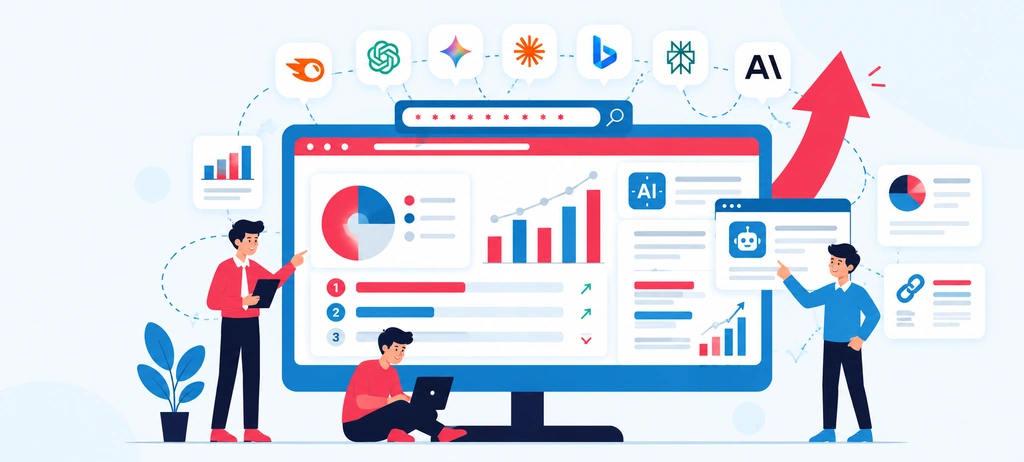
AI search visibility tracking is the process of measuring how often your brand, website, products, services, or content appear in AI-generated answers across Google AI Overviews, Google AI Mode, ChatGPT, Perplexity, Gemini, and other answer engines. It tracks mentions, citations, source URLs, sentiment, referral traffic, competitors, and answer accuracy.
That is why AI search visibility tracking has become a new measurement layer for SEO teams and executives. It helps you monitor brand mentions, citations, source URLs, answer accuracy, ChatGPT traffic, AI Overview reporting signals, LLM referral tracking, and competitor visibility across AI-powered search platforms.
This guide explains what to track, how to build an AI visibility dashboard, how to connect AI search performance to SEO KPIs, and how W3era recommends using AI SEO optimisation services, semantic SEO, GEO, and AEO to improve measurable visibility
Key Takeaways
- AI visibility is not the same as keyword ranking. It measures whether AI systems mention, cite, summarise, or recommend your brand in generated answers.
- Search Console and GA4 still matter. Google says AI feature traffic appears in Search Console performance reporting, while GA4 now includes an “AI Assistants” channel for sources like ChatGPT and Gemini. (Google for Developers)
- Core AI search metrics include brand mentions, citations, cited URLs, answer share of voice, sentiment, accuracy, source quality, and LLM referrals.
- Google AI Overviews and AI Mode still rely on SEO fundamentals. Google says crawlability, indexability, snippet eligibility, useful content, page experience, internal links, and visible text remain important. (Google for Developers)
- ChatGPT and Perplexity visibility should be tracked separately. ChatGPT Search can provide timely answers with links to web sources, while Perplexity’s Sonar provides web-grounded responses with citations. (OpenAI)
- AI answer tracking should be repeated over time. AI responses can vary by prompt, location, platform, date, personalization, and retrieval source.
- The best reporting model combines SEO + AI visibility + business outcomes. Track whether AI visibility leads to qualified sessions, assisted conversions, branded demand, and better content decisions.
What Is AI Search Visibility Tracking?
AI search visibility tracking measures how your brand appears inside AI-powered search experiences. Instead of asking only, “What position does this page rank in Google?” it asks:
· Is our brand mentioned in AI answers?
· Is our website cited as a source?
· Which page is cited?
· Which competitors are mentioned more often?
· Is the answer accurate?
· Is the sentiment positive, neutral, or negative?
· Does AI visibility generate referral traffic?
Which topics are missing from our AI search presence?
Traditional rank tracking measures search result positions. AI visibility tracking measures answer presence, citation presence, answer prominence, and source influence.
· For example, a traditional SEO report may say:
· “Your page ranks #4 for ‘AI SEO growth services.’”
An AI search visibility report may say:
“Across 50 non-branded AI SEO prompts, your brand appeared in 18% of ChatGPT responses, was cited in 6% of Perplexity answers, did not appear in Google AI Overviews, and was mentioned behind three competitors in comparison-style prompts.”
That second report gives executives a new kind of search intelligence: not just whether the website ranks, but whether the brand is being surfaced by AI systems when buyers ask decision-making questions.
Why AI Search Visibility Measurement Matters Now
AI search adoption is no longer experimental. Google reported that AI Overviews had more than 2 billion monthly users across over 200 countries and territories in 2025, while Alphabet later reported that AI Mode had more than 75 million daily active users after global rollout. (blog.google)
OpenAI also reported that ChatGPT had more than 800 million weekly users in 2025, and ChatGPT Search can provide timely answers with links to relevant web sources. (OpenAI)
That changes SEO reporting in three ways.
1. Search journeys are becoming answer-led
Users no longer always scan ten blue links. They may ask a full question and receive a synthesized answer. Google says AI Mode can use query fan-out, where the system breaks a complex question into subtopics and searches across related sources. (Google for Developers)
2. Mentions may happen without clicks
A brand can influence a buyer even when the user does not click. If an AI answer names your company as a recommended provider, explains your service, or cites your guide, that exposure may affect later branded searches, direct visits, sales calls, and conversions.
3. SEO teams need new measurement language
Executives understand rankings, traffic, and revenue. AI visibility adds new questions:
· What is our AI answer share of voice?
· Are we cited as a trusted source?
· Which competitors appear more often?
· Are AI systems describing our brand accurately?
· Which pages are influencing AI answers?
Which topics need stronger content, schema, authority, or citations?
AI Search Visibility Tracking vs Traditional SEO Reporting
| Reporting Area |
Traditional SEO Reporting |
AI Search Visibility Tracking |
Why Both Matter |
| Main unit |
Web page ranking |
Brand/source appearance in AI answers |
AI answers may influence users before clicks |
| Core metric |
Ranking position |
Mentions, citations, answer prominence |
AI visibility is often not a classic rank position |
| Tools |
Search Console, GA4, rank trackers |
AI visibility tools, manual prompt tests, GA4, Search Console |
No single tool captures everything |
| User behaviour |
Searches, clicks, visits |
Prompts, answers, summaries, citations |
AI users ask longer and more conversational questions |
| Attribution |
Click and session-based |
Mention, citation, referral, assisted influence |
Some AI exposure may not produce direct clicks |
| Competitive view |
SERP competitors |
Answer competitors and cited-source competitors |
A brand may appear in AI answers even if it is not ranking #1 |
| Business value |
Organic acquisition |
Discovery, authority, trust, assisted conversion |
AI visibility supports early-stage and decision-stage journeys |
Google’s own AI guidance reinforces that SEO fundamentals still apply to AI features, but AI search creates broader discovery patterns through AI Overviews, AI Mode, and query fan-out. (Google for Developers)
What Should You Track in AI Search Visibility Reporting?
AI search visibility tracking should not rely on one number. Use a scorecard that combines presence, source quality, accuracy, sentiment, traffic, and business impact.
| Metric |
What It Measures |
Formula / Method |
Why It Matters |
| Brand mention rate |
How often your brand appears in AI responses |
Prompts with brand mention ÷ total prompts × 100 |
Shows whether AI systems recognize your brand for target topics |
| Citation rate |
How often your website is cited or linked |
Responses citing your domain ÷ total responses × 100 |
Shows whether your content is used as a source |
| AI answer share of voice |
Your visibility compared with competitors |
Your mentions or citations ÷ total competitor mentions or citations × 100 |
Helps benchmark category visibility |
| Answer prominence |
Where your brand appears in the AI answer |
Manual or tool-based scoring |
First-mentioned brands often receive more attention |
| Cited URL quality |
Which pages are cited |
Track exact cited URLs |
Helps identify pages influencing AI answers |
| Sentiment |
Whether your brand is described positively, neutrally, or negatively |
Human review or sentiment scoring |
Helps detect brand perception risks |
| Accuracy |
Whether AI answers describe your company correctly |
Human validation checklist |
Prevents misleading or outdated AI descriptions |
| LLM referral traffic |
Sessions from AI assistants |
GA4 source/channel analysis |
Connects AI visibility to website visits |
| AI-assisted conversions |
Leads or sales influenced by AI referrals |
GA4 + CRM + attribution review |
Connects AI search to business outcomes |
| Topic gap score |
Topics where competitors appear but you do not |
Prompt cluster comparison |
Guides content and authority-building priorities |
The Four Main Types of AI Search Visibility
1. AI Overview Tracking
AI Overview tracking measures whether your brand, page, or source URL appears in Google AI-generated summaries.
Google says AI Overviews and AI Mode are part of Search, and links shown in AI features can generate clicks and impressions under standard Search Console rules. (Google Help)
Track:
· Queries where AI Overviews appear
· Whether your page is linked or cited
· Which page earns visibility
· Whether traffic or impressions shift for affected queries
· Whether competitors are cited more often
· Whether your snippet/content is answer-ready
2. Google AI Mode Reporting
AI Mode is more exploratory. Google says AI Mode may break a user’s question into subtopics and issue multiple related searches using query fan-out. (Google for Developers)
Track:
· Complex prompts related to your industry
· Follow-up question visibility
· Competitor mentions
· Source URLs surfaced in AI Mode
· Topic clusters where your site is absent
· Whether your content covers subtopics deeply enough
3. ChatGPT Visibility Tracking
ChatGPT Search can answer timely questions with links to relevant web sources, and OpenAI’s help documentation explains that ChatGPT may rewrite prompts into targeted search queries and provide citations or a source panel. (OpenAI)
Track:
· Brand mentions in ChatGPT responses
· Whether ChatGPT cites your website
· Referral traffic from ChatGPT
· Accuracy of brand descriptions
· Competitor recommendations
· Prompts where your brand should appear but does not
4. Perplexity, Gemini, and LLM Visibility Tracking
Perplexity’s Sonar is designed for web-grounded AI responses with citations, while its Search API provides real-time ranked web results from a refreshed index. (Perplexity)
Track:
· Source citations
· Cited page types
· Competitor citations
· Topic coverage
· Answer sentiment
· LLM referral sessions
· Brand and entity-based SEO solutions consistency across platforms
How to Set Up AI Search Visibility Tracking: Step-by-Step
Step 1: Define the Business Questions
Do not start with tools. Start with the decisions the report must support.
Ask:
· Are we visible when buyers ask AI tools for solutions?
· Are competitors being recommended more often?
· Are our guides or service pages cited?
· Is ChatGPT traffic converting?
· Are Google AI Overviews reducing or increasing clicks?
· Which content topics should we improve first?
· Are AI systems describing our services accurately?
· For executives, the report should answer:
· “Are we gaining or losing discoverability in AI-powered search, and what should we do next?”
· Step 2: Build a Prompt and Query Library
· A prompt library is the foundation of AI answer tracking. Include at least five prompt types.
| Prompt Type |
Example |
What It Reveals |
| Branded |
“What is W3era known for in SEO?” |
Brand accuracy and reputation |
| Non-branded informational |
“How do I track AI search visibility?” |
Content/source visibility |
| Commercial investigation |
“Best AI SEO agencies for global brands” |
Vendor recommendation visibility |
| Comparison |
“W3era vs other AI SEO agencies” |
Competitive positioning |
| Problem-solution |
“How can a SaaS company measure ChatGPT traffic?” |
Use-case relevance |
| Platform-specific |
“Which sources does Perplexity cite for AI SEO measurement?” |
Citation visibility |
| Follow-up prompts |
“Which of these providers offers AI Overview tracking?” |
Multi-step journey visibility |
Start with 25–50 prompts for a focused topic cluster. Expand once the baseline is stable.
Prioritize platforms based on audience behaviour.
| Platform |
What to Track |
Notes |
Google AI Overviews
· Links, impressions, clicks, affected queries, cited pages
Use Search Console plus manual SERP checks
Google AI Mode
· Brand mentions, source links, subtopic visibility
· Useful for complex exploratory questions
· ChatGPT Search
· Mentions, citations, source links, referral traffic
· Track ChatGPT traffic in GA4
· Perplexity
· Citations, answer prominence, competitor sources
· Strong for source-based answer monitoring
· Gemini
· Brand mentions, answer accuracy, referral traffic where visible
· Important for Google ecosystem users
· Copilot / Claude / others
· Mentions and competitor visibility
Track if relevant to your audience
Step 4: Run a Baseline Audit
For each prompt, capture:
| Platform |
What to Track |
Notes |
| Date |
Location or language setting |
Prompt text |
| Answer summary |
Whether your brand appears |
Whether your domain is cited |
| Cited URL |
Competitors mentioned |
Sentiment |
| Accuracy notes |
Screenshot or evidence link |
Recommended action |
| AI answers can change, so the baseline should be treated as a snapshot, not a permanent truth. |
Step 5: Create an Evidence Log |
An AI visibility report is stronger when every claim has proof. |
| Create an evidence log with: |
Field |
Example |
| Date tested |
May 19, 2026 |
Platform |
| ChatGPT Search |
Prompt |
“Best AI SEO agency for enterprise websites” |
| Brand mentioned? |
Yes / No |
Cited? |
| Yes / No |
Cited URL |
Exact page URL |
| Competitors mentioned |
Competitor A, Competitor B |
Sentiment |
| Positive / Neutral / Negative |
Accuracy issue |
Missing AI SEO service description |
| Screenshot |
Stored internally |
Action |
| Improve AI SEO service page and add case study |
|
This prevents AI visibility reporting from becoming guesswork. |
| Step 6: Track AI Referral Traffic in GA4 |
GA4 traffic-source reports help you understand where sessions originate. Google Analytics explains that traffic-source dimensions show where traffic comes from and how users arrive, and session-scoped dimensions appear in the Traffic acquisition report. (Google Help) |
GA4 also includes an AI Assistants default channel group that includes sources such as ChatGPT, Gemini, DeepSeek, Copilot, Grok, and similar AI assistants. Google notes that Google’s AI Overviews and AI Mode are included in Organic Search, not the AI Assistants channel. (Google Help) |
| Recommended GA4 setup: |
Review the default AI Assistants channel |
Create custom explorations for AI referral sources |
| Segment traffic from ChatGPT, Perplexity, Gemini, Copilot, Claude, and other tools |
Compare engaged sessions, conversion rate, and lead quality |
Monitor landing pages receiving AI referral traffic |
| Connect GA4 events to CRM outcomes where possible |
Suggested starting regex for AI referral review: |
chatgpt|openai|perplexity|copilot|gemini|claude|poe|you.com|phind|deepseek|grok|meta.ai |
Validate this pattern against your own GA4 data before using it in executive reporting.
Step 7: Use Search Console for Google AI Feature Signals
Google says AI feature appearances are included in Search Console performance reporting, and Search Console defines clicks, impressions, CTR, and average position using standard performance rules. (Google for Developers)
For Google AI Overviews and AI Mode, review:
· Query-level impression changes
· Page-level click changes
· CTR movement for informational queries
· Queries with declining clicks but stable or rising impressions
· Pages that may be exposed in AI features
· Branded search changes after AI visibility gains
· Content clusters with rising non-click visibility
· Search Console alone will not give a complete AI visibility picture. Use it with manual AI checks, GA4, AI visibility tools, and competitor monitoring.
· Step 8: Build a Monthly AI Visibility Dashboard
· A useful AI search dashboard should combine four layers:
| Dashboard Layer |
Metrics |
| Visibility |
Mentions, citations, answer share of voice, answer prominence |
| Source quality |
Cited URLs, citation frequency, source diversity, page type |
| Accuracy and trust |
Sentiment, factual accuracy, outdated claims, brand description quality |
| Business impact |
AI referral sessions, engaged sessions, conversions, assisted pipeline, branded search lift |
For executives, summarise results in plain language:
“Our AI visibility improved from 18% to 31% across priority AI SEO prompts. Perplexity cited three W3era pages, ChatGPT traffic increased, but competitors still dominate enterprise and SaaS-related prompts. Next action: strengthen AI SEO service content, add evidence-backed case studies, and improve entity/schema consistency.”
Data, Research, and Search Behaviour Insights
Google AI Features Are Expanding Search Behaviour
Google says AI Overviews and AI Mode help users ask more complex questions and explore topics in new ways, while AI Mode can use query fan-out across subtopics and data sources. (Google for Developers)
SEO implication: Track clusters of questions, not only exact-match keywords.
Google Still Recommends SEO Fundamentals
Google’s AI optimisation guidance says SEO best practices remain relevant for generative AI features because they are rooted in Search ranking and quality systems. Google also advises creating unique, valuable content rather than over-optimizing query variants to manipulate rankings or AI responses. (Google for Developers)
SEO implication: AI search visibility tracking should lead to better content, stronger sources, clearer structure, and improved topical authority—not spammy prompt-stuffing.
Search Console and GA4 Are Still Part of AI Reporting
Google says AI feature traffic appears in Search Console performance reporting, and GA4’s default channels now separate AI Assistants from Organic Search, with Google’s AI Overviews and AI Mode included in Organic Search. (Google for Developers)
SEO implication: Do not buy an AI tracking tool and ignore first-party analytics. Use both.
LLM Search Can Produce Referral Traffic
ChatGPT Search provides answers with links to relevant web sources, and Perplexity’s Sonar provides web-grounded responses with citations. (OpenAI)
SEO implication: Track LLM referral sessions, but also track zero-click AI mentions that may influence later branded searches.
GEO Research Supports Source Clarity and Evidence
The Generative Engine Optimisation research paper found that methods such as adding citations, quotations, and statistics improved source visibility in controlled generative-engine experiments, with gains varying by query type and domain. Treat this as research evidence, not a guaranteed outcome for every website. (arXiv)
SEO implication: Citation-worthy, evidence-backed content is more useful for AI answer systems and human readers.
Example AI Search Visibility Report
Below is a simplified example for an SEO agency tracking AI visibility around “AI SEO services.”
| Prompt Cluster |
Platform |
Brand Mentioned? |
Website Cited? |
Competitor Visibility |
Sentiment |
Recommended Action |
| “Best AI SEO agencies” |
ChatGPT Search |
No |
No |
3 competitors mentioned |
Neutral |
Build comparison-ready AI SEO service page and add third-party proof |
| “How to optimise for AI Overviews” |
Perplexity |
Yes |
Yes |
2 competitors cited |
Positive |
Strengthen guide with schema examples and Search Console workflow |
| “AI SEO audit checklist” |
Google AI Overview |
No |
No |
Industry blogs cited |
Neutral |
Publish downloadable AI SEO audit checklist |
| “Measure ChatGPT traffic in GA4” |
ChatGPT Search |
Yes |
No |
Analytics blogs cited |
Positive |
Add GA4 AI referral tracking section and screenshots |
| “GEO vs AEO vs AI SEO” |
Perplexity |
No |
No |
Tool/vendor pages cited |
Neutral |
Create semantic glossary and internal link cluster |
The purpose is not only to report visibility. The purpose is to identify the next content, advanced technical SEO services, authority, and entity actions.
How to Interpret AI Search Visibility Results
Do Not Treat AI Visibility as a Fixed Ranking
AI answers are dynamic. A response may change based on:
· Prompt wording
· Date
| Platform |
What to Track |
Notes |
| Location |
Search mode |
User context |
| Retrieved sources |
Model updates |
Freshness of indexed content |
| Instead of reporting one “AI rank,” report trend-based visibility across a controlled prompt set. |
Separate Mentions From Citations |
A mention means the AI answer names your brand. A citation means the AI answer links to or references your website as a source. |
| Both matter, but they indicate different things. |
Result |
Meaning |
| Action |
Mentioned but not cited |
Brand is recognized, but your site may not be the source |
| Improve citation-worthy content and authoritative pages |
Cited but not named |
Your content is useful, but brand recall is weak |
| Improve brand/entity signals and author/publisher schema |
Mentioned and cited |
Strongest visibility signal |
| Protect and expand the content cluster |
Not mentioned or cited |
Visibility gap |
| Improve content depth, authority, internal links, and external validation |
|
Track Accuracy as a Risk Metric |
| AI systems may describe a company incorrectly, use outdated service information, or mix competitors. Accuracy tracking should include: |
Brand name spelling |
Service list accuracy |
| Location accuracy |
Pricing claims |
Case study claims |
| Author or expert attribution |
Competitor comparison fairness |
Outdated information |
GEO Optimisation: How AI Search Visibility Tracking Supports Generative Engine Optimisation
Generative Engine Optimisation focuses on improving how content appears in AI-generated answers. AI search visibility tracking gives GEO teams the feedback loop they need.
How Generative Engines May Interpret This Topic
For a query like “how to track AI search visibility,” a generative engine may look for:
· Definitions
· Metrics
· Tools
· GA4 setup steps
· Search Console guidance
· AI Overview reporting limitations
· ChatGPT and Perplexity referral tracking
· Examples and formulas
· Dashboard templates
· FAQs
Expert sources
How to Structure Content for AI-Generated Answers
Use:
· Clear definitions near the top
· Direct answer blocks
· Metrics tables
· Step-by-step workflows
· Formulas
· Examples
· FAQ sections
· Source-backed claims
· Author and reviewer information
· Updated date
How Brands Can Improve Source Visibility
· To become more citation-worthy:
· Publish original workflows and templates
· Add official-source citations
· Include screenshots and examples
· Use consistent brand and service terminology
· Build topic clusters around AI SEO, GEO, AEO, and semantic SEO
· Add expert review and update dates
Avoid exaggerated claims about guaranteed AI citations
GEO Checklist
| GEO Element |
Recommendation |
| Definition clarity |
Add a 40–60 word definition block |
| Citation readiness |
Support claims with Google, OpenAI, Perplexity, Schema.org, and research sources |
| Retrieval structure |
Use short sections, tables, formulas, and question headings |
| Original value |
Add W3era’s own AI visibility framework |
| Entity consistency |
Use consistent terms for AI search visibility, LLM visibility, AI answer tracking, and GEO |
| Trust |
Add author, reviewer, sources, screenshots, and update history |
AEO Optimisation: How This Topic Supports Answer Engine Optimisation
Answer Engine Optimisation focuses on direct answers, featured snippets, People Also Ask, voice-style answers, and zero-click search.
Best AEO Formats for This Blog
| Query |
Best Format |
Suggested Answer Format |
| What is AI search visibility tracking? |
Definition block |
40–60 words |
| How do you track ChatGPT traffic? |
Step-by-step section |
GA4 workflow |
| What is LLM visibility tracking? |
Definition + examples |
Short answer + table |
| How do you measure AI Overview visibility? |
Explanation + checklist |
Search Console + manual checks |
| AI answer tracking metrics |
Metrics table |
Mention, citation, SOV, sentiment |
| Best AI visibility KPIs |
KPI table |
Executive scorecard |
People Also Ask Opportunities
Target questions such as:
· What is AI search visibility?
· How do I track AI search visibility?
· Can Google Search Console track AI Overviews?
· How do I track ChatGPT traffic in GA4?
· What is LLM visibility tracking?
· What is AI answer tracking?
· Which AI visibility metrics should SEO teams report?
· How do I know if Perplexity cites my website?
· Is AI visibility the same as SEO ranking?
· How often should I track AI search visibility?
· Start sections with a direct answer
· Use question-based headings
· Add concise definitions
· Use numbered steps for workflows
· Use tables for comparisons
· Add FAQs with direct answers
Avoid vague claims and unsupported predictions
Semantic SEO Optimisation
Semantic content optimisation services helps search systems and AI models understand meaning, entities, relationships, and topical context.
Important Entities to Include
| Entity |
Why It Matters |
| AI search visibility |
Main topic entity |
| AI search visibility tracking |
Primary keyword and measurement process |
| AI answer tracking |
Related measurement concept |
| LLM visibility |
Broader AI platform visibility |
| ChatGPT |
Key AI search platform |
| Perplexity |
Citation-based answer engine |
| Gemini |
Google AI ecosystem entity |
Google AI Overviews
Google AI search feature
Google AI Mode
· Complex query and query fan-out feature
· Search Console
· Google reporting tool
· GA4
· Referral and conversion analytics
· Brand mentions
· Core visibility metric
· Citations
· Core source authority metric
· Answer rank / prominence
· AI answer placement concept
· Referral tracking
· Measurement and attribution concept
· Generative Engine Optimisation
· GEO cluster connection
· Answer Engine Optimisation
· AEO cluster connection
· Semantic SEO
Entity and topic relationship strategy
Include these naturally:
· AI Overview reporting
· LLM referral tracking
· ChatGPT visibility
· ChatGPT traffic
· AI citation tracking
· Brand mention tracking
· Source attribution
· Answer share of voice
· Entity salience
· Topical authority
· Query intent
· Internal linking
· Structured data
· Evidence logs
· Prompt library
· AI search dashboard
· Sentiment tracking
· Internal Linking Opportunities
· This blog should link to:
· AI SEO Services
· Semantic SEO Services
· Generative Engine Optimisation Services
· Answer Engine Optimisation Services
· LLM Optimisation Services
· AI SEO Audit Services
· Schema Markup Services
· Technical SEO Services
· Strategic SEO consulting experts Services
· Schema Opportunities
· Use structured data to clarify the page type, author, publisher, FAQs, and page hierarchy. Google says structured data helps Google understand page content and can support rich result eligibility when guidelines are met. (Google for Developers)
AI SEO Optimisation
AI SEO combines technical SEO, AI content optimisation solutions, semantic SEO, GEO, AEO, structured data, and E-E-A-T to improve visibility across AI-assisted search experiences.
Google AI Overviews
· For Google AI Overviews, focus on:
· Crawlable pages
· Indexed content
· Snippet eligibility
· Helpful content
· Clear headings
· Accurate facts
· Strong internal links
· Original examples
Author and reviewer signals
Google says there are no additional technical requirements for appearing in AI features beyond normal Search eligibility, but foundational SEO remains important. (Google for Developers)
Google AI Mode
For Google AI Mode, optimise for complex, multi-step questions.
Add:
· Decision frameworks
· Comparison tables
· Follow-up questions
· Related subtopics
· Topic clusters
· Entity-rich sections
· Internal links across related pages
· Google’s AI Mode may use query fan-out to search across related subtopics, which makes comprehensive topical coverage more important than isolated keyword targeting. (Google for Developers)
LLM Visibility
For ChatGPT, Perplexity, Gemini, and other LLM-powered search systems, focus on:
· Source-backed content
· Concise definitions
· Citation-worthy pages
· Original insights
· Clear brand/entity information
· Updated service pages
· Authoritative external mentions
· Consistent organisation schema
Strong topical clusters
E-E-A-T Improvements
Add:
· Named author
· Expert reviewer
· Update date
· Source list
· Screenshots
· Original examples
· Verified case studies
· Clear contact information
· Transparent service CTAs
· Google’s guidance on AI-generated content says Google rewards original, high-quality content that demonstrates E-E-A-T, regardless of whether automation assisted the production process. (Google for Developers)
W3era AI-VISIBLE Framework
W3era can use the AI-VISIBLE Framework to audit, measure, and improve AI search visibility.
| Step |
Meaning |
Action |
| A — Audit current visibility |
Establish the baseline |
Test priority prompts across Google AI features, ChatGPT, Perplexity, Gemini, and other relevant platforms |
| I — Identify prompt clusters |
Build a repeatable query set |
Group prompts by branded, non-branded, comparison, problem-solution, and buyer-intent categories |
| V — Verify mentions and citations |
Separate brand visibility from source visibility |
Track whether the brand is mentioned, whether the website is cited, and which URL appears |
| I — Inspect answer accuracy |
Check whether AI systems describe the brand correctly |
Review service claims, location, pricing, expertise, and competitor comparisons |
| S — Score share of voice |
Benchmark against competitors |
Measure AI answer share of voice by prompt cluster and platform |
| I — Integrate analytics |
Connect visibility to business outcomes |
Use GA4, Search Console, CRM data, and AI referral tracking |
| B — Build citation-worthy content |
Turn findings into SEO actions |
Improve guides, service pages, schema, internal links, author signals, and external sources |
| L — Log evidence |
Keep proof for every result |
Store prompts, screenshots, dates, sources, and recommended actions |
| E — Evolve monthly |
Monitor trends and refine |
Repeat measurement, compare trends, and update strategy every month |
AI-VISIBLE Scoring Model
| Score Area |
Weight |
What to Measure |
| Brand mention rate |
20% |
How often the brand appears |
| Citation rate |
20% |
How often the domain is cited |
| Answer prominence |
10% |
Whether the brand appears early or late in the answer |
| Sentiment and accuracy |
15% |
Whether the answer is positive and factually correct |
| Competitive share of voice |
15% |
Visibility compared with competitors |
| Referral and conversion impact |
10% |
AI assistant sessions, engagement, leads, assisted conversions |
| Content/source quality |
10% |
Whether cited pages are strategic and up to date |
This model should be adjusted based on business goals. For example, a SaaS company may weigh conversions more heavily, while a B2B agency may weigh brand mentions and competitor share of voice more heavily.
30/60/90-Day Implementation Roadmap
| Timeline |
Focus |
Actions |
| First 30 days |
Baseline and dashboard |
Build prompt library, test platforms, create evidence log, review GA4 AI Assistants traffic, review Search Console trends |
| Days 31–60 |
Content and entity improvements |
Improve missing topic pages, add answer blocks, strengthen internal links, add schema, update service pages, add expert review |
| Days 61–90 |
Authority and conversion alignment |
Build citation-worthy assets, publish case studies, monitor competitors, refine dashboard, connect AI referrals to CRM outcomes |
Common Mistakes to Avoid
| Mistake |
Why It Hurts |
How to Fix It |
| Treating AI visibility as a single rank |
AI answers vary by prompt, platform, and date |
Track prompt clusters and trends instead of one fixed ranking |
| Only tracking ChatGPT |
Buyers may use Google AI Overviews, AI Mode, Perplexity, Gemini, and Copilot |
Track the platforms your audience actually uses |
| Ignoring citations |
A brand mention without a source link may not drive traffic |
Track both mentions and cited URLs |
| Ignoring GA4 and Search Console |
First-party analytics still show traffic and performance signals |
Combine AI tools with GA4 and Search Console |
| Not validating answer accuracy |
AI systems may misstate services, locations, or expertise |
Add human review and accuracy scoring |
| Reporting vanity metrics only |
Mentions alone do not prove business impact |
Connect visibility to traffic, leads, conversions, and branded demand |
| Using unsupported AI SEO claims |
Overpromising AI citations damages trust |
Use careful language and credible sources |
| Publishing generic AI content |
Low-value scaled content can violate Google spam policies |
Add original examples, expert review, sources, and practical workflows |
| Forgetting competitors |
AI answers often recommend multiple brands |
Track direct competitors and “answer competitors” |
| Failing to repeat tests |
One-time prompt checks become outdated quickly |
Run monthly or biweekly tracking for priority clusters |
Google’s spam policies explicitly include attempts to manipulate rankings or generative AI responses in Google Search, so AI visibility work should be based on useful content and trustworthy optimisation, not shortcuts. (Google for Developers)
W3era Expert Tips
1. Start With 25–50 High-Intent Prompts
Do not start with hundreds of random prompts. Begin with prompts that represent buyer discovery, comparison, problem-solving, and service evaluation.
2. Separate “Mentioned” From “Cited”
A mention shows brand awareness. A citation shows source influence. Report both because they lead to different SEO actions.
3. Track AI Referrals by Landing Page
Do not only report total ChatGPT traffic. Identify which landing pages receive AI referrals and whether those users engage, convert, or move into the sales funnel.
4. Use Search Console for Google AI Signals, but Do Not Depend on It Alone
Google AI features appear within Search Console performance reporting, but AI visibility also includes mentions, citations, and zero-click exposure that Search Console may not fully explain. (Google for Developers)
5. Create Citation-Worthy Assets
Publish content that AI systems and human researchers can confidently reference: original checklists, expert frameworks, data-backed guides, comparison tables, screenshots, and case studies.
6. Review Brand Accuracy Monthly
AI systems may describe your company using outdated or incomplete information. Track whether answers correctly explain your services, industries, locations, proof points, and differentiators.
7. Connect AI Visibility to Revenue Conversations
For executives, the strongest report is not “we appeared in 12 AI answers.” It is “AI referrals drove qualified sessions, branded searches increased, and our competitors lost answer share in priority buying prompts.”