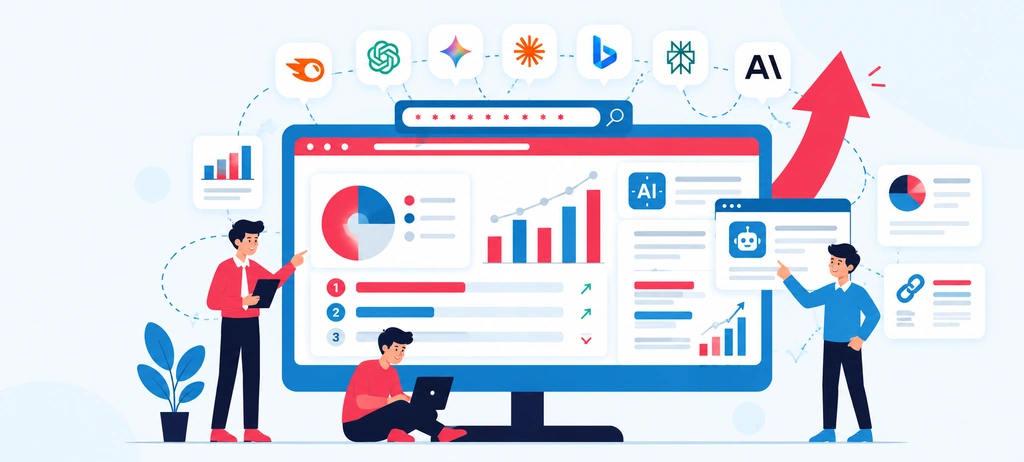
LLM SEO is the process of optimizing your website so AI tools such as ChatGPT, Gemini, Google AI Overviews, and Perplexity can understand, trust, summarize, and cite your content. It combines traditional SEO, entity optimization, structured content, expert-led information, technical crawl access, and strong brand signals. To get cited by AI search engines, your content must answer questions clearly, cover topics in depth, demonstrate credibility, stay up to date, and appear across trusted sources. The brands that win AI citations are not only ranking pages. They are becoming reliable entities across the web.
Search is changing from keyword results to AI-generated answers. People now ask ChatGPT, Gemini, and Perplexity full questions and expect direct responses with supporting sources. This shift creates a new SEO challenge: your website must be easy for large language models to retrieve, interpret, and cite. That is where LLM SEO matters. It helps your brand appear in AI-powered answers, not just traditional search results. In this guide, you will learn how AI tools choose sources and how to increase your chances of being cited.
Key Takeaways
- LLM SEO is an advanced form of SEO focused on visibility in AI-generated answers.
- ChatGPT, Gemini, Perplexity, and Google AI Overviews use different systems to find and cite sources.
- Crawlability, topical authority, entity strength, freshness, and trust signals influence the likelihood of citations.
- AI tools prefer clear, structured, answer-first content that directly satisfies search intent.
- Entity optimization helps AI systems understand who your brand is and why it should be trusted.
- Backlinks, brand mentions, reviews, author credibility, and third-party citations still matter.
- Measuring LLM visibility requires manual prompt testing, referral tracking, and citation monitoring.
- A strong [SERVICE PAGE] can gain more semantic support when related blogs build topical authority around AI search optimization.
Large language models do not all work in the same way. Some rely mainly on training data, while others use live web retrieval to find current information. Understanding this difference is the first step toward getting cited by ChatGPT, Gemini, and Perplexity.
Training data is the information a model learned from before release or update. It helps the system understand language, topics, relationships, patterns, and general knowledge. However, training data alone is not enough for fresh information. It may not know about a new product, new law, updated pricing, recent research, or a newly published guide.
Live web retrieval solves that problem. In AI search, retrieval-augmented generation, often called RAG, allows an AI system to search external sources, retrieve relevant documents, and use them to create an answer. This is where citations become possible. If your page is discovered, relevant, accessible, and trustworthy, the AI system may use it as a supporting source.
Think of it this way. Traditional SEO asks, “Can this page rank on Google?” LLM SEO asks, “Can this page become the source an AI assistant chooses when answering a question?” The second question depends on more than ranking. It depends on clarity, entity trust, technical accessibility, topical completeness, freshness, and how well your content matches the user’s exact information need.
Training Data vs Live Web Retrieval
Training data helps AI understand concepts. Live retrieval helps AI answer current questions. For example, an LLM may already understand what “technical SEO” means through training data. But if a user asks, “What are the latest ways to appear in Google AI Overviews?” the system needs live sources or recent indexed content.
This creates two layers of visibility:
- Memory-level visibility: The model already recognizes your brand, topic, or website from broad web signals.
- Retrieval-level visibility: The model identifies your current page during a live search or retrieval.
Brands with strong entity signals may be mentioned more often. Pages with strong retrieval signals may be cited more often. The best LLM SEO strategy builds both.
How Perplexity, ChatGPT With Search, and Gemini Pull Citations
Perplexity is built around source-backed answers. It typically displays citations clearly, making it one of the easiest platforms for tracking AI visibility. Perplexity looks for pages that answer the prompt directly, appear reliable, and can be fetched quickly. It often favors pages with concise explanations, updated information, original references, and strong topical alignment.
ChatGPT with search can surface sources when the system uses web retrieval. For publishers, one important technical step is allowing the right crawler access. If your site blocks discovery, ChatGPT may not be able to summarize and cite your content properly. ChatGPT citations depend on relevance, accessibility, source quality, and the page's support for the answer.
Gemini and Google AI Overviews are closely tied to Google’s search ecosystem. Google AI features can use search systems, indexed pages, snippets, structured content, and related query expansion to generate answers. This means your existing SEO fundamentals still matter. A page that is not indexed, blocked from snippets, or difficult to understand has a slightly lower chance of appearing as a supporting source.
Why Some Sites Get Cited Repeatedly, and Others Never Do
Some websites appear repeatedly in AI answers because they send strong signals of trust and relevance across the web. They have deep topic coverage, clear authorship, accurate facts, fresh updates, strong internal linking, and external mentions from trusted websites.
Other sites struggle because their content is too generic. They may publish surface-level blog posts that define a topic but add no new value. They may lack author credibility, structured headings, data, examples, or third-party authority. They may also block crawlers, rely too much on JavaScript, or hide important information behind forms.
AI systems need confidence. A page that says “we are experts” is less useful than a page that proves expertise through examples, data, methodology, case studies, comparison tables, original insights, and clear explanations.
For example, a blog titled “What Is AI SEO?” may struggle if it only repeats basic definitions. A better page would explain AI SEO, compare the citation behavior of ChatGPT and Perplexity, provide a crawler access checklist, include sample robots.txt rules, offer FAQs, and link to a relevant [SERVICE PAGE] for deeper implementation support.
The 5 Factors That Determine LLM Citation Likelihood
No one can guarantee an AI citation. These systems change often, and answers can vary by prompt, location, personalization, and retrieval source. However, five factors consistently improve your probability of being discovered and cited.
1. Topical Authority and Depth of Coverage
AI search tools prefer sources that show depth. If your website has only one article about AI search, it is harder for an LLM to understand your authority. If your website has a connected content cluster covering LLM SEO, AI Overviews, entity SEO, schema markup, technical SEO, digital PR, and answer engine optimization, the site looks more complete.
Topical authority comes from covering the full topic ecosystem, not just one keyword, through a structured AI content optimization and topical authority strategy. For LLM SEO, supporting pages may include:
- What is generative engine optimization?
- How to optimize for Google AI Overviews
- How to track ChatGPT referral traffic
- How to structure content for Perplexity citations
- Entity SEO checklist for AI search
- Technical SEO checklist for AI crawlers
- Schema markup for answer-driven search
- How to build brand authority for AI platforms
Each supporting page should internally link to the main LLM SEO guide and, where relevant, to the [SERVICE PAGE]. This creates semantic reinforcement. It tells both users and search systems that your website is not covering the topic casually. It is building a useful knowledge base.
2. Structured, Answer-First Content Format
AI systems work better with content that is easy to extract. A page with vague introductions, long paragraphs, and unclear headings is harder to summarize. A page with direct answers, descriptive H2S, short sections, bullet points, tables, FAQs, and definitions is easier to cite.
Answer-first writing means you give the direct answer early, usually within the first 40 to 60 words of a section. After that, you can add explanation, examples, and expert insight.
For example:
Weak format:
LLM SEO is becoming increasingly important in today’s digital world because many businesses want to grow online, and AI tools are changing search behavior.
Better format:
LLM SEO is the process of optimizing content, entities, and technical access so AI platforms can retrieve, understand, and cite your website in generated answers. It improves visibility across ChatGPT, Gemini, Perplexity, Google AI Overviews, and other answer engines.
The second version is clearer, more extractable, and more useful for both humans and machines.
3. Brand Entity Strength in the Knowledge Graph
Entity SEO is a major part of AI search visibility and often requires entity-driven SEO and brand authority development. An entity is a clearly identifiable thing, such as a brand, person, organization, product, place, or concept. AI systems need to understand how your brand connects to topics, services, people, locations, and proof signals.
A strong brand entity has consistent information across the web. Your name, description, services, founder information, address, social profiles, business listings, author profiles, and third-party mentions should all align.
For example, if your company is an SEO agency, the web should consistently connect your brand with related entities such as search engine optimization, technical SEO, local SEO, Google Business Profile optimization, ecommerce SEO, AI search optimization, content strategy, schema markup, digital PR, and organic growth.
Confusing signals weaken entity confidence. If one profile says you are a web design company, another says you are a PPC agency, and your website says you are an SEO agency, AI systems may struggle to accurately classify your brand.
4. Recency and Freshness of Content
AI search often favors fresh sources for fast-changing topics. LLM SEO is one of those topics. Search behavior, AI features, crawler documentation, platform policies, and citation formats can change quickly.
Freshness does not mean changing the publish date without improving the content. It means updating the page with new examples, platform changes, screenshots, research, FAQs, tool recommendations, and technical instructions.
For this topic, update your content when:
- Google changes AI Overview or AI Mode guidance
- OpenAI updates crawler documentation
- Perplexity changes crawler or citation behavior
- Gemini changes how it displays sources
- New AI visibility tools enter the market
- Search Console adds new reporting features
- Your own prompt testing reveals citation changes
Add a visible “Last updated” date near the top of the article. This helps users and AI systems understand that the content is maintained.
5. Domain Authority and Backlink Profile
Backlinks still matter, but not only as ranking signals. They also help AI systems and search engines understand trust, authority, and popularity. A page that earns links from respected industry websites, research pages, tool directories, digital marketing publications, and partner sites has stronger citation potential.
However, backlink quality matters more than volume. Ten relevant links from respected SEO, SaaS, ecommerce, or business websites are more useful than hundreds of low-quality directory links.
Brand mentions also matter. Even unlinked mentions can help connect your brand with a topic. For LLM SEO, mentions in webinars, podcasts, guest posts, LinkedIn articles, expert roundups, software marketplaces, review platforms, and industry studies can strengthen entity recognition.
Content Optimization for LLM Citations
Content that gets cited by AI is usually clear, complete, specific, and easy to verify. It does not rely on keyword repetition. It helps the user solve a question quickly.
Answer-First Writing: Direct Answer in the First 60 Words
Every major section should begin with a clear answer. This improves readability and retrieval. AI systems often scan passages to find the best answer fragment. If your answer is buried after three paragraphs, another page may be chosen instead.
Use this structure:
- Direct answer
- Short explanation
- Practical example
- Evidence or expert insight
- Internal link to related content or [SERVICE PAGE]
For example, in a section about how to get cited by ChatGPT, the first sentence should not be generic. It should answer directly:
“To get cited by ChatGPT, make your content crawlable for ChatGPT Search, answer questions clearly, publish original and trustworthy information, strengthen your brand entity, and earn mentions from reliable third-party sources.”
That sentence can stand alone. It is useful for users and easy for an AI system to extract.
Clear H2/H3 Structure That Matches Question Queries
LLM prompts are usually conversational. People ask questions such as:
- What is LLM SEO?
- How do I get cited by ChatGPT?
- How does Perplexity choose sources?
- Does schema help AI citations?
- Why is my website not showing in Gemini?
- How do I measure AI search visibility?
Your headings should match these natural questions. Avoid clever headings that hide the meaning. A heading like “The New Search Frontier” sounds creative, but “How LLMs Source and Cite Information” is clearer.
Use H2S for major search intent and H3S for supporting questions. This creates a content map that AI systems can understand.
Including Specific Data, Statistics, and Named Examples
Generic content is weak for LLM SEO. AI systems already have enough generic explanations. They need sources with information gain.
Information gain can come from:
- Original survey data
- Internal case studies
- Platform-specific examples
- Screenshots
- Comparison tables
- Named tools
- Exact workflows
- Benchmarks
- Expert commentary
- Practical templates
- Before-and-after examples
For example, instead of writing “track your AI traffic,” explain how to track referral traffic from ChatGPT using analytics, how to create a GA4 exploration, how to monitor Perplexity citations manually, and how to record prompts in a visibility sheet.
Named examples also help. Mention tools such as Brandwatch, Mention, Google Alerts, Ahrefs, Semrush, Screaming Frog, Google Search Console, GA4, Perplexity, ChatGPT Search, Gemini, and Google AI Overviews where relevant.
FAQPage Schema and Structured Data
Structured data helps search engines understand your content, but it should support visible content, not replace it. For this topic, useful schema types include:
- Article
- BlogPosting
- FAQPage
- Organization
- Person
- BreadcrumbList
- WebPage
- Service
- LocalBusiness where relevant
FAQPage schema can help clarify question-answer pairs, especially when the FAQ section is written in direct language. Each answer should be concise, accurate, and aligned with the visible page content.
Do not add schema for information that does not appear on the page. Also avoid marking every sentence as schema. Structured data is a support layer. The main strength still comes from helpful content, topical depth, and trust.
Semantic Variations to Use Naturally
Do not repeat the same keyword too many times. Use semantic variations naturally throughout the article. For this topic, relevant variations include:
- AI SEO
- LLM optimization
- AI search optimization
- generative engine optimization
- GEO
- answer engine optimization
- AI citation optimization
- ChatGPT SEO
- Perplexity SEO
- Gemini SEO
- Google AI Overview SEO
- AI visibility
- entity SEO
- retrieval optimization
- source selection
- AI-generated answers
- citation monitoring
These terms help search systems understand the full context of the topic without forcing exact-match repetition.
Entity Optimization for AI Search
Entity SEO and Knowledge Graph optimization helps AI systems understand your brand as a trusted source. In classic SEO, you optimize pages. In LLM SEO, you also optimize the identity behind those pages.
Google Knowledge Panel
A Google Knowledge Panel can strengthen brand recognition because it shows that Google understands an entity well enough to summarize it. Not every business will get a Knowledge Panel quickly, but every business can improve the signals that support one.
Start with consistent brand information. Your organization name, logo, address, phone number, founder details, social profiles, sameAs links, business categories, and descriptions should match across your website and external platforms.
Add Organization schema to your homepage. Create a strong About page. Build author pages for experts. Use clear service pages. Get listed on trusted business profiles and industry directories. Earn mentions from relevant publications. These steps make your brand easier to identify.
Wikipedia and Wikidata Presence
Wikipedia and Wikidata can be powerful sources of entities, but they are not suitable for every business. A brand should not create a Wikipedia page unless it meets notability standards and has reliable independent coverage.
Wikidata can help connect structured entity information, but it should be accurate and not forced. For many small and mid-sized businesses, a strong website, Google Business Profile, LinkedIn page, industry citations, review profiles, and author pages may be more realistic starting points.
The goal is not to chase Wikipedia at any cost. The goal is to create a consistent entity footprint across the web.
Consistent Brand Signals Across the Web
AI systems compare signals from many places. If your brand is described differently across platforms, it can weaken trust. Create a simple brand entity statement and use it consistently.
Example:
“W3era is a digital marketing agency offering SEO, local SEO, technical SEO, paid advertising, content marketing, and AI search optimization services for businesses that want transparent, data-backed organic growth.”
This type of statement can be adapted for your homepage, About page, social profiles, author bios, directories, guest posts, and press mentions.
Also keep these details consistent:
- Brand name
- Logo
- Website URL
- Business category
- Main services
- Target locations
- Founder or leadership details
- Social profiles
- Review profiles
- Contact details
- Short business description
For stronger semantic relevance, connect your [SERVICE PAGE] to related entities, including AI search, ChatGPT Search, Gemini, Perplexity, Google AI Overviews, entity SEO, technical SEO, schema markup, content strategy, and digital PR.
Each AI platform has a different citation environment. A page that performs well in Perplexity may not always appear in Gemini. A page that ranks well in Google may not always be cited by ChatGPT. That is why platform-specific optimization matters.
ChatGPT With Search
ChatGPT citations depend on whether the system can discover and use your content for search-based answers. The first step is technical SEO for AI crawler accessibility and ensuring important content remains discoverable. Important pages should be public, crawlable, indexable, and not blocked by the crawler used for ChatGPT Search.
A strong ChatGPT SEO strategy includes:
- Allowing search crawler access where appropriate
- Keeping core content visible in HTML
- Writing direct answers near the top of sections
- Publishing original guides, research, and comparisons
- Creating strong author and organization signals
- Earning third-party mentions from trusted sources
- Tracking referral traffic from ChatGPT in analytics
For example, if you publish a guide on “how to get cited by ChatGPT,” include a direct definition, a technical SEO and crawler access checklist, examples of answer-first formatting, content templates, schema recommendations, and a monitoring process. A thin article with only basic theory is less likely to be used.
Perplexity’s Source Selection Criteria
Perplexity is highly citation-focused, so it is a useful platform for manual testing. It often rewards pages that provide direct, current, and source-backed answers. Since users can ask follow-up questions, content depth matters.
To improve Perplexity visibility:
- Make sure your content can be fetched
- Avoid blocking Perplexity crawlers unintentionally
- Use clear titles and H2S
- Add concise definitions
- Include tables and structured examples
- Cite credible external references where needed
- Keep pages updated
- Publish topic clusters, not isolated posts
A good Perplexity-ready page should feel like a useful source document. It should answer the main query and related questions without forcing the user to visit five more pages.
Google AI Overviews
Google AI Overviews are connected to Google Search systems. That means classic SEO fundamentals still matter: crawlability, indexability, helpful content, internal linking, page experience, structured data, and authority.
To improve your chances of appearing in Google AI Overviews:
- Make sure the page is indexed
- Keep the content eligible for snippets
- Use helpful, people-first content
- Answer complex questions clearly
- Build topical depth around the subject
- Use structured data that matches visible content
- Maintain accurate business and author information
- Strengthen internal links between related blogs and service pages
Google AI Overviews may answer multi-part questions. This means your content should cover supporting subtopics. For example, a guide on LLM SEO should not only define the term. It should also explain AI citations, RAG, entity SEO, structured content, platform differences, and measurement.
Gemini Deep Research
Gemini Deep Research is designed for longer research workflows. It can gather information from multiple sources and organize the findings into a more detailed response. This means your content should be useful not only as a quick answer but also as a research-grade source.
To support Gemini-style research visibility:
- Publish comprehensive guides
- Include original frameworks
- Show named examples
- Add expert commentary
- Use clear section summaries
- Keep data and claims updated
- Create supporting pages around subtopics
- Build a strong author and brand footprint
Deep research tools are more likely to value completeness. A shallow 700-word blog may not provide enough substance. A well-structured 3,500-word guide with definitions, examples, workflows, FAQs, and related entities has stronger potential.
LLM SEO needs a different measurement system from traditional SEO. You still need rankings, traffic, impressions, backlinks, and conversions, but you also need to monitor AI mentions and citations.
Brandwatch and Mention can help track brand mentions across the web and some social environments. They are useful for reputation monitoring and entity visibility, but they may not capture every AI citation.
Manual prompt testing is still essential. Create a spreadsheet with your priority prompts and test them regularly across ChatGPT, Gemini, Perplexity, and Google AI Overviews.
Track prompts such as:
- What is the best agency for AI SEO?
- How do I get cited by ChatGPT?
- What are the best LLM SEO strategies?
- How does Perplexity choose sources?
- How do I optimize for Google AI Overviews?
- What is the difference between SEO and LLM SEO?
- Which companies offer AI search optimization services?
Record:
- Date tested
- Platform
- Prompt
- Whether your brand appeared
- Whether your page was cited
- Which competitor was cited
- Cited URL
- Type of mention
- Notes on answer quality
- Follow-up prompt result
This creates a practical AI visibility benchmark.
Setting Up Citation Monitoring
Start with 20 to 50 prompts that match real search intent. Use prompts from Google Search Console queries, sales calls, People Also Ask results, customer questions, internal site search, and competitor comparison terms.
Group prompts by funnel stage:
Informational prompts
- What is LLM SEO?
- How does AI search work?
- What is generative engine optimization?
Problem-aware prompts
- Why is my website not cited by ChatGPT?
- Why is my brand not appearing in Perplexity?
- How do I track AI search traffic?
Solution-aware prompts
- Best AI SEO services
- LLM SEO agency
- ChatGPT SEO optimization service
- AI search optimization consultant
Comparison prompts
- ChatGPT SEO vs traditional SEO
- Perplexity SEO vs Google SEO
- AI Overviews vs featured snippets
Then test these prompts monthly. For fast-moving industries, test every two weeks. Record competitors that appear repeatedly and study their content format, authority signals, citations, and entity footprint.
Also monitor analytics. Look for referral traffic from AI platforms, including ChatGPT, Perplexity, Gemini-related sources, and other AI search tools. Add UTM tracking where possible for campaigns and content distribution.
Practical Example: Building an LLM SEO Content Cluster
A single blog post can help, but a cluster performs better. Here is a pillar page and content cluster architecture for an agency or B2B brand.
Pillar page:
LLM SEO: How to Get Cited by ChatGPT, Gemini & Perplexity
Supporting blogs:
- How to Optimize for Google AI Overviews
- How to Get Your Website Cited by ChatGPT
- Perplexity SEO: How to Become a Cited Source
- Entity SEO Guide for AI Search
- Schema Markup for AI Search Visibility
- Technical SEO Checklist for AI Crawlers
- How to Track ChatGPT and Perplexity Traffic
- Generative Engine Optimization vs Traditional SEO
Service page connection:
The pillar page and supporting blogs should naturally link to the [SERVICE PAGE] using varied anchors such as:
- AI SEO services
- LLM SEO strategy
- AI search optimization support
- technical SEO audit for AI search
- organic growth strategy for AI visibility
- search visibility consulting
This approach strengthens topical authority while sending qualified users to the service page when they are ready for expert support.
Expert Insights for Better AI Citation Potential
The best LLM SEO strategy is not about tricking AI systems. It is about becoming the clearest and most reliable source for a topic.
Expert Insight 1: Build Source Pages, Not Just Blog Posts
A source page is more useful than a standard article. The strongest source pages are usually created as part of a broader Generative AI Content Strategy where AI accelerates research and drafting, while human experts contribute original insights, validation, and editorial oversight. It includes definitions, examples, original insights, structured data, FAQs, templates, and references. AI systems need sources that can support an answer. If your page only introduces a topic, it may not be enough.
Before publishing, ask: “What does this section add that competitors do not?” If the answer is nothing, improve it. Add examples, process steps, mini checklists, data, expert notes, or platform-specific guidance.
Expert Insight 3: Treat Your Brand as an Entity
Your website should clearly explain who you are, what you do, where you operate, who your experts are, and why users should trust you. Entity confusion reduces confidence. Consistency builds recognition.
Expert Insight 4: Do Not Ignore Technical Access
Even excellent content can fail if AI crawlers cannot access it. Review robots.txt, noindex tags, canonical tags, CDN rules, JavaScript rendering, and server logs. Technical SEO is now part of AI visibility.
Expert Insight 5: Track Prompts, Not Just Keywords
Users do not speak to AI tools the same way they search Google. They ask longer, more specific questions. Tracking prompts gives you a better view of AI search visibility than tracking only exact-match keywords.
Common LLM SEO Mistakes
Many businesses rush into AI SEO without fixing basic problems. Avoid these mistakes:
- Blocking important crawlers without understanding the impact
- Publishing generic AI-written blogs with no original insight
- Using long introductions before answering the question
- Ignoring entity consistency across profiles
- Adding schema that does not match visible content
- Updating dates without updating content
- Building isolated blogs with no internal links
- Ignoring author expertise
- Treating AI search as separate from traditional SEO
- Measuring only rankings and ignoring AI citations
- Forgetting to connect informational content to the [SERVICE PAGE]
LLM SEO works best when technical SEO, content strategy, digital PR, entity optimization, and analytics work together.
Conclusion
Getting cited by ChatGPT, Gemini, and Perplexity requires the same foundation as great SEO — comprehensive content, strong entity signals, technical accessibility, and consistent topical authority. The difference is that AI search is still early enough that businesses who optimize for it now will have a significant advantage over those who wait.
If you want W3Era's team to audit your current AI search visibility and build a strategy to get your brand cited across AI platforms — book a free 30-minute strategy call here.