Domain Authority (DA) is a Moz metric that measures the overall ranking strength of an entire website on a scale of 1–100. Page Authority (PA) measures the ranking strength of a single specific page on the same scale. The key difference: DA reflects your whole domain's backlink profile across all pages, while PA reflects the links pointing to one specific URL. Neither DA nor PA is a Google ranking factor, both are comparative benchmarks used by SEO professionals to evaluate competitive strength. A DA of 40–60 is considered competitive in most niches.
What is Domain Authority (DA) in Moz?
Domain Authority (DA) is a search engine ranking score developed by Moz that predicts how likely a website is to rank on search engine results pages (SERPs). It operates on a logarithmic scale from 1 to 100 — the higher the score, the stronger the domain's ranking potential.
DA is calculated based on the quality and quantity of inbound links and the number of unique linking root domains pointing to your site. It is not a Google ranking factor — it's a third-party benchmarking tool used by SEO professionals to compare site strength and evaluate link-building opportunities.
- Who Introduced Domain Authority?
Domain Authority was introduced by Moz, founded by Rand Fishkin and Gillian Muessig in 2004. It was created to give SEO professionals a reliable, standardised way to measure website authority — filling the gap left by Google's increasingly inaccessible PageRank score. Today, DA remains one of the most widely referenced metrics in the SEO industry.
- Why Domain Authority Matters?
Domain Authority gives you a clear, data-backed snapshot of where your site stands against competitors. A higher DA means stronger ranking potential, more organic traffic, and greater credibility in your niche. It helps you prioritize link-building targets, benchmark progress, and make smarter SEO decisions — all in one score.
Related Blogs:
How Moz Calculates Domain Authority (DA)?
Moz calculates a website’s DA score based on various factors with the help of a Domain Authority checker. The most essential factor is the quality and quantity of inbound links or backlinks to your website. Moz obtains this information from their up-to-date Link Explorer index. Websites with more backlinks and diverse referring domains tend to have higher DA scores. You can check your moz rank with our free moz rank checker tool.
Which is considered a good DA score?
While a perfect DA score of 100 is nearly impossible to achieve, this is not the only aspect that determines the search engine ranking of a website. Despite this, it is a comparative metric. A low DA score does not particularly mean poor search engine ranking, and a high DA score does not guarantee top ranking.
- Context only: compare your DA vs competitors in the same SERP/niche.
- Ranges (rough): 0–20 = new/early; 20–40 = growing; 40–60 = competitive; 60+ = strong.
- Log scale: harder to move 60→65 than 10→15.
For instance, if your website has a DA score of 25, it may seem low compared to the millions of other websites, but it could still outrank your competitors for important keywords in the industry in which you are serving your customers.
According to Moz’s website, this score does not affect Google search results.
This has been evidenced by the fact:
“Domain Authority is not a Google ranking factor and does not affect the SERPs.”
This means that Google does not acknowledge Domain Authority is a ranking factor.
Later on, in the year 2020, John Mueller, Search Advocate at Google, was asked about how Domain Authority was important to crawl webpages faster on Twitter.
He answered this question:
“Just to be clear, Google doesn’t use Domain Authority *at all* when it comes to Search crawling, indexing, or ranking. This is pretty clear on their site.
We do, however, index tweets that talk about it.”
Google does not use site metrics to determine the ranking of a website.
People Also Read: Domain Authority Checker: What It Is & How to Improve Your Website's Authority
What is Moz Page Authority (PA)?
Page Authority or PA is a metric created by Moz that estimates the probability of a page ranking high on search engine result pages (SERP). PA scores are rated on a scale of 1-100, with higher scores indicating a stronger potential for ranking success.
Page Authority relies on data from Moz’s web index and considers numerous factors when calculating a score. Similar to site metrics, it employs a machine learning model to determine the algorithm that most closely aligns with rankings across thousands of predicted SERPs. Based on that specific calculation, you can determine the Page Authority for particular pages of your website.
-
Predictive 0–100 score at the URL/page level.
-
Driven mainly by that page’s link profile (external + internal).
-
Use PA to prioritise which page to rank for a target query.
How Moz Calculates Page Authority (PA)?
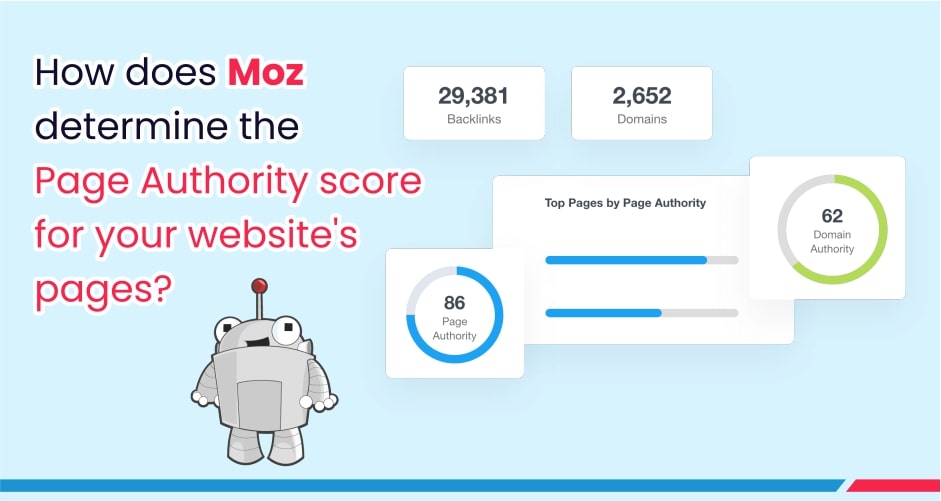
PA is rated on a logarithmic scale of 100 points, which means that improving your score from 20 to 30 is much easier than going from 70 to 80. The algorithm used to calculate this score is updated regularly means that your PA score may fluctuate over time.
-
Signals: number/diversity/quality of links to the page; internal links help.
-
Model: machine‑learning; log‑scale output 0–100.
-
Not keyword density, word count, or on‑page score alone.
When will you determine that a PA score is “good” or “bad”?
Page Authority, like Domain Authority, relies on a machine learning algorithm, which means that the score can fluctuate as the input data changes. Therefore, using the webpage metric as a relative metric for comparison is recommended. Since it is a comparative metric, this score cannot be categorized as “good” or “bad”.
Domain Authority vs Page Authority (Key Differences)
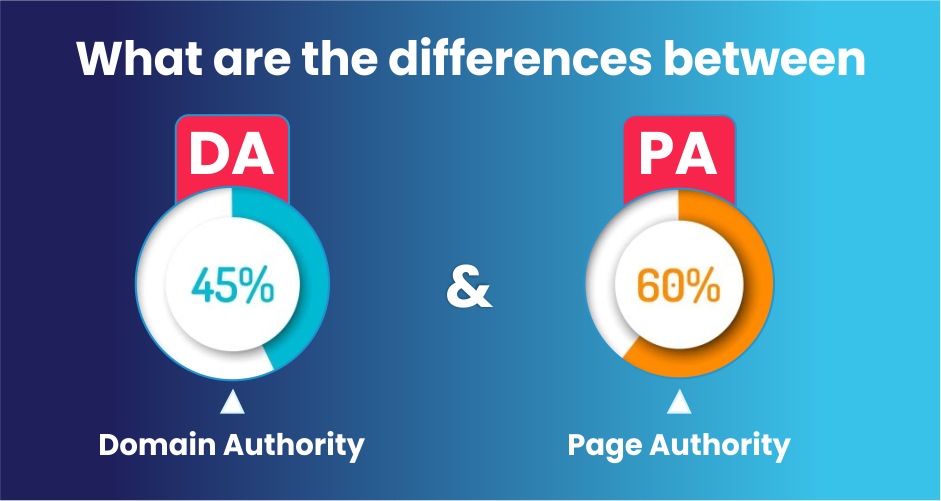
Domain and Page Authority are two terms frequently used in search engine optimization to identify the credibility and authority of a website or webpage, respectively. While both metrics are developed by Moz, a leading SEO software provider, they measure different aspects of a site’s search engine performance.
There are several differences between Domain and Page Authority.
Website metric evaluates the overall reputation and authority of a website, whereas webpage metric evaluates the ranking potential of a specific website page. Webpage metrics and site metrics serve as metrics for predicting a webpage’s ranking and the strength of entire domains or subdomains, respectively. Although they differ in scope, they use the same methodology to calculate keyword ranking strength.
Site metric is calculated based on various factors, like the number and quality of backlinks, the age of the domain, and the social signals. However, on the contrary, page metric focuses primarily on external links, such as the number and quality of backlinks, the relevance of the content to the search query, and the quality of user experience.
The score range for Domain and Page Authority is the same, i.e., from 1 to 100. A website with a high site metric may not necessarily have high Page Authority for all of its pages and vice versa. Each page of a website is evaluated independently for PA. This is why some web pages have a higher PA score than the overall DA score.
| Factor |
Domain Authority (DA) |
Page Authority (PA) |
| Scope |
Domain / subdomain |
Single URL |
| Purpose |
Site strength benchmark |
Page‑level potential |
| Primary signals |
Domain‑wide link profile |
Links to the page (+ internals) |
| Movement |
Slower |
Faster |
| Scale |
0–100 (log) |
0–100 (log) |
| Compare with |
Competitor DA |
Top‑ranking pages’ PA |
| Improves via |
Quality referring domains |
Quality page links + internal links |
| Tool check |
MozBar / Link Explorer |
MozBar / Link Explorer |
| Use in planning |
Authority building roadmap |
Pick target page for a query |
| Google factor? |
No (comparative metric) |
No (comparative metric) |
Use DA/PA relatively (trend + competitor context); don’t compare across different tools.
How to Use DA & PA in SEO (Do’s & Don’ts)
Website and page metrics are crucial metrics in SEO because they provide insights into the credibility and authority of a website or webpage. Page Authority can be particularly useful for SEO practitioners looking to optimize specific pages for search engine visibility. A higher DA or PA score indicates that the site or page is more likely to rank higher on SERPs, which can lead to increased traffic, visibility, and conversions. However, DA and PA are not the only factors influencing rankings, and a high score in these metrics does not guarantee top rankings for a website.
"Google doesn't use Domain Authority at all when it comes to Search crawling, indexing, or ranking" ~ John Mueller
| ✅ Do |
❌ Don’t |
| Use DA/PA as relative benchmarks; track trend. |
Treat DA/PA as Google ranking factors or goals. |
| Check PA of top‑ranking pages to pick targets. |
Compare DA/PA with other tools’ scores (DA ≠ DR ≠ Authority Score). |
| Raise PA with quality page links + internal links. |
— |
How to Improve Your Domain Authority
DA is calculated through backlinks. You can enhance the site metric of your website by implementing off-site strategies like link building. There are various ways that help in increasing the authority of your domain, thereby increasing your website metric scores. Some effective link-building strategies are described below that are Google-compliant.
-
Get listed in directories
Listing a domain on online directories is a great and affordable way for small and local businesses to boost their website metric. Implementing local SEO strategies, such as citation building, are a cost-effective way to boost the domain score of your website. By providing accurate and consistent information about your business across different directories and online platforms, search engines like Google can better understand the locations and markets you serve. As a result, the links back to your website from these sources can gradually improve your DA score.
Writing trustworthy and quality content helps in reaching more customers. If you use AI to speed up drafting, an AI Detector can help you review sections that read overly machine-generated and refine them before publishing—so the final content feels trustworthy, clear, and aligned with Google’s E-E-A-T. This leads to ensuring that the information you are providing to your customers is relevant, informative, and updated, along with impacting the lives of people in a positive manner. Google’s E-E-A-T helps in determining whether the content is trustworthy or not and whether the creator of the content has experience in the relevant subject or not.
Writing blog posts, guest posts conducting original research, or showcasing your thought leadership on relevant high-authority websites in your industry is an effective way to earn more backlinks to your site and improve the score of your website.
When you provide excellent content to publishers, you can showcase your brand’s expertise and often receive a backlink to your website within the post itself. As publishers are constantly searching for high-quality content, this is an effective way to increase your domain’s authority and improve your DA score.
Broken link building is an advanced strategy that can help you find link opportunities to increase your DA score, but it requires the use of free backlink tools. The process to increase the DA score is as follows:
-
A backlink analyzer tool has been used to identify broken links on other websites.
-
Create content that can act as a substitute for the missing resource or identify existing content on your website to serve as a replacement for the resource.
-
Approach the editor and propose your content as a replacement.
People Also Read: What is Page Authority: The SEO Metric You Must Master
Best Tools to Check Domain Authority
Not all DA tools are built the same. Here's a quick side-by-side breakdown of the top five tools to help you pick the right one for your needs.
| Feature |
W3Era |
Moz |
Ahrefs |
Semrush |
Majestic |
| Primary Metric |
Domain Authority |
Domain Authority (DA) |
Domain Rating (DR) |
Authority Score |
Trust Flow / Citation Flow |
| Free Access |
✅ 100% Free |
✅ Limited |
❌ No |
✅ Limited |
✅ Limited |
| Sign-Up Required |
❌ No |
✅ Yes |
✅ Yes |
✅ Yes |
✅ Yes |
| Bulk URL Check |
✅ Yes |
✅ Yes |
✅ Yes |
✅ Yes |
✅ Yes |
| Page Authority Check |
✅ Yes |
✅ Yes |
✅ Yes |
✅ Yes |
✅ Yes |
| Backlink Analysis |
✅ Yes |
✅ Yes |
✅ Yes |
✅ Yes |
✅ Yes |
| Total SEO Tools |
50+ |
Limited |
Limited |
Limited |
Limited |
| Starting Price |
Free |
$99/mo |
$129/mo |
$119/mo |
$49/mo |
| Best For |
Free, no-login DA checks |
DA benchmarking |
Backlink research |
All-in-one SEO |
Link trust analysis |
|
Conclusion
Domain Authority and Page Authority are two essential metrics for evaluating a website’s ability to rank well in search engine results pages. While domain and page authority may not directly impact search rankings, they still have a considerable influence on the website’s rankings. Domain authority may not have a direct effect, but it is an essential metric as it monitors various signals that ultimately impact search. On the other hand, page authority has its direct impact as it is a significant indicator of credibility.
While using PA to enhance your SEO ranking can be immensely beneficial, it is not the only factor responsible for SEO success. By understanding the differences between the authority metrics, website owners and SEO practitioners can use both webpage and website metrics to develop effective strategies for improving their site’s search engine visibility.
At W3Era, you can also use MozRank Checker to track your keywords and improve the ranking of your website. With our free tools, you can check the search engine ranking of your domain website or web pages for up to 10 websites at a time. If the MozRank of your website or single webpage is high, then there is a higher possibility that the MozRank of the receiving pages related to the link can be higher.