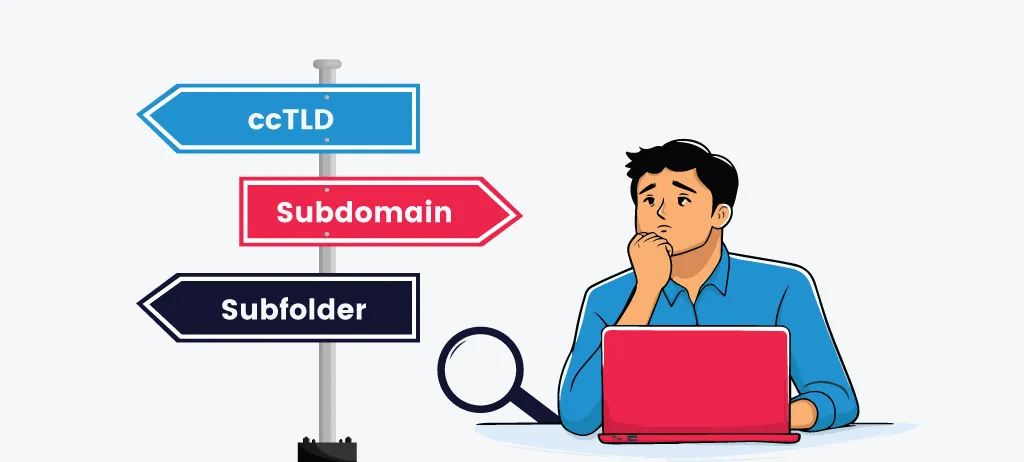
When it comes to international SEO, choosing the right URL structure is critical. Whether you’re targeting multilingual customers or expanding into multiple countries, your choice between ccTLD, subdomain, or subfolder can influence rankings, traffic, and conversions. But which is best?
In this guide, we’ll break down ccTLD vs subfolder SEO, compare subdomain vs subfolder for international SEO, and help you find the best URL structure for international SEO—with a practical decision tree and real-world brand examples.
Key Takeaways
- ccTLDs signal strong local relevance but demand heavy resources.
- Subdomains offer flexibility but require separate SEO efforts.
- Subfolders are efficient, cost-effective, and ideal for shared SEO authority.
- Choose structure based on budget, market priorities, and scalability.
- For hybrid needs, combine strategies (e.g., subfolders + ccTLD for priority markets).
ccTLD vs Subdomain vs Subfolder – Which One Wins for International SEO?
What Are the Three International URL Structures?
1. ccTLD (Country Code Top-Level Domain)
A ccTLD is a country-specific domain ending (like .uk, .de, .fr) that signals to users and search engines that your content is specifically intended for that country.
Best for:
- Strong local trust and brand recognition
- Markets where Google gives preference to local domains
- Fully localized websites (language, currency, offers)
Example:
- Amazon uses amazon.co.uk, amazon.de, and amazon.in to cater to different countries. Each site is tailored to local audiences in terms of language, currency, and logistics.
2. Subdomain
A subdomain (like fr.example.com) sits before your main domain. While it shares your domain name, it functions as a separate property in Google’s eyes.
Best for:
- Separate content strategies by region or language
- Teams managing different markets independently
- Sites requiring unique design/hosting per region
Example:
- Wikipedia organizes by language using subdomains: en.wikipedia.org, es.wikipedia.org, and fr.wikipedia.org. Each operates semi-independently with its own set of contributors and structure.
3. Subfolder (Subdirectory)
A subfolder adds a country or language path to your main domain, like example.com/fr/. It keeps all content under one domain, sharing Search Engine Optimization (SEO) authority across regions.
Best for:
- Centralized content and SEO management
- Startups or mid-size businesses expanding internationally
- Cost-effective and quick scaling
Example:
- Adobe uses subfolders for regional content: adobe.com/fr/, adobe.com/de/. This allows the company to consolidate SEO benefits under one strong global domain.
Comparison Table – Pros and Cons of Each Structure
| Structure |
Pros |
Cons |
| ccTLD (country domains) |
Strong local ranking signal: Clearly signals country relevance to search engines, often improving visibility in that country’s SERPs (and even required for certain locales like China’s Baidu). - User trust & CTR: Local users tend to trust country-specific domains, which can boost click-through rates. - Full localization: Allows entirely separate sites with country-specific content, currency, and branding for maximum localization.
|
- High resource cost: Requires separate domain registration, hosting, and SEO efforts for each country (e.g. 10 countries = 10 sites). - No shared authority: Each ccTLD is a separate domain, so link equity isn’t shared – you must build authority from scratch for each site. - Complex management: Harder to maintain multiple sites; also some ccTLDs have residency or legal requirements for ownership.
|
| Subdomains |
- Easy setup & flexibility: Quick to deploy via DNS/CMS, with no extra domain cost. Allows different servers or teams per region if needed, giving operational independence. - Localized optimization: You can tailor each subdomain’s content and SEO to its audience (keywords, language) without affecting the main site. - Keeps brand consistency: Uses the main domain name, so still tied to your brand, unlike completely separate ccTLD brand names.
|
- Weaker geo-target signals: Search engines don’t automatically associate subdomains with countries. You’ll rely on hreflang and Search Console settings for geotargeting. - Separate authority building: Google treats subdomains as separate sites, so the root domain’s authority doesn’t fully carry over. Each subdomain needs its own backlink profile and SEO work to rank well. - User confusion: Some users might not recognize a subdomain (e.g. fr.example.com) as your French site, leading to lower click rates or confusion compared to a ccTLD.
|
|
Subdirectories (Subfolders)
|
- Shared SEO authority: All international sections leverage the single domain’s backlink profile and trust. New country sections benefit from the root domain’s established authority, helping pages rank faster. - Cost-effective & simple: No need to buy new domains or set up separate sites – easier implementation and central management. Adding a country is as simple as creating a new folder/section on the site. - Unified brand experience: Users see one global domain (example.com) with localized sections, reinforcing one brand. It’s straightforward for users to find local content at example.com/xx and less confusing than juggling multiple domains.
|
- Weaker local signal than ccTLD: Does not inherently signal country targeting to Google. You must rely on hreflang tags and geo-targeting settings, as well as local content, to indicate relevance to each region. - Management challenges at scale: For many countries/languages, a single site can become complex to organize and maintain (hreflang implementation, content localization, and site structure can get complicated). - Limited localization flexibility: Since all locales share the same domain and core infrastructure, it can be harder to entirely customize experiences (e.g. different site designs or separate local services) compared to wholly separate ccTLD sites.
|
How to Choose: ccTLD vs Subdomain vs Subfolder
Use This If-Then Framework to Choose the Right URL Structure
Want strong geo-targeting, legal compliance, and separate brand control?
Choose ccTLDs (example.fr, example.co.uk)
Why:
ccTLDs send the clearest country-specific signals to search engines. They’re ideal if you operate as a localized brand in multiple countries, need legal separation by region, or want to establish a strong local presence and trust.
Good for:
- Country-specific teams, currencies, regulations (e.g., GDPR variations)
- Large enterprises with global subsidiaries or franchises
- Companies needing localized hosting or compliance with country laws
Example:
Amazon uses ccTLDs like amazon.de and amazon.co.jp to provide a fully localized experience per market, including language, currency, payment, and shipping rules.
Need operational flexibility but have limited budgets or infrastructure?
Go with Subdomains (fr.example.com, es.example.com)
Why:
Subdomains let you separate regions by site without needing entirely new domain registrations. They’re easier to deploy than ccTLDs and give your regional teams freedom to manage their content—but search engines may treat them as distinct entities from your root domain, so SEO benefits don’t always carry over.
Good for:
- Multilingual websites where language content varies greatly
- Medium-sized businesses with semi-autonomous regional marketing
- Teams testing regional SEO without full infrastructure commitment
Example:
Wikipedia uses subdomains like en.wikipedia.org, fr.wikipedia.org, es.wikipedia.org to manage distinct language-specific content managed by separate communities.
Prefer unified domain authority, centralized SEO control, and easy scaling?
Go with Subfolders (example.com/fr/, example.com/de/)
Why:
Subfolders live under your main domain, so you benefit from consolidated SEO authority and link equity. They’re easier to maintain, ideal for fast-growing global businesses, and highly scalable—especially when paired with hreflang and structured data for multilingual SEO.
Good for:
- Startups and mid-size companies entering new markets
- Brands that want faster indexing and SEO gains through shared authority
- Organizations with one central marketing/SEO team
Example:
Adobe uses subfolders like adobe.com/fr/ and adobe.com/de/, maintaining a unified domain while localizing content for each market.
Real-World Examples from Global Brands
- Amazon – ccTLDs: Amazon uses separate country-specific domains like amazon.co.uk and amazon.in. This helps it rank better in local search results and build trust with users in each country by offering localized shopping experiences.
- Adobe – Subfolders: Adobe keeps all international content under one main domain, using subfolders like adobe.com/fr/. This structure allows them to consolidate SEO authority while efficiently managing multilingual content.
- Wikipedia – Subdomains: Wikipedia separates language versions using subdomains, such as en.wikipedia.org and fr.wikipedia.org. Each version operates semi-independently, which is helpful for managing different language communities and editorial structures.
Conclusion – Choosing Smart for International SEO Growth
Each structure—ccTLD, subdomain, or subfolder—has its place in an international SEO strategy. If you need clarity, our SEO experts at W3era can help craft a hybrid or scalable model tailored to your goals. Want higher global visibility? Let’s talk. Contact Us Today to discuss your global SEO strategy.