Brand mentions are online references to a business, product, service, person, or brand. They can appear on websites, news publications, social platforms, forums, review platforms, podcasts, videos, and AI-generated answers. A brand mention can be linked or unlinked. A linked mention contains a hyperlink and can generate referral traffic and a backlink. An unlinked mention does not contain a link but can still increase brand visibility and may create a relevant link-reclamation opportunity. The value of a brand mention depends on more than its quantity. Source quality, topical relevance, context, sentiment, audience, referral potential, and link opportunities all matter. Businesses can monitor mentions through Google Search, Google Alerts, SEO and social listening platforms, news monitoring, competitor research, and AI-search queries.
Key Takeaways
- A brand mention is an online reference to your company, product, service, person, or brand.
- Brand mentions can be linked or unlinked.
- An unlinked mention can sometimes create a legitimate link-reclamation opportunity.
- Mention volume alone does not tell you whether brand visibility is valuable.
- Source quality, topical relevance, context, sentiment, and audience should be evaluated.
- Brand monitoring can uncover Digital PR, link-building, content, reputation, and competitor opportunities.
- Entity SEO provides a useful framework for understanding the context surrounding external brand references.
- AI mentions and AI citations are different and should be monitored separately.
- Digital PR can create useful reasons for journalists and publishers to mention a brand.
- A strong monitoring process follows a repeatable discover, evaluate, act, and measure workflow.
What Are Brand Mentions?
A brand mention is any online reference to a company, product, service, founder, employee, expert, or brand. The reference can appear in an article, social media post, forum discussion, review, podcast, video, news story, or another form of online content. It can also appear with or without a link to the company's website. For example, suppose an industry website publishes an article saying: W3era recently published research about changes in organic search behavior. If the article mentions W3era but does not link to the research, that is an unlinked brand mention. If the publication links the reference to the original research, it becomes a linked brand mention. Both are worth monitoring, but they create different opportunities. A linked mention can send visitors directly to your website and create a referring link. An unlinked mention can still expose your brand to a relevant audience and may become a link-reclamation opportunity if linking to the referenced resource would genuinely help readers. Brand mentions can come from many different sources, including news websites, blogs, industry publications, social networks, Reddit, forums, reviews, podcasts, videos, and online communities. The benchmark Semrush article similarly treats mentions broadly and distinguishes between linked and unlinked references while also covering AI mentions.
A simple example
Imagine three different websites discuss the same company. The first website says that the company published a useful SEO study but does not provide a link. That is an unlinked brand mention. The second website references the same study and links to the research page. That is a linked brand mention. The third website discusses one of the company's experts during a podcast. That is also a brand mention, even though there may be no traditional website backlink. This is why looking only at your backlink profile does not provide a complete picture of how your brand is being discussed across the web.
Why Do Brand Mentions Matter?
Your website is only one part of your brand's online presence. People may discover your company through an industry publication, customer review, social discussion, podcast, community recommendation, or another website before they ever search for the company directly. Brand mentions help you understand these external discovery paths.
They also provide information that rankings and website analytics alone cannot show. A growing number of relevant mentions may indicate that your brand is becoming more visible within a particular market, while a sudden increase in negative mentions may reveal a reputation issue that needs attention.
Brand Awareness
Brand awareness grows when people repeatedly encounter your company in places they already trust or use. For example, someone researching technical SEO may see your company mentioned in an industry publication, encounter your brand again in a podcast, and later search for your company directly. That journey does not necessarily begin with a search for your brand. Tracking mentions helps you understand where those external encounters are happening and which sources are introducing your brand to new audiences.
Brand Reputation
Brand monitoring also shows what people are saying about your business. You may discover positive customer experiences, complaints, product questions, industry recommendations, inaccurate information, reviews, or competitor comparisons. Without a monitoring process, these conversations can continue without your team knowing they exist.
This makes brand monitoring useful for both SEO and reputation management. A sudden increase in mentions should not automatically be considered a success because the increase could come from a successful PR campaign, a viral discussion, a product issue, or negative news coverage. The context behind the increase is what matters.
Brand Authority
Relevant third-party coverage can help establish your business as a recognizable participant in its industry. However, source quality matters. A reference from an established industry publication discussing your expertise is very different from a mention on an unrelated website. When evaluating brand visibility, consider the publication's relevance, audience, editorial context, and the subject associated with the mention. This is why topical relevance is important when evaluating brand coverage.
Referral Traffic
When a brand mention includes a link, readers can visit your website directly. That referral traffic can be valuable because the visitor has already encountered your company within a relevant context. Someone clicking through from an article about technical SEO, for example, may have a much stronger interest in SEO services than someone arriving from an unrelated website. For this reason, referral traffic should not be judged only by volume. Look at engagement, leads, conversions, and the relevance of the referring audience.
Backlink Opportunities
An unlinked mention can sometimes reveal a natural link-building opportunity. Suppose an industry publication references your original research but does not link to it. The publisher has already decided that your research is relevant enough to mention. If linking to the study would help readers understand or verify the information, you have a legitimate reason to contact the publisher. This is where brand monitoring naturally connects with link building and Digital PR.
Types of Brand Mentions
Brand mentions appear in different forms, and each type can create a different opportunity. The most useful approach is to classify mentions based on where they appear and what purpose they serve.
| Type of brand mention |
What it means |
Potential opportunity |
| Linked mention |
Your brand is mentioned with a hyperlink |
Referral traffic and backlink |
| Unlinked mention |
Your brand is mentioned without a hyperlink |
Brand exposure and link reclamation |
| Editorial mention |
Your brand, expert, or research appears in an article |
Media exposure and authority |
| Social mention |
Your brand is discussed on a social platform |
Awareness and reputation |
| Review mention |
Your company or product appears in a review |
Trust and reputation |
| Podcast or video mention |
Your brand or expert is discussed in media |
Audience reach and recognition |
| AI mention |
Your brand appears in an AI-generated response |
AI visibility and brand recall |
The benchmark Semrush material also separates linked, unlinked, and AI mentions and explains that AI mentions and AI citations should not be treated as exactly the same thing. The important point is that these categories should not all be evaluated using the same criteria. An editorial mention may be valuable for media exposure, while an unlinked mention may be particularly interesting to an SEO team because it can create a potential link-reclamation opportunity.
What Is a Linked Brand Mention?
A linked brand mention is a reference to your brand that also contains a hyperlink to your website or a specific resource.
For example:
W3era published a detailed SEO audit guide for businesses reviewing their organic search performance. If the reference links to the relevant guide, it is both a brand mention and a backlink. Linked mentions can create several benefits at once. They can expose your brand to a relevant audience, send referral visitors to your website, and create a referring link that your SEO team can evaluate as part of its backlink profile. The context of the link still matters. A natural editorial link from a relevant publication is different from a link placed on an unrelated page simply because someone wanted to include a URL.
What Is an Unlinked Brand Mention?
An unlinked brand references your company but does not include a hyperlink.
For example:
W3era recently published research on changes in search behavior. If there is no link to the research, this is an unlinked mention. Unlinked mentions can still create brand exposure because readers are being introduced to your company. They can also reveal potential link-reclamation opportunities. However, not every unlinked mention should become a backlink request. Before contacting a publisher, check whether the website is relevant, whether the mention is accurate, and whether linking to your website or resource would genuinely improve the page for its readers. The strongest opportunities usually combine a relevant source, meaningful brand reference, useful destination page, and genuine reader benefit.
What Are Editorial Brand Mentions?
An editorial brand mention occurs when a publisher naturally references your company, research, product, service, founder, or expert within an article. For example, a journalist writing about search trends might reference research your company conducted to support a statistic. Editorial mentions can be valuable because they place your brand inside content that already has an audience and a specific subject context. They may also create opportunities for backlinks, referral traffic, expert recognition, and future media relationships. This is one reason Digital PR and brand monitoring work well together. Digital PR creates stories and assets that publishers may want to cover, while brand monitoring helps you discover where those stories were actually mentioned.
What Are Social Brand Mentions?
Social brand mentions occur when people discuss your company, product, service, or experts on social platforms and online communities. A social mention may not create a traditional SEO backlink, but it can still provide useful information. Social conversations can reveal what customers think about your brand, which topics generate discussion, what content people share, and what questions repeatedly appear around your products or services. For SEO teams, these conversations can also become content research. If customers repeatedly ask the same question in communities, that may indicate a topic that deserves a detailed answer on your own website.
Brand Mentions vs Backlinks: What Is the Difference?
Brand mentions and backlinks are closely related, but they are not interchangeable. A brand mention is a reference to your brand. A backlink is a hyperlink from another website to a page on your website. One reference can contain both.
For example:
W3era's research on search visibility found that...
If the reference links to your research, it is a brand mention with a backlink. If the publisher mentions the research but provides no link, it is an unlinked brand mention.
| Brand mention |
Backlink |
| References your brand |
Links to your website |
| May be linked or unlinked |
Contains a hyperlink |
| Can increase brand exposure |
Can generate referral traffic |
| Can reveal PR opportunities |
Creates an existing referral path |
| Can become a link-reclamation opportunity |
Can be evaluated as a referring link |
Understanding this distinction is important because an SEO team should not treat every brand mention as though it already provides the same value as a backlink. For a deeper explanation of how backlinks work, you can explore our guide to what are backlinks.
How Brand Mentions Support Entity SEO
Brand mentions become particularly interesting when you look at them through an entity SEO perspective. Search engines need to understand entities and the relationships between them. For a business, those relationships can include the brand, its services, its industry, its areas of expertise, and the locations it serves.
A simplified relationship might look like:
Brand → Industry → Services → Topics → Expertise → Location
For example:
W3era → Digital Marketing → SEO → Technical SEO → Digital PR → USA SEO
When relevant external sources discuss your brand in connection with these subjects, they provide additional context about how your company is positioned online. This does not mean that every external mention is automatically a Google ranking signal. It is more useful to think about the context surrounding the entity. A mention on an unrelated website provides very little meaningful information about what your company is known for. A mention from an industry publication discussing your technical SEO expertise provides much stronger topical context. This is why your existing guide to entity SEO and topical authority is highly relevant here.
Why Topical Relevance Matters for Brand Mentions
Imagine an SEO company receives 500 mentions from completely unrelated websites. Now imagine another SEO company receives 50 mentions from publications focused on SEO, search marketing, ecommerce, content marketing, and digital growth. The first company has more mentions. The second company may have stronger topical alignment. The lesson is not that mention volume is useless. The lesson is that volume needs context. When evaluating brand mentions, ask whether the source is relevant to your industry, whether the surrounding content relates to your expertise, whether the brand is being discussed for a meaningful reason, and whether the source reaches the audience you actually want to attract. This is where topical relevance becomes an important part of the brand-monitoring process.
How Brand Mentions Affect AI Search Visibility
Search visibility is no longer limited to traditional blue-link results. People increasingly use AI systems to ask questions such as:
- Which SEO agencies specialize in ecommerce?
- What are the best technical SEO companies?
- Which agencies provide SEO services in the USA?
- An AI-generated response may mention a company as part of its answer.
- This creates another layer of brand visibility that SEO teams can monitor.
AI Mentions
An AI mention occurs when an AI-generated response names your brand, product, service, or expert. For example, an AI system might include your company when answering a question about SEO agencies.
AI Citations
An AI citation goes a step further by providing a source or link that supports the information. These concepts should not be treated as identical. A brand may appear in an AI response without receiving a citation. The benchmark material specifically distinguishes AI mentions from AI citations and recommends monitoring the two separately.
What Should You Monitor?
Instead of asking an AI system only whether it knows your company, monitor the questions where your brand should reasonably appear. Track whether your brand appears, how it is described, which competitors appear, which sources are cited, which topics trigger your brand, and how visibility changes over time. This can help your content and SEO teams identify gaps between the topics you want your brand associated with and the topics for which AI systems currently recognize your business. For a broader framework around measuring visibility across search, your existing search visibility guide fits naturally here.
How to Track Brand Mentions
The best monitoring method depends on your brand size, mention volume, and available resources. A smaller business can start with Google Search and Google Alerts. A larger organization with substantial media coverage may need dedicated monitoring and social listening platforms. The objective is not to collect every possible reference. The objective is to build a reliable system for finding meaningful mentions that can influence brand, SEO, Digital PR, reputation, or business decisions.
Use Google Search to Find Brand Mentions
Start with an exact search for your brand:
"Brand Name"
Then exclude your own website:
"Brand Name" -site:yourdomain.com
This can help you find external references that are not visible within your own website.
You can also combine your brand name with specific terms:
"Brand Name" review
"Brand Name" research
"Brand Name" SEO
"Brand Name" expert
"Brand Name" interview
These searches can uncover different types of coverage and help you understand which subjects are already associated with your brand.
For larger brands, repeat the process with important brand variations, product names, service names, and common misspellings.
Monitor Brand Variations and Misspellings
People do not always write your brand name exactly as it appears on your website. Depending on your business, you may need to monitor abbreviations, common misspellings, product names, service names, founder names, executive names, previous brand names, and brand-plus-location variations. The goal is not to create hundreds of unnecessary monitoring queries. Focus on the variations that customers, publishers, and industry communities are actually likely to use. This prevents valuable mentions from being missed simply because someone used a slightly different version of your brand name.
Use Google Alerts
Google Alerts provides a straightforward way to receive notifications when new web content matches a phrase. Create alerts for your brand name, product name, founder name, important service, and common misspellings. You can also combine your brand with specific topics.
For example:
Brand Name + review
Brand Name + research
Brand Name + SEO
Google Alerts is a useful starting point, but it should not be treated as a complete brand-monitoring platform. The benchmark Semrush material also identifies limitations compared with dedicated monitoring systems, particularly when deeper historical analysis, broader source coverage, or advanced reporting is required.
As your brand grows, manually checking search results becomes increasingly difficult. Dedicated monitoring platforms can collect mentions from multiple sources and make it easier to filter, categorize, and compare them. Depending on the platform, you may be able to monitor news websites, blogs, social platforms, forums, reviews, industry publications, and competitor mentions. More advanced platforms may also provide sentiment analysis, share of voice, historical data, trend analysis, competitive comparisons, and influencer information.
This becomes particularly useful when a business is running ongoing PR or content campaigns and needs to determine which campaigns are actually generating meaningful coverage.
How to Track Brand Mentions in AI Search
AI monitoring requires a slightly different approach from traditional brand monitoring.
Instead of searching only for your brand name, create a list of important questions where your company would be relevant.
For an SEO agency, these might include:
- Best SEO agencies for ecommerce
- Best technical SEO companies
- SEO agencies in the USA
- SEO services for small businesses
- Best international SEO agencies
Run these questions regularly and record the results. For each query, track whether your brand appears, how it is described, which competitors appear, which sources are cited, and whether the result changes over time. This question-based approach is also consistent with the benchmark material's recommendation to build AI-monitoring queries around important topics and real user questions.
How to Measure Brand Mentions
Counting mentions is only the beginning. Imagine one campaign generates 500 brand mentions. That sounds impressive, but the number alone does not tell you whether the campaign was successful. If most mentions come from irrelevant websites or negative discussions, raw volume can hide the real result. A better measurement system combines quantity, quality, context, sentiment, and business impact.
Mention Volume
Track the total number of mentions within a defined period. Monthly and quarterly comparisons can help you understand whether your brand visibility is increasing, decreasing, or remaining stable.
Mention Growth
Compare your current visibility with previous periods and pay particular attention to changes following major campaigns. For example, if mention volume increases significantly after publishing original research, investigate which publications covered it and whether those mentions generated links, traffic, or additional opportunities.
Linked vs Unlinked Mentions
Separate linked and unlinked references. This shows how much coverage already generates a referral pathway and how much may represent potential link-reclamation opportunities.
Source Quality
Evaluate the websites and platforms generating mentions. Consider industry relevance, audience quality, publication reputation, editorial standards, traffic potential, and the context surrounding the mention. A highly relevant publication may deserve more attention than dozens of low-quality references.
Sentiment
Classify mentions as positive, neutral, or negative. This becomes especially important when mention volume changes suddenly. A spike could indicate a successful PR campaign, but it could also result from a product problem, customer complaint, or negative news story.
Referral Traffic
For linked mentions, measure how many visitors arrive at your website. Then look beyond visits. Review engagement, conversions, leads, and other meaningful actions.A small number of highly relevant visitors can be more valuable than hundreds of visitors who have no commercial interest. When evaluating this alongside your wider acquisition data, your existing guide to organic traffic provides a useful supporting resource.
Branded Search Growth
Track branded search demand around major campaigns and periods of significant media coverage. If more people begin searching for your brand after seeing it mentioned in publications or communities, that may indicate that external exposure is creating additional brand interest.
Share of Voice
Compare your brand's visibility with competitors. This answers a more useful question than simply asking how many mentions your company received.
The question becomes:
How much of the relevant industry conversation belongs to our brand compared with competitors?
Turn Brand Mentions Into SEO Opportunities
Find valuable brand mentions, identify relevant link opportunities, and turn your existing online visibility into stronger SEO and organic growth.
Which Brand Mentions Should You Prioritize?
A growing brand can eventually accumulate more mentions than its team can manually review. Prioritization helps solve this problem.
A practical framework is:
Relevance + Source Quality + Sentiment + Link Opportunity + Audience Value
For example:
| Mention |
Relevance |
Source quality |
Link opportunity |
Priority |
| Relevant industry publication |
High |
High |
High |
Highest |
| Relevant niche website |
High |
Medium |
High |
High |
| Large social discussion |
Medium |
Medium |
Low |
Medium |
| Unrelated website |
Low |
Low |
Low |
Low |
This prevents your team from spending hours trying to convert low-value mentions while ignoring highly relevant opportunities. Not every mention needs to become a backlink. Some are valuable for reputation, some for PR relationships, some for audience discovery, and some simply provide market intelligence.
How to Get More Brand Mentions
Tracking mentions tells you where your brand is already visible. The next step is creating more reasons for relevant people and publications to talk about your company. The strongest opportunities usually come from something genuinely useful or newsworthy, such as original research, proprietary data, expert commentary, industry analysis, Digital PR campaigns, or timely responses to important events.
Use Digital PR to Earn Brand Mentions
Digital PR gives publishers a reason to reference your company. Instead of asking a publication to mention your business without a clear reason, create something that is useful to its audience. For example, an SEO company could conduct research into the most common technical problems affecting ecommerce websites. The findings could become original statistics, a research report, visual charts, expert commentary, supporting content, and a Digital PR campaign.
A successful campaign can create a chain such as:
Original research → media coverage → brand mention → potential backlink → referral traffic
This is why your existing Digital PR guide is one of the strongest contextual links for this article.
Create Original Research
Original research gives publishers information they cannot simply find by copying another article. Depending on your industry, this could include surveys, customer studies, proprietary datasets, industry benchmarks, search behavior analysis, or market trend research. The research should be transparent and useful. Explain where the data came from, how it was collected, what sample was used, when the research was conducted, and what limitations apply. Good research can become a source for journalists, bloggers, analysts, and industry professionals, creating multiple opportunities for brand mentions.
You do not always need a large research project to earn coverage. Expert commentary can also make a brand useful to publishers. When a journalist is covering a major industry change, they may need someone who can explain what happened, why it matters, who is affected, and what businesses should do next. A concise, genuinely useful expert contribution can earn a brand mention while also building relationships with journalists for future coverage. The important part is to provide expertise rather than turning every media response into a sales message.
Create Data-Driven Industry Reports
Businesses often have valuable internal data that can become external content assets. For example, an SEO agency could analyze thousands of websites and identify common technical issues, content patterns, or search trends. A report built from that information can become research articles, original statistics, infographics, social content, expert commentary, and Digital PR campaigns. Each format can create another opportunity for people to reference the original research and discover your brand.
Build Relationships With Journalists and Publishers
Brand mentions are often the result of relationships built over time. Identify journalists and publishers who consistently cover your industry. Understand what they write about, what type of sources they use, and what subjects their audiences care about. Then provide useful information when you genuinely have something relevant. The goal is not to send the same promotional pitch to every journalist. It is to become a useful source when your expertise, data, or research can improve their story.
How to Turn Unlinked Mentions Into Backlinks
Unlinked mentions are one of the most practical opportunities discovered through brand monitoring. Suppose an industry publication writes: W3era recently published research about changes in search behavior. But the article does not link to the research. You already have something important: the publication has decided that your brand or research is relevant enough to mention.
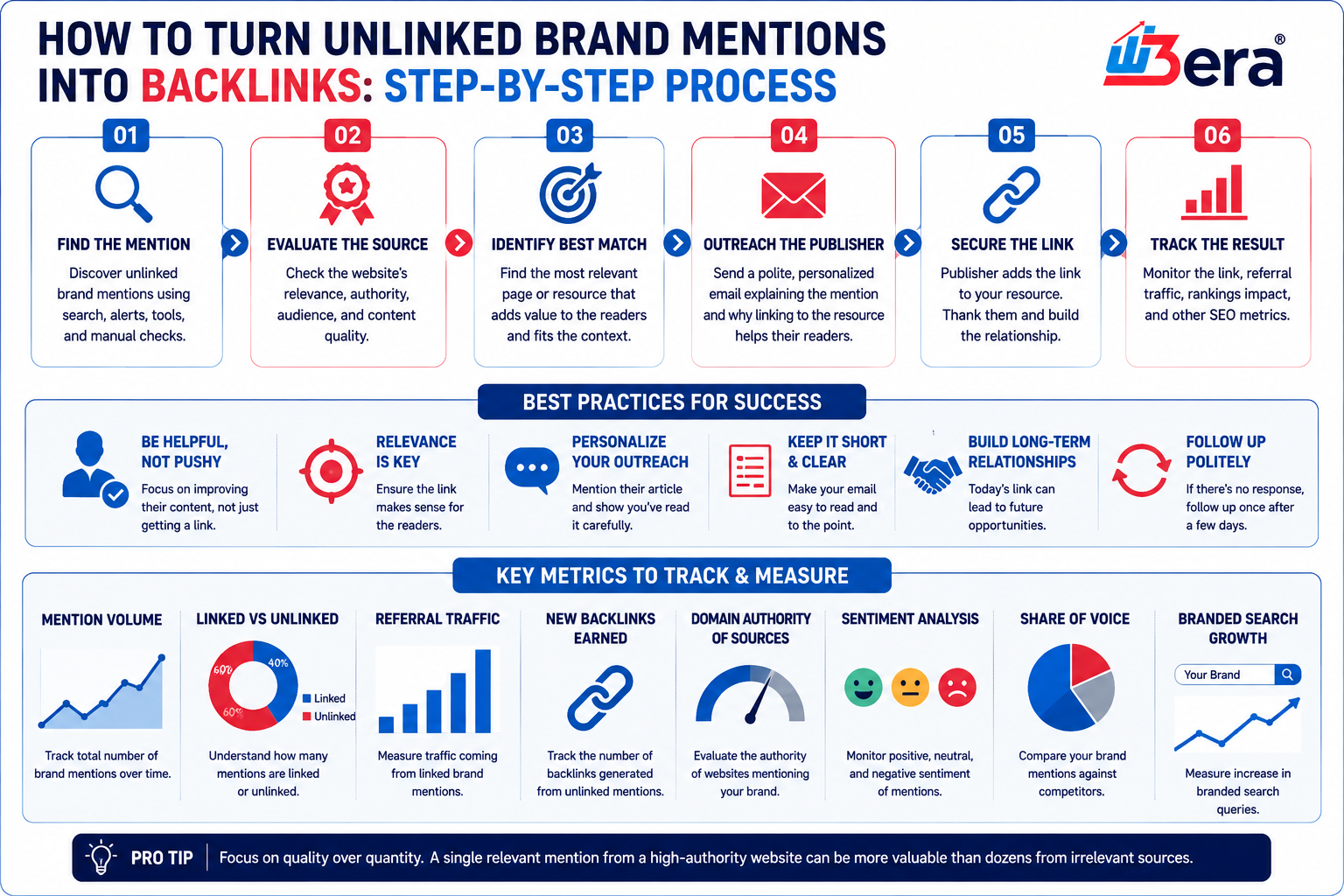
The next step is determining whether adding a link would genuinely help the reader.
Step 1: Find the Mention
Record the exact URL, article, author, and surrounding context.
Step 2: Evaluate the Source
Review the publication's relevance, audience, editorial quality, and relationship to your industry.
Step 3: Identify the Best Destination
Do not automatically ask the publisher to link to your homepage. If the mention refers to research, link to the research. If it references a specific guide, use that guide. The destination should match the context.
Keep the outreach straightforward. Explain that the article references your research, company, expert, or resource and provide the relevant page. Do not demand a backlink. Explain why the resource could help readers who want to explore or verify the information.
Step 5: Track the Result
Record whether the publisher responded, added the link, declined, or did not respond. Over time, this creates a measurable link-reclamation workflow. This process fits naturally within broader link building, and your existing link building guide can provide readers with the next level of detail.
How to Use Competitor Brand Mentions
Competitor monitoring can reveal where your industry is receiving attention. Track where competitors are being mentioned and look for patterns. You may discover publications covering them, journalists writing about their industry, podcasts featuring their experts, research being cited, topics associated with their brands, websites linking to them, and PR campaigns generating coverage.
The most useful question is not simply:
Where was my competitor mentioned?
Instead ask:
Why was the competitor mentioned?
- Maybe they published original research.
- Maybe their founder provided expert commentary.
- Maybe they created an industry report.
- Maybe they responded quickly to a news event.
Once you understand the reason for the coverage, you can determine whether your brand has a stronger or different angle. Competitor mention analysis therefore becomes a source of Digital PR intelligence, content ideas, and outreach opportunities.
Brand Mentions and Digital PR Work Together
Brand monitoring and Digital PR should not operate as completely separate activities. Digital PR creates stories and assets that publishers may want to cover. Brand monitoring tells you where those stories appeared.
The process can look like this:
Create useful asset → Pitch relevant publishers → Earn coverage → Monitor mentions → Evaluate coverage → Find unlinked opportunities → Build relationships → Measure results
This creates a feedback loop. The information collected from one campaign can improve the next campaign. If one topic generates strong coverage while another receives very little attention, your team can use that information when deciding what research, content, or PR angle to develop next.
Brand Mention Tracking Workflow
A practical brand monitoring system can follow seven stages.
Discover
Find mentions through Google Search, Google Alerts, monitoring platforms, social networks, news websites, forums, reviews, and AI search.
Categorize
Classify each mention as linked, unlinked, editorial, social, review, AI, positive, neutral, or negative.
Evaluate
Review the source, relevance, context, audience, sentiment, and potential opportunity.
Respond
Decide whether the mention requires action. That might mean responding to a customer, correcting inaccurate information, thanking a publisher, joining an industry discussion, or contacting a publisher about an unlinked reference.
Convert
Turn suitable opportunities into backlinks, media relationships, expert opportunities, content ideas, or future PR campaigns.
Measure
Track mention growth, source quality, backlinks, referral traffic, branded searches, share of voice, AI visibility, and business outcomes.
Repeat
Review the results regularly and use the findings to improve your SEO, content, and Digital PR strategy.
This turns brand monitoring from a passive spreadsheet exercise into an ongoing organic growth process.
Common Brand Mention Tracking Mistakes
Tracking Only the Exact Brand Name
Your audience may use abbreviations, misspellings, product names, founder names, or alternative brand names. If you monitor only the official spelling, you may miss relevant coverage.
Measuring Only Mention Volume
A larger number of mentions does not automatically mean better visibility. Always evaluate the quality, relevance, sentiment, and context behind the number.
Ignoring Unlinked Mentions
An unlinked mention can represent an existing relationship and a potential link-reclamation opportunity.
Treating Every Mention as an SEO Signal
A mention should not automatically be treated as equivalent to a backlink or a direct Google ranking signal. Look at what the mention represents and the context in which it appears.
Ignoring Competitors
Competitor coverage can reveal publishers, journalists, topics, and PR opportunities that your team may not have discovered independently.
Monitoring Without Taking Action
Finding mentions is only the beginning. The real value comes from deciding what to do with the information.
A useful process is:
Find → Evaluate → Act → Measure
How Brand Mentions Fit Into a Larger SEO Strategy
Brand mentions become more valuable when they are connected to the rest of your organic growth system.
Think of the relationship as a connected process.
- Content creates useful information.
- Digital PR puts that information in front of relevant publishers.
- Brand mentions show where the brand is being discussed.
- Backlinks create additional discovery and referral paths.
- Entity associations connect the brand with relevant topics and expertise.
- Search visibility expands across relevant queries and channels.
- Traffic and leads turn visibility into business outcomes.
This is why brand mentions naturally connect with Digital PR, backlinks, link building, entity SEO, topical relevance, content, and search visibility rather than operating as an isolated marketing activity.
Building Brand Visibility for Businesses in the USA
If your business targets customers across the United States, brand mention monitoring should go beyond simply counting how often your company is referenced. Look at which US publications, industry websites, communities, regional sources, and business discussions are talking about your company and the subjects they associate with your brand. This can reveal opportunities for Digital PR, content promotion, link acquisition, media relationships, and stronger visibility within specific markets. For example, an SEO company targeting US businesses could monitor mentions around technical SEO, ecommerce SEO, local SEO, enterprise SEO, and other relevant services while also identifying the publications and communities that influence its target audience. When this activity is combined with technical SEO, content development, authority building, Digital PR, and search visibility, businesses can create a more complete organic growth strategy. Companies looking to execute this at a broader level can explore professional SEO services in the USA.
Building Brand Visibility for Businesses in the UK
For businesses targeting the UK market, brand mention monitoring should focus on publications, industry websites, communities, reviews, and media conversations that are relevant to UK customers and decision-makers. The objective is not simply to increase the number of mentions. You want to understand where your brand is gaining recognition, which topics are associated with it, what competitors are being discussed alongside it, and which publishers may provide future Digital PR opportunities. When brand visibility is combined with technical SEO, content development, authority building, Digital PR, and search visibility, it can become part of a broader organic growth strategy. Businesses looking to build that strategy for the UK market can explore professional uk seo consultant.
How to Prioritize Brand Mention Opportunities
Not every mention deserves immediate outreach.
A practical prioritization model is to consider five factors:
- Relevance: Does the source cover your industry or target audience?
- Source quality: Is the publication credible and useful?
- Context: Is your brand being discussed for a subject that matters to your business?
- Opportunity: Could the mention lead to a backlink, PR relationship, expert opportunity, or useful content insight?
- Audience value: Could the mention expose your brand to people who may actually need your product or service?
When several of these factors are strong, prioritize the mention. This prevents your team from spending hours trying to convert low-value mentions while ignoring highly relevant opportunities.
Brand Mention Tracking Checklist
Before considering your monitoring system complete, make sure you have coverage across the following areas.
Brand coverage
Monitor your brand name, important variations, common misspellings, product names, service names, and relevant executives or experts.
External sources
Include search results, news websites, industry publications, social platforms, forums, reviews, podcasts, and relevant AI search queries.
Mention classification
Separate linked, unlinked, editorial, social, review, and AI mentions. Where relevant, also record sentiment.
SEO opportunities
Look for relevant backlinks, unlinked mentions, referral traffic, new referring domains, Digital PR opportunities, content opportunities, and competitor coverage.
Performance measurement
Track mention volume, mention growth, source quality, sentiment, share of voice, branded search demand, AI visibility, referral traffic, and leads. A consistent framework makes it easier to compare campaigns and identify which activities are actually creating useful visibility.
Conclusion
Brand mentions are an important part of building online visibility, brand authority, and SEO growth. They help you understand where your brand is being discussed, what people associate with your business, and which opportunities can lead to traffic, backlinks, PR coverage, or stronger brand recognition. The best approach is not to chase every mention. Focus on relevant, trustworthy mentions, monitor linked and unlinked references, track competitor coverage, and use Digital PR and useful content to create more reasons for others to talk about your brand. By consistently finding, evaluating, and acting on brand mentions, you can turn external brand visibility into stronger SEO, better audience trust, and long-term organic growth.